Mississauga in Peel Region, Ontario — Central Canada (North America)
Voices of Our Ancestors

Photographed by Tim Boyd, September 14, 2024
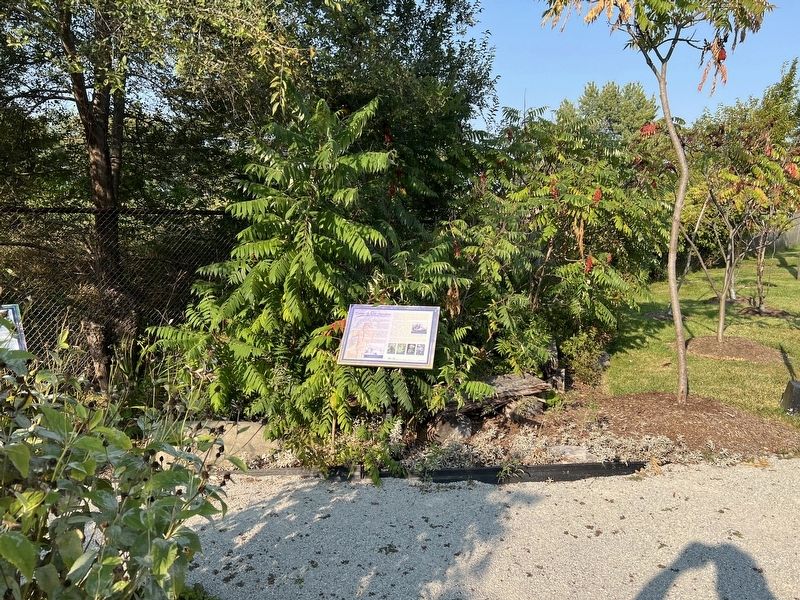
1. Voices of Our Ancestors Marker
Elected as Chief in 1829, Reverend Peter Jones encouraged the Mississaugas to become "a new race of people", equal to the settlers around them. He sought to establish a firm economic base for the community, to protect the fisheries from encroachment, and to firmly root Christianity and education in the Credit Mission. To this end, the village became home to a Methodist Chapel and to a schoolhouse.
The Credit River Mississaugas' conversion to Christianity involved more than just the adoption of English names, and change came rapidly. The Mississaugas moved from traditional bark structures scattered over a large area to neat log homes, set close together. This meant abandoning communal living. Often three families had lived side-by-side in small clearings, sharing wigwams. With the buildings of the village, two families came to share each log cabin.
The adoption of agriculture provided a new economic base, and
this page online
Under the teachings of John Jones, the Mississaugas learned new farming techniques. Once accustomed to harvesting from nature and the traditional uses of indigenous plants, the Mississaugas quickly adjusted to cultivated farms. On their farms, they grew wheat, oats, peas, corn, potatoes and other vegetables, and maintained small orchards. However, the introduction of farming did not altogether cause the Mississaugas to abandon traditional crops and the use of native plants. A common traditional crop planting was known as the Three Sisters, which involved the companion planting of squash, maize (corn), and beans together.
The many indigenous plants found in this garden reflect some of those used for both food and medicine By
Photographed by Tim Boyd, September 14, 2024
2. Voices of Our Ancestors Marker
The Mississaugas also harvested from nature materials needed for building, canoes, baskets, and other items of daily life, and this included gathering wood from red cedar, alder and birch trees. The Mississaugas have left little physical trace of their time on this land.
Topics. This historical marker is listed in these topic lists: Agriculture • Indigenous Peoples and Communities • Religion & Religious Structures • Settlements & Settlers. A significant historical year for this entry is 1829.
Location. 43° 32.891′ N, 79° 37.452′ W. Marker is in Mississauga, Ontario, in Peel Region. It is on Mississauga

Photographed by Tim Boyd, September 14, 2024
3. Chi-twaa Tigaanes (Sacred Gardens)

Regionally, this marker is in Greater Toronto, specifically on the Golden Horseshoe, and in the Toronto Metropolitan Area. It is also in Central Canada. Globally, it is in North America, on the Great Lakes, in the Western Hemisphere, in the Western World, and in the Anglosphere. Historically, it finds itself in what was once a British colony, the Viceroyalty of New France, the Haudenosaunee (Iroquois) Confederacy, and Rupert’s Land.
Other nearby markers. At least 8 other markers are within 3 kilometers of this marker, measured as the crow flies: On This Ground (here, next to this marker); Chi-twaa Tigaanes/ Sacred Garden (here, next to this marker); Who We Are (here, next to this marker); We Were Here (here, next to this marker); Benares Historic House (approx. 2.6 kilometers away); Mazo de la Roche (approx. 2.6 kilometers away); Memorial Park (approx. 2.9 kilometers away); The Rev. James Magrath at St. Peter’s (approx. 2.9 kilometers away). Touch for a list and map of all markers in Mississauga.
Credits. This page was last revised on October 2, 2024. It was originally submitted on September 27, 2024, by Tim Boyd of Hamilton, Ontario. This page has been viewed 117 times since then and 10 times this year. Photos: 1, 2, 3. submitted on September 27, 2024, by Tim Boyd of Hamilton, Ontario. • Andrew Ruppenstein was the editor who published this page.
