
Dyea in Skagway, Alaska — Northwest (North America)
Before the Gold Rush
Photographed by William Fischer, Jr., August 24, 2024
1. Before the Gold Rush Marker
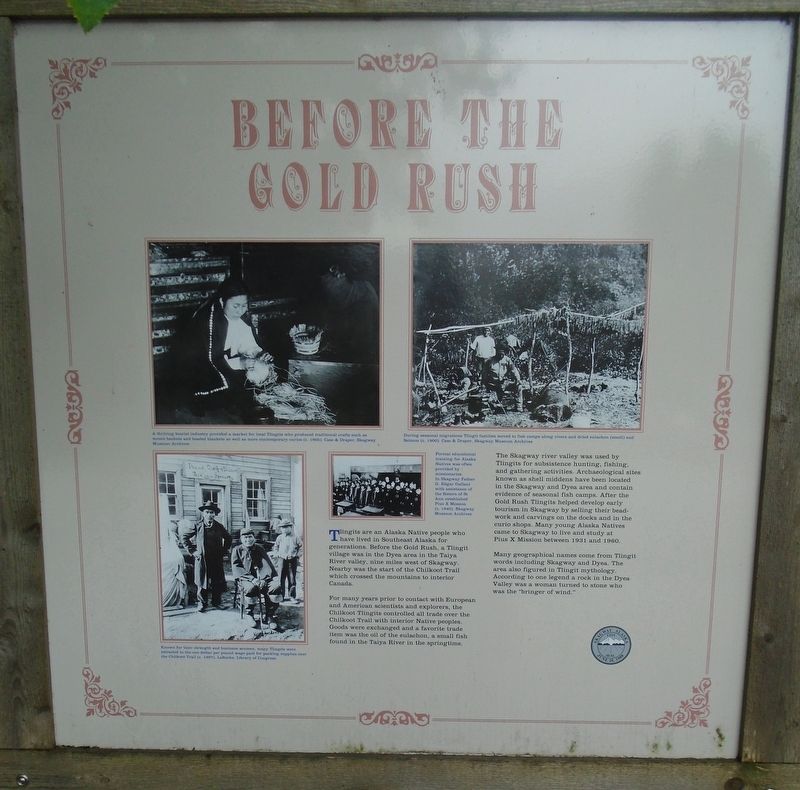
Tlingits are an Alaska Native people who have lived in Southeast Alaska for generations Before the Gold Rush, a Tlingit village was in the Dyea area in the Taiya River valley, nine miles west of Skagway. Nearby was the start of the Chilkoot Trail which crossed the mountains to interior Canada.
For many years prior to contact with European and American scientists and explorers, the Chilkoot Tlingits controlled all trade over the Chilkoot Trail with interior Native peoples. Goods were exchanged and a favorite trade item was the oil of the eulachon, a small fish found in the Taiya River in the springtime.
The Skagway river valley was used by Tlingits for subsistence hunting, fishing. and gathering activities. Archaeological sites known as shell middens have been located in the Skagway and Dyea area and contain evidence of seasonal fish camps. After the Gold Rush Tlingits helped develop early tourism in Skagway by selling their bead-work and carvings on the docks and in the curio shops. Many young Alaska Natives came to Skagway to live and study at Pius X Mission between 1931 and 1960.
Many geographical names come
this page online
[Photo captions, clockwise from top left, read]
• A thriving tourist industry provided a market for local Tlingits who produced traditional crafts such as woven baskets and beaded blankets as well as more contemporary curios (c. 1905)
• During seasonal migrations Tlingit families moved to fish camps along rivers and dried eulachon (smelt) and Salmon (c. 1900).
• Formal educational training for Alaska Natives was often provided by missionaries. In Skagway Father G. Edgar Gallant with assistance of the Sisters of St. Ann established Pius X Mission (c. 1940).
• Known for their strength and business acumen, many Tlingits were attracted to the one dollar per pound wage paid for packing supplies over the Chilkoot Trail (c. 1897).
Erected by the City of Skagway.
Topics. This historical marker is listed in these topic lists: Education • Indigenous Peoples and Communities • Settlements & Settlers • Waterways &
Photographed by William Fischer, Jr., August 24, 2024
2. Before the Gold Rush Marker
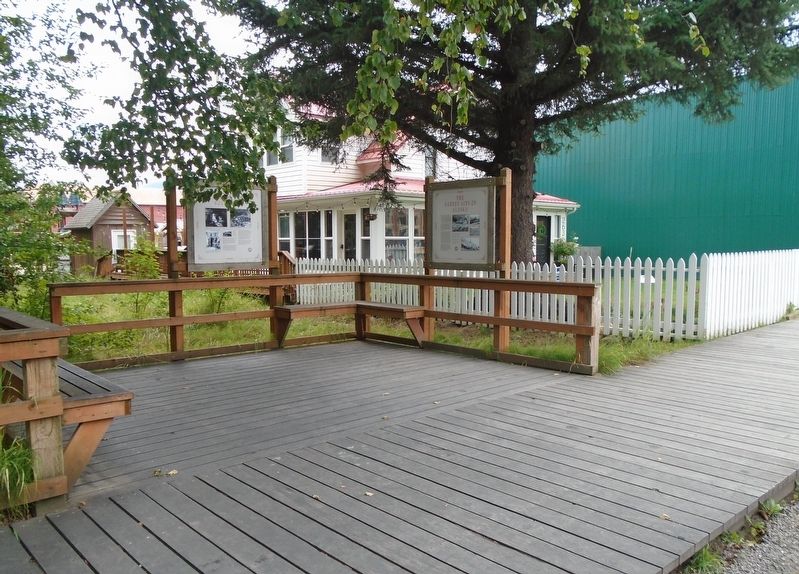
Location. 59° 27.363′ N, 135° 18.755′ W. Marker is in Skagway, Alaska. It is in Dyea. It is on 7th Avenue east of Broadway, on the right when traveling east. Touch for map. Marker is at or near this postal address: 263 7th Avenue, Skagway AK 99840, United States of America. Touch for directions.

Regionally, this marker is in Southeast Alaska, in Tlingit and Haida & Tsimshian Region. It is also on the American Pacific Coast. Globally, it is in North America, the Inside Passage, the Pacific Rim, the Western Hemisphere, the Western World, and the Anglosphere. Historically, it finds itself in what was once the Russian Empire.
Other nearby markers. At least 8 other markers are within walking distance of this marker: The Garden City of Alaska (here, next to this marker); Skagway Remembers (within shouting distance of this marker); Trail of '98 Museum (within shouting distance of this marker); Mollie Walsh (within shouting distance of this marker); Peniel Mission (about 300 feet away, measured in a direct line); Bank of Alaska (about 300 feet away); Perceptions and Misconceptions (about 400 feet away); Harsh Realities (about 400 feet away). Touch for a list and map of all markers in Skagway.
Another marker is no longer nearby. Skagway Remembers (was within shouting distance of this marker but has been permanently removed).
Also see . . . Tlingit Place Names on the Chilkoot Trail. (Submitted on September 28, 2024, by William Fischer, Jr. of Reynoldsburg, Ohio.)
Credits. This page was last revised on September 28, 2024. It was originally submitted on September 28, 2024, by William Fischer, Jr. of Reynoldsburg, Ohio. This page has been viewed 186 times since then and 28 times this year. Photos: 1, 2. submitted on September 28, 2024, by William Fischer, Jr. of Reynoldsburg, Ohio.
