
Elmhurst in DuPage County, Illinois — The American Midwest (Great Lakes)
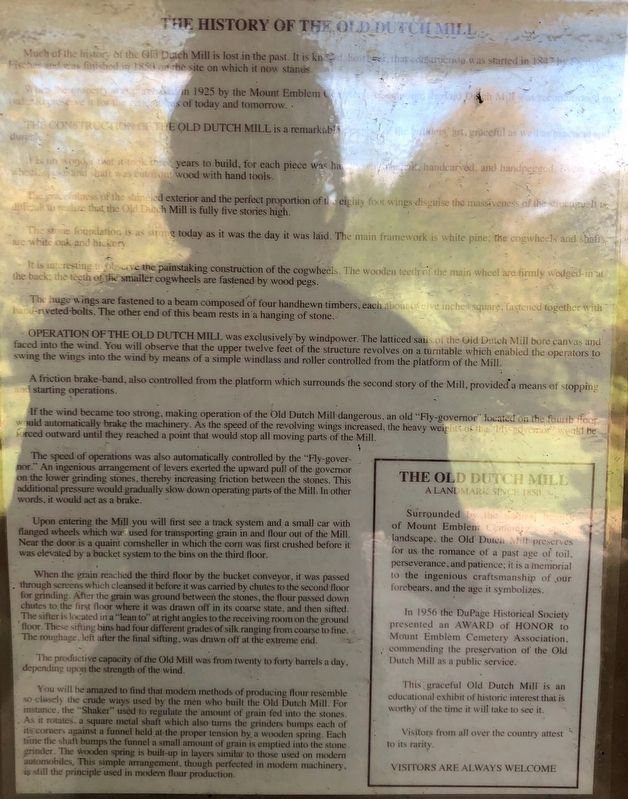
The History of the Old Dutch Mill
Photographed by Sean P. Flynn, September 29, 2024
1. The History of the Old Dutch Mill Marker
When the property was purchased in 1925 by the Mount Emblem Cemetery Association, the Old Dutch Mill was reconditioned in order to preserve it for the generations of today and tomorrow.
The construction of the Old Dutch Mill is a remarkable example of the builders' art, graceful as well as practical and durable.
It is no wonder that it took three years to build, for each piece was handhewn, handcut, handcarved, and handpegged. Every cog. wheel, spoke and shaft was cut from wood with hand tools.
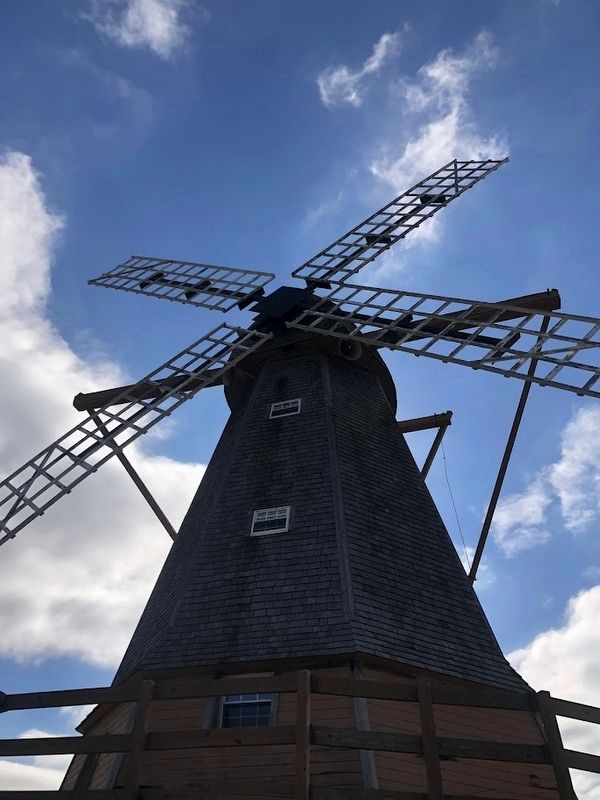
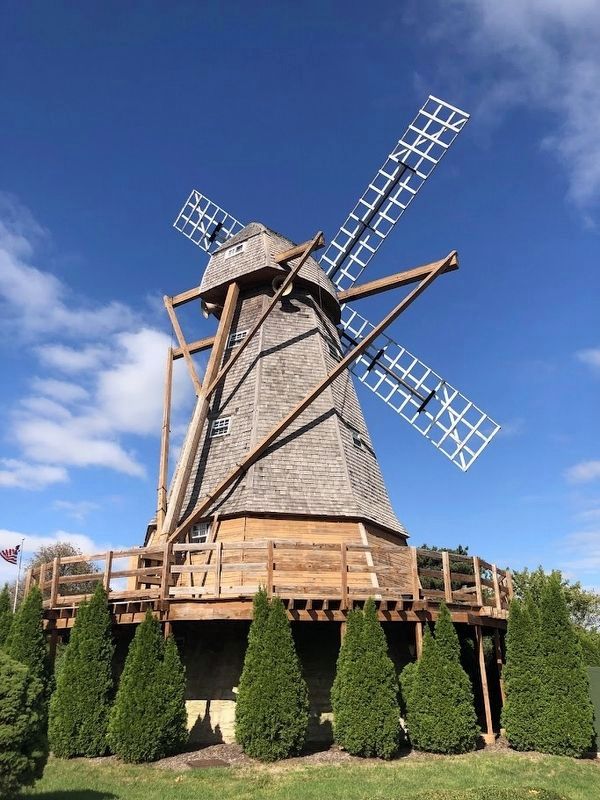
The gracefulness of the shingled exterior and the perfect proportion of the eighty foot wings disguise the massiveness of the structure. It is difficult to realize that the Old Dutch Mill is fully five stories high.
The stone foundation is as strong today as it was the day it was laid. The main framework is white pine; the cogwheels and shafts are white oak and hickory.
It is interesting to observe the painstaking
this page online
The huge wings are fastened to a beam composed of four handhewn timbers, each about twelve inches square, fastened together with hand-riveted bolts. The other end of this beam rests in a hanging of stone.
Operation of the Old Dutch Mill was exclusively by windpower. The latticed sails of the Old Duch Mill bore canvas and faced into the wind. You will observe that the upper twelve feet of the structure revolves on a turntable which enabled the operators to swing the wings into the wind by means of a simple windlass and roller controlled from the platform of the Mill.
A friction brake-band, also controlled from the platform which surrounds the second story of the Mill, provided a means of stopping and starting operations.
If the wind became too strong, making operation of the Old Dutch Mill dangerous, an old “Fly-governor” located on the fourth floor would automatically brake the machinery. As the speed of the revolving wings increased, the heavy weights of the “Fly-governor”
Photographed by Sean P. Flynn, September 29, 2024
2. Old Dutch Mill (Fischer Windmill)
The historical marker is off camera, just below the bottom of the photo, near the entrance into the mill.
The speed of operations was also automatically controlled by the “Fly-governor.” An ingenious arrangement of levers exerted the upward pull of the governor on the lower grinding stones, thereby increasing friction between the stones. This additional pressure would gradually slow down operating parts of the Mill. In other words, it would act as a brake.
Upon entering the Mill you will first see a track system and a small car with flanged wheels which was used for transporting grain in and flour out of the Mill. Near the door is a quaint cornsheller in which the corn was first crushed before it was elevated by a bucket system to the bins on third floor.
When the grain reached the third floor by the bucket conveyor, it was passed through screens which cleansed it before it was carried by chutes to the second floor for grinding . After the grain was ground between the stones, the flour passed down chutes to the first floor where it was drawn off in its course state, and then sifted. The sifter is located in a “lean-to” at right angles
Photographed by Sean P. Flynn, September 29, 2024
3. Old Dutch Mill
The entrance is on the opposite side of the mill.
The productive capacity of the Old Mill was from twenty to forty barrels a day, depending upon the strength of the wind.
You will be amazed to find that modern methods of producing flour resemble so closely the crude ways used by the men who built the Old Dutch Mill. For instance, the “Shaker” used to regulate the amount of grain fed into the stones. As it rotates, a square metal shaft which also turns the grinders bumps each of its corners against a funnel held at the proper tension by a wooden spring. Each time the shaft bumps the funnel a small amount of grain is emptied into the stone grinder. The wooden spring is built-up in layers similar to those used on modern automobiles. This simple arrangement, though perfected in modem machinery. is still the principle used in modern flour production.
[Box in the bottom right corner:]
A Landmark Since 1950

Photographed by Sean P. Flynn, September 29, 2024
4. A look inside the Fischer Windmill
This graceful Old Dutch Mill is an educational exhibit of historic interest that is worthy of the time it will take to see it.
Visitors from all over the country attest to its rarity.
Visitors are always welcome
Topics and series. This historical marker is listed in these topic lists: Agriculture • Architecture • Cemeteries & Burial Sites • Settlements & Settlers. In addition, it is included in the Windmills series list. A significant historical year for this entry is 1847.
Location. 41° 55.764′ N, 87° 55.395′ W. Marker is in Elmhurst, Illinois, in DuPage County. It can be reached from the intersection of Grand Avenue (County Route 20) and County Line Road, on the right when traveling east. The marker is in Mount Emblem Cemetery, affixed
Photographed by Sean P. Flynn, September 29, 2024
5. Fischer Windmill at Mt. Emblem Cemetery

Regionally, this marker is in Greater Chicago. It is also in the American Midwest and on the Great Lakes. Globally, it is in North America, the Western Hemisphere, the Western World, and the Anglosphere. Historically, it finds itself in what was once the territory of the Mississippian Culture and also the Northwest Territory.
Other nearby markers. At least 8 other markers are within 2 miles of this marker, measured as the crow flies: Veterans Memorial (approx. 0.9 miles away); Sky Haven Airport (approx. 0.9 miles away); Bensenville Fire Prevention District 9/11 Memorial (approx. 1.4 miles away); Bensenville Memorial Fountain (approx. 1.4 miles away); Old Northlake Library site (approx. 1½ miles away); Churchville School (approx. 1.6 miles away); Mini Golf, Mini Prairie (approx. 1.8 miles away); Lee A. Daniels (approx. 1.9 miles away). Touch for a list and map of all markers in Elmhurst.
More about this marker.
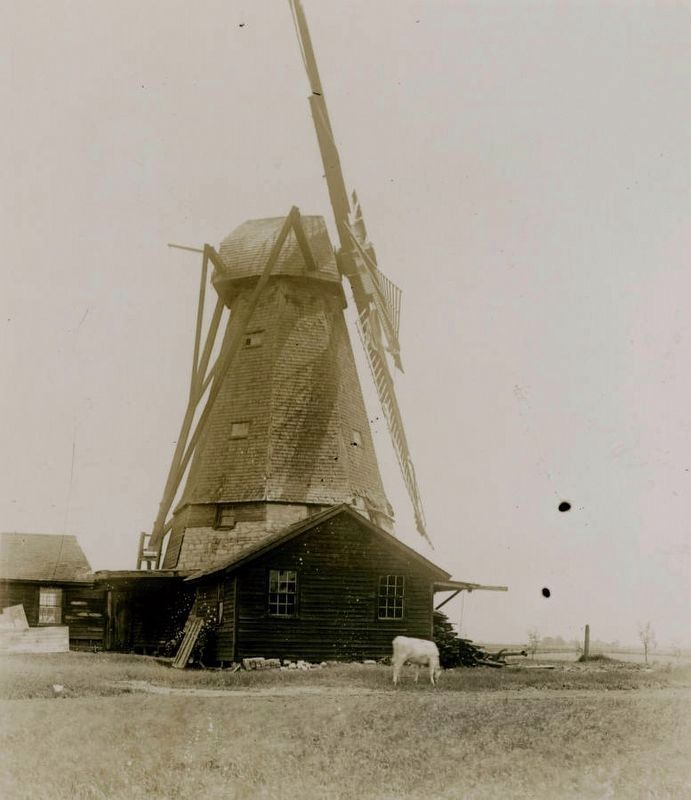
Percy H. Sloan; Courtesy of Newberry Library, circa 1925
6. Fischer Mill
A cow can be seen grazing in front of the mill in this early 20th century photo.
Link #1 below, from the Illinois Windmills website, includes a history of the windmill, including more recent efforts to preserve and restore the windmill. When visited in September 2024, the windmill door was open and a visitor was able to take a stairwell to the second level; a "Do Not Enter" sign was on the stairwell to the top level.
Ironically, despite its direct link to DuPage County's rural past, Mount Emblem Cemetery is in a loud and busy spot; County Line Road abuts always-congested Interstate 294 (the Tri-State Tollway), and planes taking off from and landing at O'Hare Airport can be seen about two miles away.
Also see . . .
1. Fischer Windmill. From the Illinois Windmills website
Excerpt: "Edward Ehlers' widow Caroline (daughter of Henry Korthauer, one of the original builders) sold the farm and windmill to the Mount Emblem Association for $10,000 in 1925. Although the windmill and farm buildings were initially scheduled for demolition, the association instead hired Henry and Franklyn Ehlers, Edward's sons, of Ehlers Brothers General Contractors, to preserve the mill as a museum. Ehlers Brothers Construction also built the Elmhurst State Bank Building (now a 5/3 Bank) at 105 S York Rd.(Submitted on September 30, 2024, by Sean P. Flynn of Oak Park, Illinois.)
"They installed new windows, shingles and trim; replaced and reinforced the stage and hand rails; painted the mill; and built new sails, which were turned to a Saint Andrew’s cross ('X' formation), meaning the mill is in a 'long rest'."
2. Windmill spins stories of Elmhurst's rural history. This 1985 article by the Chicago Tribune looks at the history of the mill and periodic efforts to preserve it. (Submitted on September 30, 2024, by Sean P. Flynn of Oak Park, Illinois.)
Additional keywords. Fischer's Windmill
Credits. This page was last revised on January 17, 2025. It was originally submitted on September 30, 2024, by Sean P. Flynn of Oak Park, Illinois. This page has been viewed 243 times since then and 52 times this year. Photos: 1, 2, 3, 4, 5, 6. submitted on September 30, 2024, by Sean P. Flynn of Oak Park, Illinois.
