
Croulebarbe in Paris in Département de Paris, Île-de-France, France — Western Europe
Pierre and Marie Curie
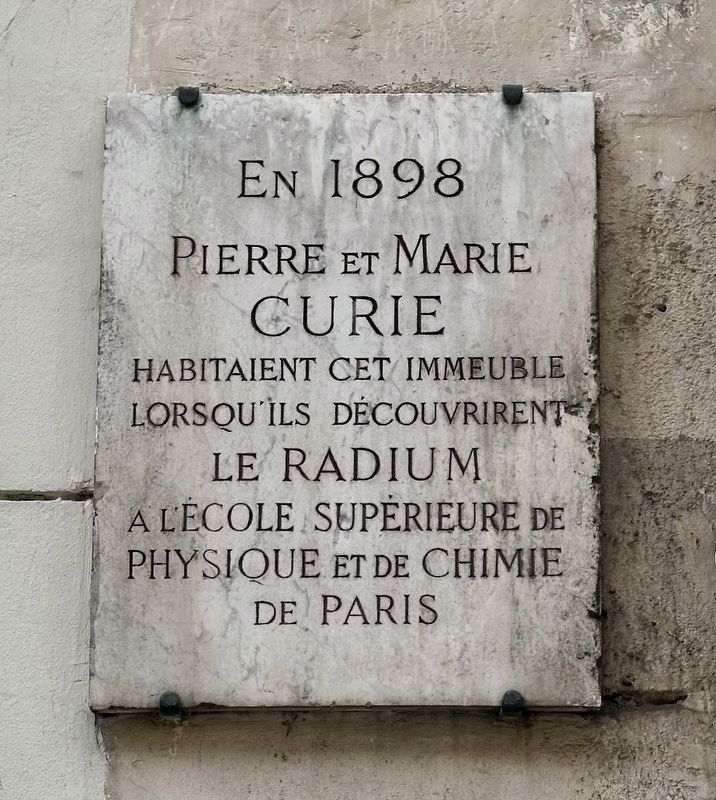
Photographed by Andrew Ruppenstein, September 17, 2024
1. Pierre and Marie Curie Marker

Pierre et Marie
Curie
habitaient cet immeuble
lorsqu'ils découvrirent
le radium
a l’École Supérieure de
Physique et de Chimie
de Paris
In 1898 Pierre and Marie Curie were living in this building when they discovered radium at the École Supérieure de Physique et de Chimie in Paris.
Topics. This historical marker is listed in these topic lists: Science & Medicine • Women. A significant historical date for this entry is December 21, 1898.
Location. 48° 50.13′ N, 2° 20.707′ E. Marker is in Paris, Île-de-France, in Département de Paris. It is in Croulebarbe. It is on Rue de la Glacière. Touch for map. Marker is at or near this postal address: 24 Rue de la Glacière, Paris, Île-de-France 75013, France. Touch for directions.

Regionally, it is in the North Atlantic Region, Europe, the European Union, Atlantic Europe, the Schengen Area, Western Europe, a coastal Mediterranean country, and the Western World. Historically, it finds itself in what was once a French colony and also the Roman Empire.
Other nearby markers. At least 8 other markers are within walking distance of this marker: L’Église de Notre Dame de la Cuisine Fatiguée (approx. half a kilometer away); Guillevic (approx. half a kilometer away); Ancienne abbaye de Port-Royal (approx. 0.6 kilometers away); Bombardement de Paris (approx. 0.6 kilometers away); La Maternite Ecole d’Accouchement (approx. 0.6 kilometers away); Square Saint-Médard (approx. 0.6
this page online
Also see . . . Radium. Excerpt:
Radium was discovered by Marie Skłodowska-Curie and her husband Pierre Curie on 21 December 1898 in a uraninite (pitchblende) sample from Jáchymov. While studying the mineral earlier, the Curies removed uranium from it and found that the remaining material was still radioactive. In July 1898, while studying pitchblende, they isolated an element similar to bismuth which turned out to be polonium. They then isolated a radioactive mixture consisting of two components: compounds of barium, which gave a brilliant green flame color, and unknown radioactive compounds which gave carmine spectral lines that had never been documented before. The Curies found the radioactive compounds to be very similar to the barium compounds, except they were less soluble. This discovery made it possible for the Curies to isolate the radioactive compounds and discover a new element in them. The Curies announced their discovery to the French Academy of Sciences on 26 December 1898. The naming of radium dates to about 1899, from the French word radium, formed in Modern Latin from radius (ray): this was in recognition of radium's emission of energy in the form of rays.
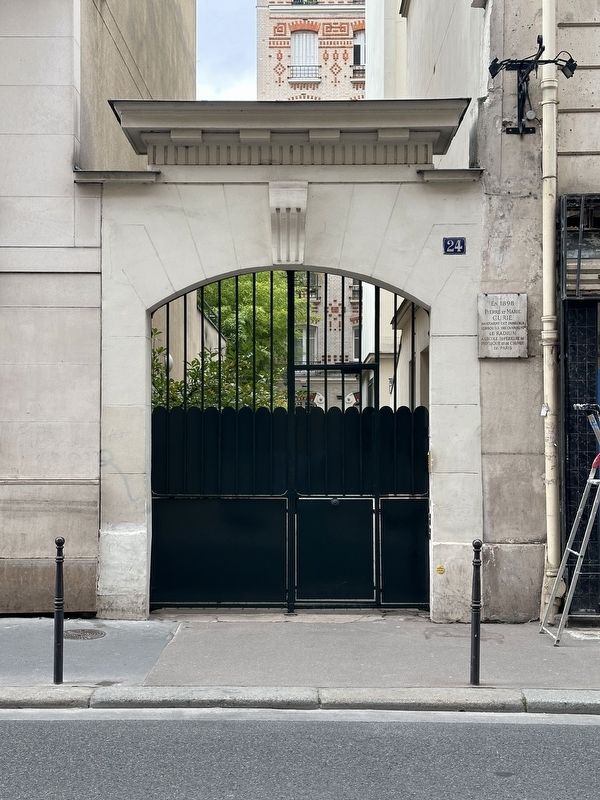
Photographed by Andrew Ruppenstein, September 17, 2024
2. Pierre and Marie Curie Marker - wide view
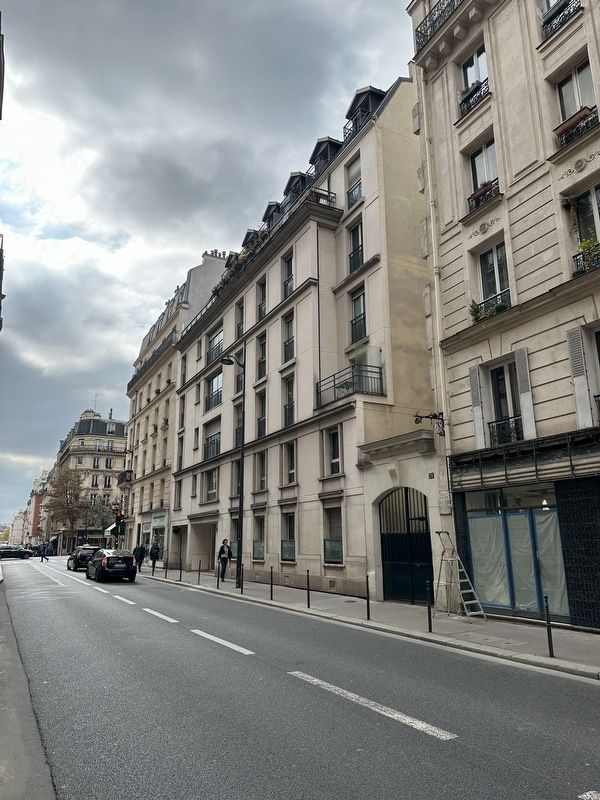
Photographed by Andrew Ruppenstein, September 17, 2024
3. Pierre and Marie Curie Marker - wider view
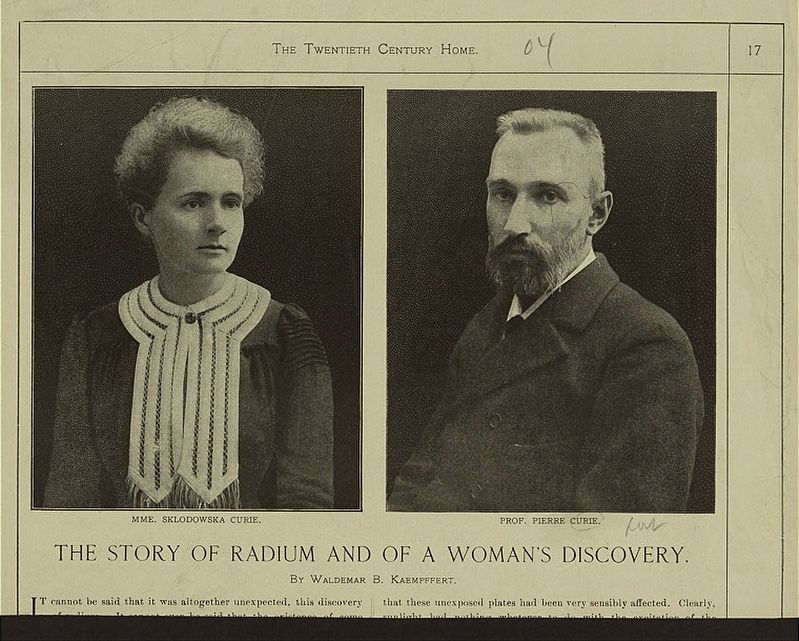
courtesy of the New York Public Library, circa 1900
4. Pierre and Marie Curie
Credits. This page was last revised on September 30, 2024. It was originally submitted on September 30, 2024, by Andrew Ruppenstein of Lamorinda, California. This page has been viewed 310 times since then and 34 times this year. Photos: 1, 2, 3, 4. submitted on September 30, 2024, by Andrew Ruppenstein of Lamorinda, California.
