Eastport in Washington County, Maine — The American Northeast (New England)
U.S.S. Minnesota
⎯⎯⎯
U.S.S. Vermont
Photographed by Steve Stoessel, September 30, 2024
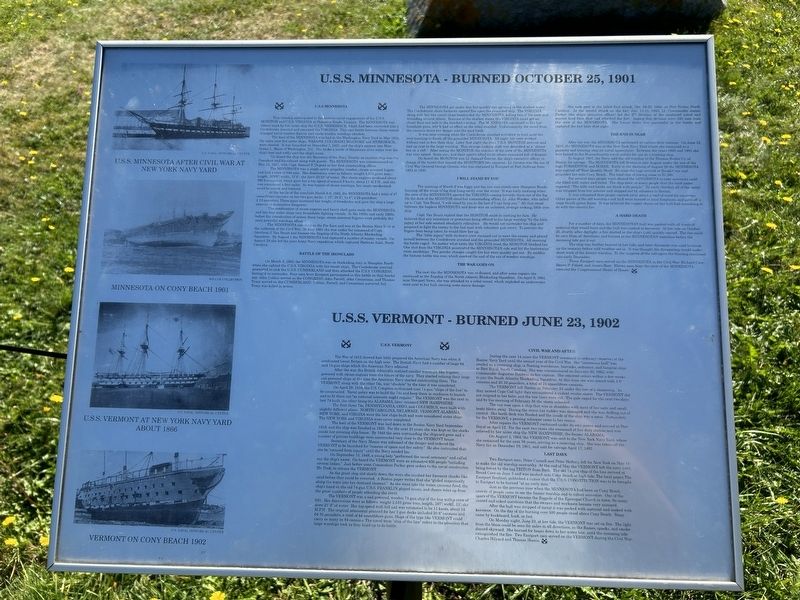
1. U.S.S. Minnesota/ U.S.S. Vermont Marker
The keel of the Minnesota was laid in the Washington Navy Yard in May 1854, the same year her sister ships, Wabash, Colorado, Roanoke, and Merrimack were started. It was launched on December 1, 1855, and the ship's sponsor was Miss Susan L. Mann of Washington, D.C. She broke a bottle of Minnesota river water over the ship's bow and softly said the ship's name.
On board the ship was the Secretary of the Navy. Nearby on another ship was the President and his cabinet along with guests. The Minnesota was commissioned on May 21, 1857, with Capt. Samuel F. Dupont as her first commanding officer.
The Minnesota was a single screw propeller, wooden, steam-powered frigate and had a crew of 646 men. Her dimensions
this page online
At the battle of the ironclads March 8-9, 1862, the Minnesota had a total of 47 smoothbore cannons on her two gun decks: 1 10"; 28 9"; 14 8; 2 24-pounders; 2 12-pounders. These guns increased her weight of broadsides and gave the ship a large amount of destructive firepower.
The combination of steam engines and heavy shell guns made the Minnesota and her four sister ships very formidable fighting vessels. In the 1850s and early 1860s, before the introduction of armor, these large, steam-powered frigates were probably the most powerful warships afloat.
The Minnesota saw duty in the Far East and was at the Boston Navy Yard at outbreak of the Civil War. In May 1861 she was under the command of Capt. om J. Van Brunt and became the flagship of the North Atlantic Blockading Squadron. By August 1 the Minnesota had
Photographed by Steve Stoessel, September 30, 2024
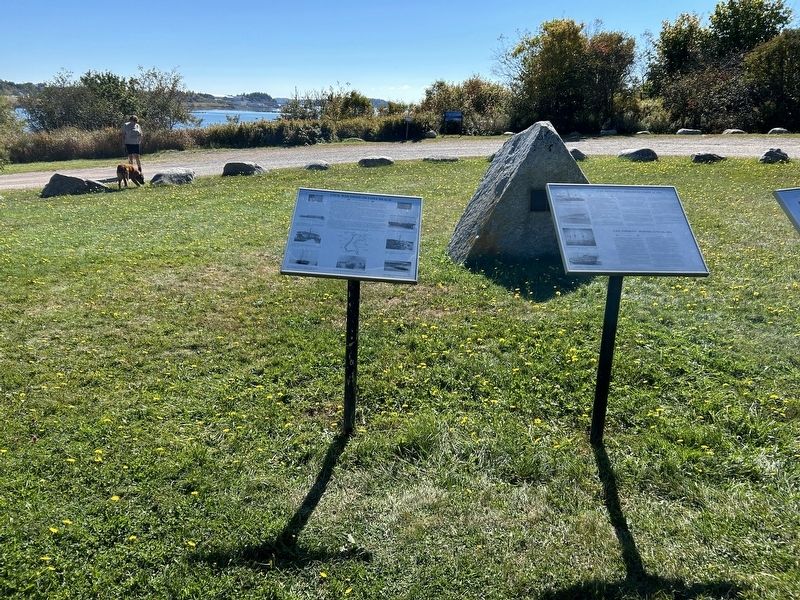
2. U.S.S. Minnesota/ U.S.S. Vermont Marker
Battle of the Ironclads
On March 8, 1862, the Minnesota was on blockading duty in Hampton Roads he sighted the C.S.S. Virginia with her escort ships. The Confederate ironclad proceeded to sink the U.S.S. Cumberland and then attacked the U.S.S. Congress, forcing it to surrender. Four men from Eastport participated in this battle on that fateful day: John Collins served on the Congress,; John Farrell, John Concannon, and Thomas Tracy served on the Cumberland. Collins, Farrell, and Concannon survived, but Tracy was killed in action.
The Minnesota got under way but quickly ran aground in the shallow water. The Confederate shore batteries opened fire upon the grounded ship. The Virginia along with her two escort ships bombarded the Minnesota, killing two of the crew and wounding several others. Because of the shallow water, the Virginia could get no closer than one mile to the beached warship. The Minnesota continued to fire her broadside guns, which had no effect on the rebel ironclad. Unfortunately, the recoil from the cannons drove her deeper into the mud bank.
It was near evening when the Confederate ironclad withdrew to wait until the next morning to finish off the grounded Minnesota. All night her crew worked without rest to free their ship. Later that night the little U.S.S. Monitor arrived, and tied up next to the large warship. This strange-looking craft was described as a "cheese box on a raft." After seeing the Monitor the reaction of the crew of the Minnesota was very mixed. Some men had their spirits lifted while others remained full of despair.
On board the Monitor was Lt. Samuel Greene, the ship's executive officer, in charge of the turret that housed the Monitor’s two cannons. Lt. Greene was the son of Civil War General George Greene, who was stationed in Eastport at Fort Sullivan from 1831 to 1835.
I Will Stand By You
The morning of March 9 was foggy and the sun rose slowly over Hampton Roads,-burning off the wisps of fog that hung eerily over the water. It was early morning when the crew of the Minnesota spotted the Virginia coming towards them out of the fog. On the deck of the Monitor stood her commanding officer, Lt. John Worden, who called up to Capt. Van Brunt, "I will stand by you to the last if I can help you." All that stood between the hapless Minnesota and doom was an untested, strange-looking, little iron ship.
Capt. Van Brunt replied that the Monitor could do nothing for him. He believed that any assistance or protection being offered to his large warship "by the little pigmy at her side seemed absolutely ridiculous." He would not surrender his ship and prepared to fight the enemy to the last man with volunteer gun crews. To prevent the frigate from being taken he would blow her up.
The "little pigmy" with its brave crew steamed out to meet the enemy and placed herself between the Confederate ironclad and the grounded Minnesota. All morning the battle raged. No matter what tactic the < i>Virginia tried, the Monitor blocked her. One shot from the Virginia penetrated the Minnesota 'S side and hit the boatswains' room amidships. Two powder charges caught fire but were quickly put out. By midday the historic battle was over, which marked the end of the era of wooden warships.
The War Goes On
The next day the Minnesota was re-floated, and after some repairs she continued as the flagship of the North Atlantic Blockading Squadron. On April.9, 1864, near Newport News, she was attacked by a rebel vessel, which exploded an underwater mine next to her hull causing some minor damage.
She took part in the failed first attack, Dec. 24-25 1864 on Fort Fisher, North Carolina. In the second attack on the fort, Lt. Commander James Parker (the ship’s executive officer) led the 2nd Division of the combined naval and marine land force that had attacked the fort. Among this division were 240 from the crew of the Minnesota. The Union Army was successful in the battle and captured the fort later that night.
The End is Near
After the war, the Minnesota performed at various duty stations. On June 12, 1875, the Minnesota was at the New York Navy Yard where she remained as a gunnery and training ship for naval apprentices. Between the years 1895 and 1901 she was loaned to the Massachusetts naval militia for use as a training ship/
In August 1901, the Navy sold the old warship to the Thomas Butler Co. of Boston for salvage. The Minnesota left Boston in late August under the tow of the tugs Tormentor and Boxer. Early in the morning of August 28, the Minnesota was sighted off West Quoddy Head. By noon the tugs arrived at Broad Cove and grounded her onto Cony Beach. The total cost of the towing came to $1,300.
For several days people went aboard the Minnesota to take souvenirs until she filled with water and listed. The ship drew so many people that the local paper reported, "The hills and banks are black with people.” By early October all the metal was stripped from her interior and shipped out by schooner to Boston.
It was estimated that people carried away about a cord of firewood for souvenirs. Other pieces of the old warship's oak hull were burned in local fireplaces, and gave off a large bluish-green flame. It was believed the copper sheets on her hull had something to do with the colorful fire.
A Hard Death
For a number of days, the Minnesota’s hull was packed with all kinds of material that would burn and the hull was soaked in kerosene. At low tide on October 25, shortly after daylight, a fire started in the ship’s hold quickly spread. The fire could be seen from all directions and burned to the the Minnesota’s waterline before the incoming tide put it out.
The ship was further burned at low tide, and later dynamite was used to break up the remains before cold weather set in. It was thought the dynamiting would make short work of the former warship. To the surprise of the salvagers the blasting continued into early December.
Three Eastport men served on the Minnesota in the Civil War: Richard Case, Henry P. Fifield, and James Barr. Eleven men from the crew of the Minnesota received the Congressional Medal of Honor
After the war, the British Admiralty realized smaller warships, like frigates, powered with steam engines were the future of the navy. They started retiring their large sail-powered ships at the time the American Navy started constructing them. The Vermont, along with the other 74s, was "obsolete" by the time it was completed.
On April 29, 1816, the U.S. Congress authorized nine 74-gun "ships of the line" to be constructed. Naval policy was to build the 74s and keep them in readiness to launch and to fit them out "as national interests might require." The Vermont was the next to last 74 built, the other being the Alabama, later renamed New Hampshire.
The first three 74s, Pennsylvania, Ohio, and Columbus, were built with slightly different plans. North Carolina, Delaware, Vermont, Alabama, New York, and Virginia were the last ships built and were considered sister ships. The New York and Virginia were never completed.
The keel of the Vermont was laid down in the Boston Navy Yard September 1818, and the ship was finished in 1825. For the next 23 years she was kept on the stocks inside her covering ship house. By 1848 the area surrounding the shipyard grew and a number of private buildings were constructed very close to the Vermont house.
Secretary of the Navy Mason was informed of the danger and ordered the Vermont to be launched for "reasons of space and fire safety." He also instructed that she be "secured from injury" until the Navy needed her.
On September 15, 1848, a young lady "performed the usual ceremony" and called out the ship's name. On board the Vermont were an estimated 600 people "including several ladies." Just before noon Commodore Parker gave orders to the naval constructor, Mr. Pook, to release the Vermont.
As the great ship slid slowly down the ways she crushed her foremost chucks like sand before they could be removed. A Boston paper writes that she "glided majestically along the ways into her destined element." As she went into the water, cannons fired, the ship's band on the old 74-gun U.S.S. Franklin played music, and cheers went up from the great numbers of people attending the event.
The Vermont was a sail-powered, wooden 74-gun ship of the line with a crew of 820. Her dimensions were as follows: weight 2,633 gross tons; length, 197; width, 53'; she drew 21' 6" of water. Her top speed with full sail was estimated to be 11 knots, about 14 M.P.H. The original armament planned for her 3 gun decks included 20 8" cannons ard 64 32-pounders, a total of 84 smoothbore guns. Ships of the type like Vermont could carry as many as 84 cannons. The naval term "ship of the line" refers to the position that large warships took as they lined up to do battle.
Civil War
During the next 14 years the Vermont remained in ordinary (reserve) at the Boston Navy Yard until the second year of the Civil War. Her "cavernous hull" was needed as a receiving ship, (a floating warehouse, barracks, ordnance, and hospital ship) at Port Royal, South Carolina. She was commissioned on January 30, 1862, with Commander Augustus Baldwin as her captain. She received orders within a few weeks to join the South Atlantic Blockading Squadron. At this time she was armed with 4 8" cannons and 20 32-pounders, a total of 24 smoothbore cannons.
The Vermont left Boston on February 24 under the tow of a steamship. As they neared Cape Cod light they encountered a violent winter storm. The Vermont did not respond to her helm and the tow lines were cut. The gale raged for the next two days and by the morning of February 26 the storm subsided.
The sun rose upon a ship that was in shambles with most of her sails and small boats blown away. During the storm her rudder was damaged and she was drifting out of control. Her berth deck was flooded and the inside of the ship was a mess. Fortunately for the Vermont, a passing schooner came to her rescue.
After repairs the Vermont continued under its own power and arrived at Port Royal on April 12. For the next two years she remained at her duty station and was relieved by her sister ship the New Hampshire, the former Alabama.
On August 2, 1864, the Vermont was sent to the New York Navy Yard, where she remained for the next 38 years, serving as a receiving ship. She was taken off the Navy list on December 19, 1301, and sold for salvage April 17, 1902.
Last Days
Two Eastport men, Peter Curnell and Peter Hodney, left for New York on May 14 to make the old warship seaworthy. At the end of May the Vermont left the navy yard, being towed by the tug Triton from Bath. The old 74-gun ship of the line arrived at Broad Cove on June 3 and was pushed onto Cony Beach at high tide. The local paper, The Eastport Sentinel, published a rumor that the U.S.S. Constitution was to be brought to Eastport to be burned "at an early date."
Just as the previous year when the Minnesota had been on Cony Beach, crowds of people came to see the former warship and to collect souvenirs. One of the spars of the Vermont became the flagpole of the Episcopal Chuch in town. So many visited and asked questions that the owners and workmen became very annoyed.
After the hull was stripped of metal it was packed with material and soaked with kerosene. On the day of the burning over 500 people stood above Cony Beach. Many came by buckboard, hack, or foot.
On Monday night, June 23, at low tide, the Vermont was set on fire. The light from the blaze could be seen for miles in all directions, as the flames, sparks, and smoke danced skyward. She burned for hours down to her water line, until the incoming tide extinguished the fire. Two Eastport men served on the Vermont during the Civil War: Charles Hilyard and Thomas Harris.
Topics. This historical marker is listed in these topic lists: War, US Civil • Waterways & Vessels. A significant historical year for this entry is 1854.
Location. 44° 54.338′ N, 67° 0.76′ W. Marker is in Eastport, Maine, in Washington County. It can be reached from Deep Cove Road. Marker is at the end of entrance road to Shackford Head State Park. Touch for map. Marker is in this post office area: Eastport ME 04631, United States of America. Touch for directions.

Regionally, this marker is in Downeast Maine. It is also in the American Northeast, in New England, and on the Eastern Seaboard. Globally, it is in the North Atlantic Region, North America, the Great North Woods, the Western Hemisphere, the Western World, and the Anglosphere. Historically, it finds itself in what was once the Viceroyalty of New France and also Acadia.
Other nearby markers. At least 8 other markers are within 2 miles of this marker, measured as the crow flies: Civil War Ships on Cony Beach (here, next to this marker); USS Wabash / USS Franklin (here, next to this marker); U.S.S. Richmond (here, next to this marker); Civil War Ships Burned at Cony Beach (here, next to this marker); Aquaculture’s Place in a Working Harbor (within shouting distance of this marker); The Tumultuous History of Cony Park (about 600 feet away, measured in a direct line); Eastport Civil War Memorial (approx. 1.2 miles away); Cobscook Bay (approx. 1.3 miles away). Touch for a list and map of all markers in Eastport.
Also see . . .
1. USS Minnesota (Wikipedia). (Submitted on October 18, 2024, by Steve Stoessel of Niskayuna, New York.)
2. USS Vermont (Wikipedia). (Submitted on October 18, 2024, by Steve Stoessel of Niskayuna, New York.)
Credits. This page was last revised on March 19, 2026. It was originally submitted on September 30, 2024, by Steve Stoessel of Niskayuna, New York. This page has been viewed 349 times since then and 71 times this year. Photos: 1, 2. submitted on September 30, 2024, by Steve Stoessel of Niskayuna, New York.
