Eastport in Washington County, Maine — The American Northeast (New England)
U.S.S. Richmond
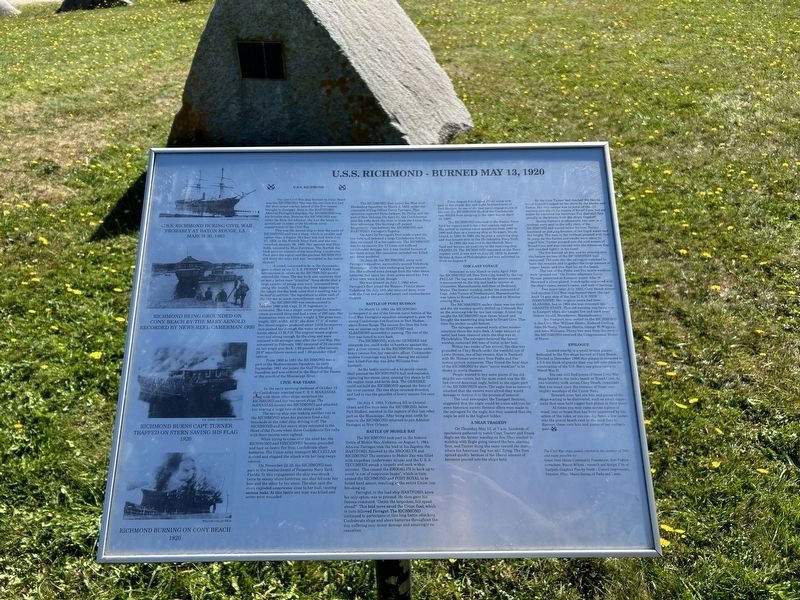
Photographed by Steve Stoessel, September 30, 2024
1. U.S.S. Richmond Marker
The last Civil War ship burned on Cony Beach was the Richmond. She was the smallest but had the most noted combat record of the five vessels brought to Eastport. Next to the Hartford, Admiral Farragut's flagship, the Richmond was his favorite ship. Because the Richmond was never far from the Admiral, she had the honor to participate in some of the bloodiest naval engagements of the Civil War.
This was the second ship to bear the name of Richmond and was a sloop, which is smaller and lighter than a frigate. Her keel was laid down July 27, 1858, in the Norfolk Navy Yard, and she was launched January 26, 1860. Her sponsor was Miss Robb, assisted by Miss Berryman. The Norfolk day book gave an account of the launching. Constructor Pook gave the signal and the gunboat Richmond slid down the ways and was "consigned to her native element."
A crowd, estimated to be in the thousands, gave a cheer as the U.S. S. Pennsylvania fired her cannons in salute as the Richmond quietly entered the water. The day book also mentions that so many ladies wore "crinoline" (hoop skirts) that a large number of young men were "prevented from seeing
this page online
The Richmond was commissioned in October 1860 with Capt. D. N. Ingraham in command. She was a single screw propeller, wooden, steam-powered sloop and had a crew of 260 men. Her dimensions were as follows: weight 2,700 gross tons; length, 225'; width, 42' 6"; she drew 17' 5" of water.
Her steam engines produced about 1,078 horsepower that pushed her through the water at about 9.5 knots, about 11 mph. The original steam engines were not strong enough for the sloop and were replaced with stronger ones after the Civil War. Her armament in February, 1862 consisted of 22 cannons on her single gun deck: 1 80-pounder rifled cannon; 20 9" smoothbore cannon and 1 30-pounder rifled cannon.
From 1860 to 1861 the Richmond was a part of the Mediterranean Squadron. In early September 1861 she joined the Gulf Blockading Squadron and was ordered to the Head of the Passes at the mouth of the Mississippi River.
Civil War Years
In the early morning darkness
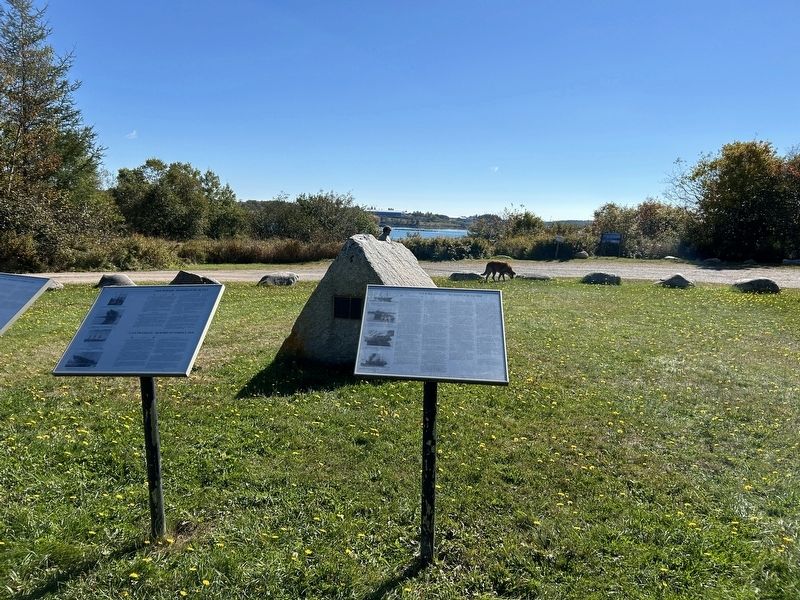
Photographed by Steve Stoessel, September 30, 2024
2. U.S.S. Richmond Marker
The enemy ship was making another run at the Richmond when her gunners fired a full broadside at the rebel ship, driving it off. The Richmond and her escort ships retreated to the Head of the Passes when three Confederate fire rafts with their escorts were sighted.
While trying to cross over the sand bar, the Richmond and Vincennes became grounded and took on heavy fire from Confederate shore batteries. The Union army transport McClellan arrived and stopped the attack with her long-range cannon.
On November 22-23, the Richmond took part in the bombardment of Pensacola Navy Yard, Florida. In this engagement the ship was struck twice by enemy shore batteries; one shot hit near her bow and the other by her stern. The shot near the stern exploded underwater close to her hull, causing serious leaks. At this battle one man was killed and seven were wounded.
The Richmond then joined the West Gulf Blockading

Photographed by Steve Stoessel, September 30, 2024
3. U.S.S. Richmond Marker
On April 24 Farragut's fleet made it past the two forts and defeated a large Confederate flotilla, then continued 12 miles upstream. The Richmond was hit by cannon fire 17 times and suffered considerable damage, but it was limited because of her chain armor. Her casualties included two killed and three wounded.
On June 28, the Richmond, along with Farragut's squadron, successfully passed Vicksburg, Mississippi, all the time exchanging heavy cannon fire. She suffered some damage from the rebel shore batteries, but again her chain armor saved her. Two of her crew were killed, though.
She was present on July 1, 1862 when Farragut's fleet joined the Western Flotilla above Vicksburg. On July 15th she returned down river with the fleet and provided escort and bombardment support.
Battle of Port Hudson
On
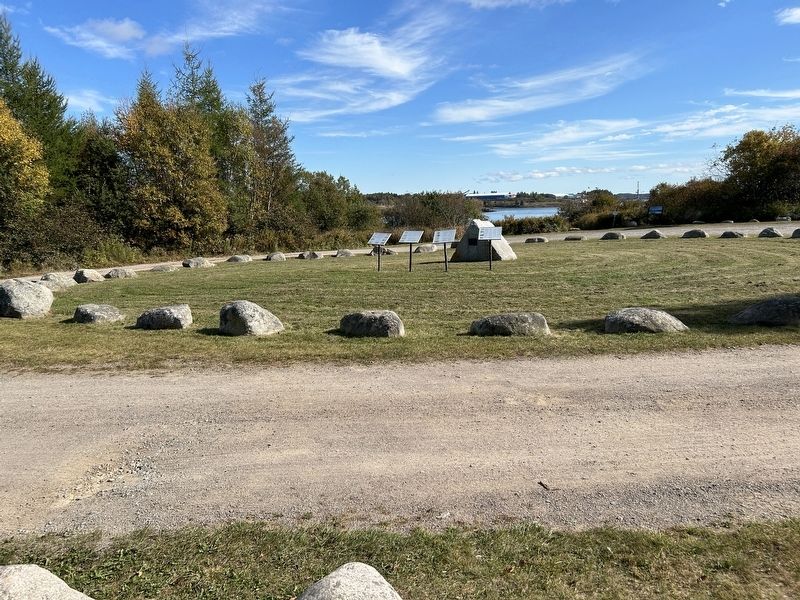
Photographed by Steve Stoessel, October 2, 2024
4. U.S.S. Richmond Marker
The Richmond, with the Genesee tied alongside her, could make no headway against the strong river current. As the Richmond came under heavy cannon fire, her executive officer, Commander Andrew Cummings was killed. Among the enlisted men killed that day was John Williams from Eastport.
As the battle continued a 42-pound cannon shell pierced the Richmond’s hull and exploded, rupturing her steam lines, causing live steam to fill the engine room and berth deck. The Genesee could not hold the Richmond against the force of the river current. The two ships reversed direction and had to run the gauntlet of heavy cannon fire once again.
On July 4, 1863, Vicksburg fell to General Grant and five days later the Richmond, below Port Hudson, assisted in the capture of this last rebel port on the Mississippi. After being sent north for repairs, the Richmond returned to join Admiral Farragut at New Orleans.
Battle of Mobile Bay
The Richmond took part in the historic Battle of Mobile Bay, Alabama, on August 5, 1864. Admiral Farragut took the lead in his flagship the Hartford, followed by the Brooklyn and Richmond. The entrance to Mobile Bay was filled with torpedoes (underwater mines) and the U.S. S. Techumsehstruck a torpedo and sank within minutes. This caused the Brooklyn to back up to avoid "a row of suspicious buoys", which in turn caused the Richmond and Port Royal to be forced hard astern, resulting in the entire Union line breaking up.
Farragut, in the lead ship Hartford, knew his only option was to proceed. He then gave his famous command, "Damn the torpedoes, full speed ahead!" This bold move saved the Union fleet, which in turn followed Farragut. The Richmond continued to participate in this long battle attacking Confederate ships and shore batteries throughout the day, suffering only minor damage and amazingly no casualties.
From August 9 to August 23 the sloop part in the steady day and night bombardment of Fort Morgan. In one of the last naval engagements of the war, the Richmond blocked the Confederate ram Webb from escaping to the open sea April 23, 1865.
The Richmond returned to the Boston Navy Yard for repairs and to have her engines replaced. She served in various naval squadrons from 1869 to 1890 and then as a training ship at Newport, Rhode Island, to 1893. In 1894 she became a receiving ship and was housed over at the Philadelphia Navy Yard.
In 1903 she was sent to the Norfolk Navy Yard and became an auxiliary to the receiving ship Franklin. The Richmond remained on the Navy register until it was sold on July 23, 1919, to Joseph Hyman & Sons of Philadelphia and was delivered to them on August 6.
One Last Voyage
Sometime in late March or early April 1920 the Richmond left New York City, towed by the tug Pallas. The tug was delayed by the severe weather it encountered on the trip and had to layover at Gloucester, Massachusetts and then at Rockland, Maine. The former warship, under the command of Capt. John Turner of Newbury, Massachusetts. was taken to Broad Cove, and anchored on Monday evening May 3.
The Richmond’s anchor chain was too short and the old warship quietly drifted up Cobscook Bay on the incoming tide for one last voyage. A local tug caught the Richmond near Goose Island and brought the wandering ship back to Broad Cove. This time the anchor caught bottom.
The salvagers removed much of her wooden structure above the main deck. A large amount of metal had been removed while the ship was at Philadelphia. The salvagers believed the former warship contained up to 200 tons of metal up in her hull.
Within two weeks of her arrival, the ship was grounded on Cony Beach under the watchful eye of Lewis Hyman, one of her owners. Also in Eastport with Mr. Hyman were men from Pathe and Fox motion picture companies. They filmed the final days of the Richmond for their "movie weeklies" to be shown in movie theaters.
People wanted to buy some pieces of the old ship for souvenirs, but the most noted was the 20-foot carved American eagle, bolted to the upper part of the Richmond’s stern. The eagle was so securely attached that the owners were afraid they would damage or destroy it in the process of removal.
The local newspaper, the Eastport Sentinel, suggested that the eagle would be a nice addition for some historical society. Several offers were made to the salvagers for the eagle, but they insisted that the eagle be sold to the highest bidder.
A Near Tragedy
On Thursday, May 13, at 7 a.m. hundreds of spectators gathered to watch Capt. Turner and Frank Bogle set the former warship on fire. They started in midship with Bogle going toward the bow, starting fires, and Turner doing the same toward the stern., where his American flag was still flying. The fires spread quickly because of the liberal amount of kerosene poured into the ship's hold.
By the time Turner had reached the flag found himself trapped on the stern by the smol flames. His only escape was to jump off the old warship into the chilly waters of Broad Cove, but not before he retrieved his American flag that still proudly in the breeze from the ship's flagstaff.
Seeing Turner's predicament, two men in a rowboat were sent to the lofty stern of the Richmond and waited below for him. Turner hesitated on jumping because of the frigid water and the height. The men in the rowboat pleaded with him to jump. As the flames and smoke were about to engulf him, Turner jumped into the cold waters of Broad Cove and was rescued with the American flag still clutched tightly in his hand.
The fire burned all day, and by evening only the bottom portion of the Richmond’s hull remained. The next day the salvagers returned to burn the remains and to gather the large amount of copper, brass, and iron that lay on the beach.
The last of the Pathe and Fox movie weeklies were "ground out." On Friday afternoon Louis Hyman presented to Eastport mayor John N. Henward a silver-plated, 5-inch spike engraved with the ship's name, owner's name, and date of burning.
Two years later, July 1922, Cony Beach almost had another Civil War ship burned there, the last built 74-gun ship of the line U. S. S. New Hampshire. Her original name had been Alabama, but in 1904 she was renamed the Granite State. This old warship was being towed to Eastport when she caught fire and sank near Graves Island, Manchester, Massachusetts.
Six Eastport men served on the Richmond in the Civil War: William Brown, Richard Curling John McNeely, Thomas Harris, George W. Wiggins, and John Williams. Thirty two men from the crew of the Richmond received the Congressional Medal of Honor.
Epilogue
Located nearby is a small bronze plaque dedicated to the five ships burned at Cony Beach. Erected in December 1996 this plaque is mounted to a 5-6 ton block of granite that was left over from the construction of the U.S. Navy sea plane ramp in World War II.
You can still find pieces of these Civil War ships buried in the rocky beach at Broad Cove. As you leisurely walk across Cony Beach, remember that you tread upon the remains of these once mighty warships of the Union Navy.
Beneath your feet are bits and pieces of the ships waiting to be discovered, such as small copper nails that once held copper hull plates in their place.
At times you may come across a piece of wood, iron or brass that has been uncovered by the action of the tides, or you can dig down a few inches into the gravel beach next to the mud flats to discover these rare bits and pieces of our nation’s past.
[photo captions, from top:]
U.S.S. Richmond during Civil War probably at Baton Rouge, LA. March 30, 1863
Richmond being grounded on Cony Beach by the Mary Arnold recorded by news reel cameramen 1920
Richmond burns, Capt. Turner trapped on stern saving his flag, 1920.
Richmond burning on Cony Beach 1920.
Erected 2003 by Maine Community Foundation.
Topics. This historical marker is listed in these topic lists: War, US Civil • Waterways & Vessels. A significant historical date for this entry is January 26, 1860.
Location. 44° 54.336′ N, 67° 0.762′ W. Marker is in Eastport, Maine, in Washington County. It can be reached from Deep Cove Road 0.1 miles south of Deep Cove Road. Marker is at Shackford Head State Park. Touch for map. Marker is in this post office area: Eastport ME 04631, United States of America. Touch for directions.

Regionally, this marker is in Downeast Maine. It is also in the American Northeast, in New England, and on the Eastern Seaboard. Globally, it is in the North Atlantic Region, North America, the Great North Woods, the Western Hemisphere, the Western World, and the Anglosphere. Historically, it finds itself in what was once the Viceroyalty of New France and also Acadia.
Other nearby markers. At least 8 other markers are within 2 miles of this marker, measured as the crow flies: USS Wabash / USS Franklin (here, next to this marker); Civil War Ships Burned at Cony Beach (here, next to this marker); Civil War Ships on Cony Beach (here, next to this marker); U.S.S. Minnesota / U.S.S. Vermont (here, next to this marker); Aquaculture’s Place in a Working Harbor (within shouting distance of this marker); The Tumultuous History of Cony Park (about 600 feet away, measured in a direct line); Eastport Civil War Memorial (approx. 1.2 miles away); Cobscook Bay (approx. 1.3 miles away). Touch for a list and map of all markers in Eastport.
Also see . . . USS Richmond (1860) (Wikipedia). (Submitted on October 3, 2024, by Steve Stoessel of Niskayuna, New York.)
Credits. This page was last revised on October 3, 2024. It was originally submitted on September 30, 2024, by Steve Stoessel of Niskayuna, New York. This page has been viewed 297 times since then and 40 times this year. Photos: 1. submitted on September 30, 2024, by Steve Stoessel of Niskayuna, New York. 2. submitted on October 1, 2024, by Steve Stoessel of Niskayuna, New York. 3, 4. submitted on October 3, 2024, by Steve Stoessel of Niskayuna, New York.
