Dyea in Skagway in Skagway Borough, Alaska — Northwest (North America)
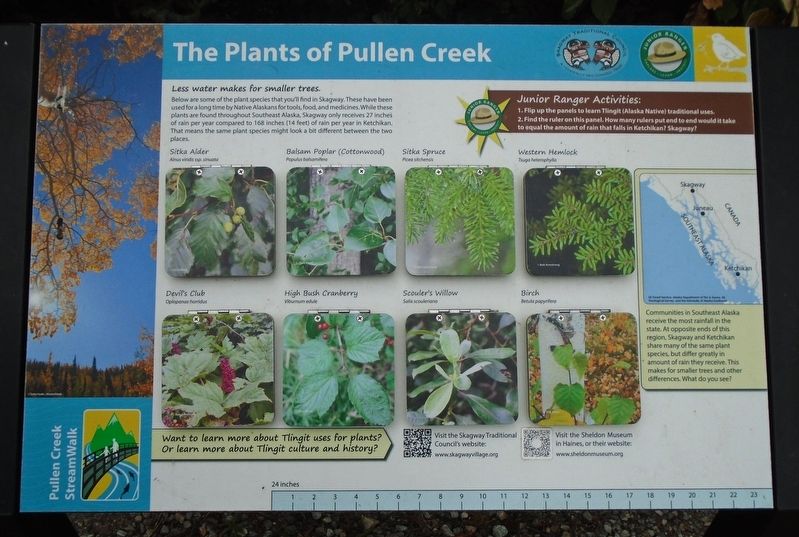
The Plants of Pullen Creek
Pullen Creek StreamWalk
Photographed by William Fischer, Jr., August 24, 2024
1. The Plants of Pullen Creek Marker
Less water makes for smaller trees.
Below are some of the plant species that you'll find in Skagway. These have been used for a long time by Native Alaskans for tools, food, and medicines. While these plants are found throughout Southeast Alaska, Skagway only receives 27 inches of rain per year compared to 168 inches (14 feet) of rain per year in Ketchikan That means the same plant species might look a bit different between the two places.
Junior Ranger Activities:
1. Flip up the panels to learn Tlingit (Alaska Native) traditional uses.
2. Find the ruler on this panel. How many rulers put end to end would it take to equal the amount of rain that falls in Ketchikan? Skagway?
Sitka Alder
Sitka alder is a very dense wood that was used to carve bowls and eating utensils because it wouldn't absorb flavors.
Balsam Poplar (Cottonwood)
Cottonwood grows tall quickly and was used to carve river canoes for travel and fishing. War canoes were carved from longer-lasting cedar (a common tree further south in Southeast Alaska).
Sitka Spruce
Sitka spruce is the Alaska state tree and is very important to Tlingit culture. Its
this page online
Western Hemlock
Western hemlock is a very heavy wood with a coarse grain. The bark was boiled with plants and urine to make dyes for spruce root baskets. The wood was used in fires to smoke fish.
Devil's Club
Devil's [C]lub is still used for many kinds of medicines. Its thorny stalks were also placed over Tlingit doors and windows for spiritual protection.
High Bush Cranberry
The berries from Highbush Cranberry were harvested and preserved in eulachon (a small, oily fish) oil for winter eating.
Scouter's Willow
The inner bark and leaves of a willow shrub have aspirin-like qualities and were used to treat pain and swelling. Its bud blooms are also a good source of vitamin c.
Birch
Birch is not a common tree in Southeast, Alaska, but you'll find it in Skagway because of its drier climate. It was used for creating artistic items like masks.
Communities in Southeast Alaska receive the most rainfall in the state. At opposite ends of this region, Skagway and Ketchikan share many of the same plant species, but differ

Photographed by William Fischer, Jr., August 24, 2024
2. The Plants of Pullen Creek Marker
Want to learn more about Tlingit uses for plants?
Or learn more about Tlingit culture and history?
Visit the Skagway Traditional Council's website: [https://www.skagwaytraditional.org/]
Visit the Sheldon Museum in Haines, or their website: www.sheldonmuseum.org
Erected by the Municipality of Skagway, Skagway Traditional Council and National Park Service.
Topics. This historical marker is listed in these topic lists: Environment • Indigenous Peoples and Communities • Settlements & Settlers.
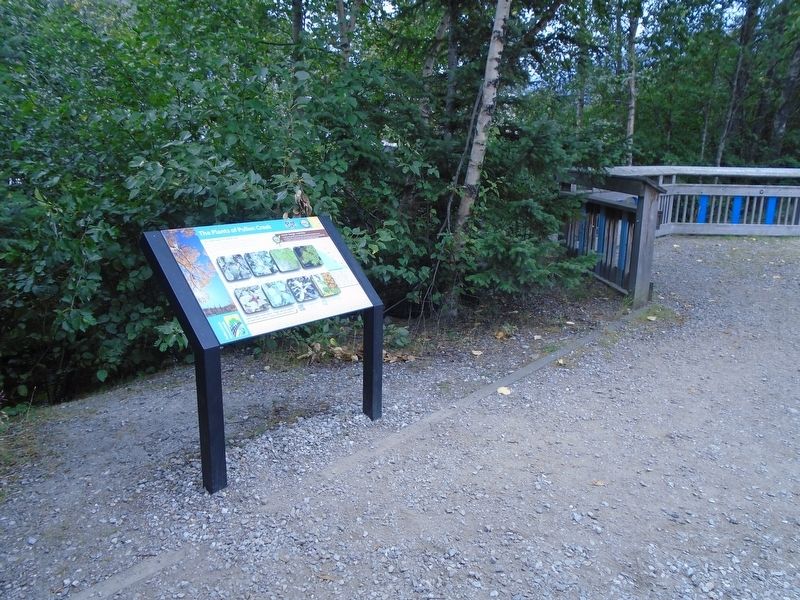
Location. 59° 27.133′ N, 135° 19.21′ W. Marker is in Skagway, Alaska, in Skagway Borough. It is in Dyea. It is on Broadway south of the railroad grade crossing, on the left when traveling south. Marker is in Shoreline Park, near the new comfort station. Touch for map. Marker is at or near this postal address: 100 Broadway, Skagway AK 99840, United States of America. Touch for directions.

Regionally, this marker is on the American Pacific Coast. Globally, it is in North
Photographed by William Fischer, Jr., August 24, 2024
3. The Plants of Pullen Creek Marker
Other nearby markers. At least 8 other markers are within walking distance of this marker: Néechxwúduyaa (a few steps from this marker); U.S. Army Invades Skagway (a few steps from this marker); The Road to Gold (a few steps from this marker); Ho, for the Klondike! (a few steps from this marker); Gateway to the Interior (a few steps from this marker); Nature Always Succeeds! (about 300 feet away, measured in a direct line); Three Thousand Pack Animals (about 300 feet away); Skagway Centennial Statue (about 400 feet away). Touch for a list and map of all markers in Skagway.
Credits. This page was last revised on October 1, 2024. It was originally submitted on October 1, 2024, by William Fischer, Jr. of Reynoldsburg, Ohio. This page has been viewed 163 times since then and 29 times this year. Photos: 1, 2, 3. submitted on October 1, 2024, by William Fischer, Jr. of Reynoldsburg, Ohio.
