Downtown Juneau in Juneau Borough, Alaska — Northwest (North America)
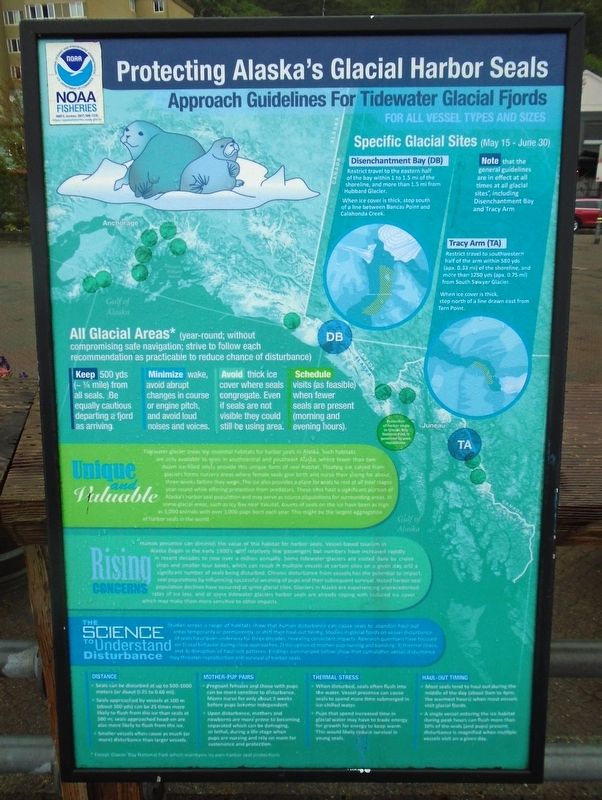
Protecting Alaska's Glacial Harbor Seals
Approach Guidelines For Tidewater Glacial Fjords
| — | For All Vessel Types and Sizes | — |
Photographed by William Fischer, Jr., August 25, 2024
1. Protecting Alaska's Glacial Harbor Seals Marker
[Approach Guidelines are informational and not transcribed]
Unique and Valuable
Tidewater glacier areas are essential habitats for harbor seals in Alaska. Such habitats are only available to seals in southcentral and southeast Alaska, where fewer than two dozen ice-filled inlets provide this unique form of seal habitat. Floating ice calved from glaciers forms nursery areas where female seals give birth and nurse their young for about three weeks before they wean. The ice also provides a place for seals to rest at all tidal stages year-round while offering protection from predators. These sites host a significant portion of Alaska's harbor seal population and may serve as source populations for surrounding areas. In some glacial areas, such as Icy Bay near Yakutat, counts of seals on the ice have been as high as 5,000 animals with over 1,000 pups born each year. This might be the largest aggregation of harbor seals in the world.
Rising Concerns
Human presence can diminish the value of this habitat for harbor seals. Vessel-based tourism in Alaska began in the early 1900's with relatively few passengers but numbers
this page online
The Science To Understand Disturbance
Studies across a range of habitats show that human disturbance can cause seals to abandon haul-out areas temporarily or permanently, or shift their haul-out timing. Studies in glacial fjords on vessel disturbance of seals have been underway for three decades, revealing consistent impacts. Research questions have focused on 1) seal behavior during close approaches, 2) disruption of mother pup nursing

Photographed by William Fischer, Jr., August 25, 2024
2. Protecting Alaska's Glacial Harbor Seals Marker
[Findings summary not transcribed]
Erected by NOAA Fisheries.
Topics and series. This historical marker is listed in these topic lists: Animals • Environment • Waterways & Vessels. In addition, it is included in the National Oceanic and Atmospheric Administration (NOAA) series list.
Location. 58° 17.918′ N, 134° 24.33′ W. Marker is in Juneau, Alaska, in Juneau Borough. It is in Downtown Juneau. It can be reached from Marine Way (Alaska Route 7) south of Ferry Way, on the right when traveling south. Marker is next to the Patsy Ann statue on the Juneau Harbor boardwalk, south of Marine Park. Touch for map. Marker is at or near this postal address: 254 Marine Way, Juneau AK 99801, United States of America. Touch for directions.

Regionally, this marker is in Southeast Alaska, in Tlingit and Haida & Tsimshian Region. It is also on the American Pacific Coast. Globally, it is in North America, in the Inside Passage, on the Pacific Rim, in the Western Hemisphere, in the Western World, and in the Anglosphere. Historically, it finds itself in what was once the Russian Empire.
Other nearby markers. At least 8 other markers are within walking distance of this marker: Patsy Ann: her history (here, next to this marker); Patsy Ann: her statue (here, next to this marker); Lighthouses of Alaska (here, next to this marker); Cape Decision (a few steps from this marker); Sentinel Island (a few steps from this marker); Five Finger (a few steps from this marker); Mary Island (a few steps from this marker); Tree Point (a few steps from this marker). Touch for a list and map of all markers in Juneau.
Regarding Protecting Alaska's Glacial Harbor Seals. Although largely informational, the marker highlights the historic changes that increased cruise tourism has had on harbor seals in southeast Alaska.
Credits. This page was last revised on October 29, 2025. It was originally submitted on October 3, 2024, by William Fischer, Jr. of Reynoldsburg, Ohio. This page has been viewed 144 times since then and 18 times this year. Photos: 1, 2. submitted on October 3, 2024, by William Fischer, Jr. of Reynoldsburg, Ohio.
