Hidenwood in Newport News, Virginia — The American South (Mid-Atlantic)
Blunt Poynt
Photographed by Jacob Satterfield, October 7, 2024
1. Blunt Poynt Marker
Inscription.
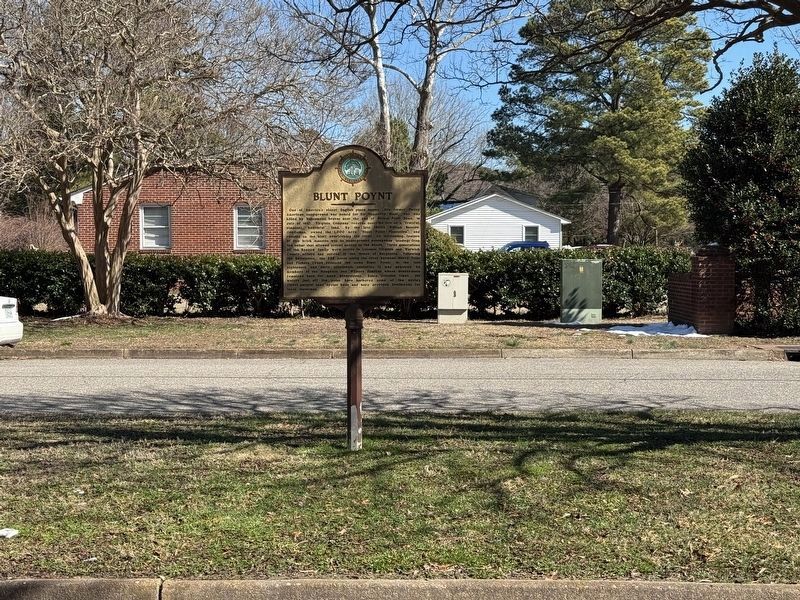
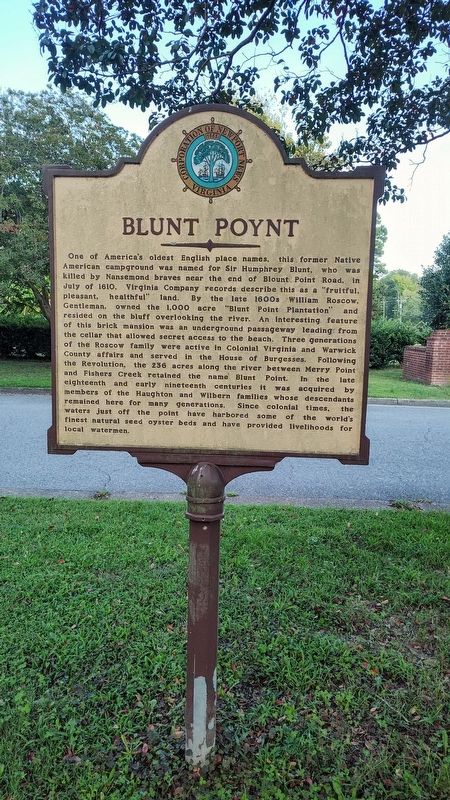
Blunt Poynt. . One of America's oldest English place names, this former Native American campground was named for Sir Humphrey Blunt, who was killed by Nansemond braves near the end of Blount Point Road, in July of 1610. Virginia Company records describe this as a "fruitful, pleasant, healthful" land. By the late 1600s William Roscow, Gentleman, owned the 1,000 acre "Blunt Point Plantation" and resided on the bluff overlooking the river. An interesting feature of this brick mansion was an underground passageway leading from the cellar that allowed secret access to the beach. Three generations of the Roscow family were active in Colonial Virginia and Warwick County affairs and served in the House of Burgesses. Following the Revolution, the 236 acres along the river between Merry Point and Fishers Creek retained the name Blunt Point. In the late eighteenth and early nineteenth centuries it was acquired by members of the Haughton and Wilbern families whose descendants remained here for many generations. Since colonial times, the waters just off the the point have harbored some of the world's finest natural seed oyster beds and have provided livelihoods for local watermen.
One of America's oldest English place names, this former Native American campground was named for Sir Humphrey Blunt, who was killed by Nansemond braves near the end of Blount Point Road, in July of 1610. Virginia Company records describe this as a "fruitful, pleasant, healthful" land. By the late 1600s William Roscow, Gentleman, owned the 1,000 acre "Blunt Point Plantation" and resided on the bluff overlooking the river. An interesting feature of this brick mansion was an underground passageway leading from the cellar that allowed secret access to the beach. Three generations of the Roscow family were active in Colonial Virginia and Warwick County affairs and served in the House of Burgesses. Following the Revolution, the 236 acres along the river between Merry Point and Fishers Creek retained the name Blunt Point. In the late eighteenth and early nineteenth centuries it was acquired by members of the Haughton and Wilbern families whose descendants remained here for many generations. Since colonial times, the waters just off the the point have harbored some of the world's finest natural seed oyster beds and have provided livelihoods for local watermen.
Erected 2019 by City of Newport News.
Topics. This historical marker is listed in these topic lists: Colonial Era
Location. 37° 3.847′ N, 76° 31.165′ W. Marker is in Newport News, Virginia. It is in Hidenwood. It is at the intersection of Beverly Hills Drive and Blount Point Road, in the median on Beverly Hills Drive. Touch for map. Marker is in this post office area: Newport News VA 23606, United States of America. Touch for directions.

Regionally, this marker is on Virginia’s Peninsula, in Hampton Roads, in Coastal Virginia, and in the Hampton Roads Metropolitan Area. It is also in the American South, specifically in the Upper South, and in the Tidewater. Globally, it is in the North Atlantic Region, North America, the Western Hemisphere, the Western World, and the Anglosphere. Historically, it finds itself in what was once the territory of the Mississippian Culture, one of the original Thirteen Colonies, one of the Confederate States of America, and the Antebellum South.
Another marker is no longer nearby. Hidenwood (was approx. 1.4 miles away but has been permanently removed).
Also see . . . Blunt Poynt. Wikipedia (Submitted on October 8, 2024.)
Photographed by Will Hrachovina, February 23, 2025
2. Blunt Poynt Marker
Credits. This page was last revised on February 24, 2025. It was originally submitted on October 8, 2024, by Jacob Satterfield of Newport News, Virginia. This page has been viewed 892 times since then and 94 times this year. Photos:1. submitted on October 8, 2024, by Jacob Satterfield of Newport News, Virginia. 2. submitted on February 23, 2025, by Will Hrachovina of Newport News, Virginia. • Bernard Fisher was the editor who published this page.