Little Village in Chicago in Cook County, Illinois — The American Midwest (Great Lakes)
Little Village Arch
Adrián Lozano, Architect; 1990
| — | Chicago Landmark | — |
Photographed by Sean P. Flynn, October 10, 2024
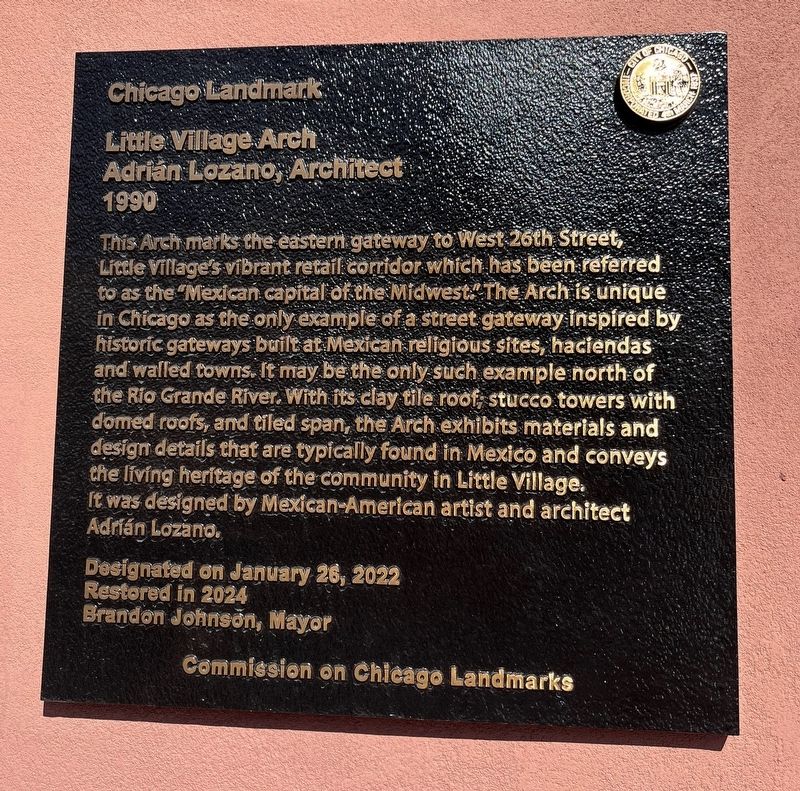
1. Little Village Arch Marker
This Arch marks the eastern gateway to West 26th Street, Little Village's vibrant retail corridor which has been referred to as the "Mexican capital of the Midwest." The Arch is unique in Chicago as the only example of a street gateway inspired by historic gateways built at Mexican religious sites, haciendas and walled towns. It may be the only such example north of the Rio Grande River. With its clay tile roof, stucco towers with domed roofs, and tiled span, the Arch exhibits materials and design details that are typically found in Mexico and conveys the living heritage of the community in Little Village. It was designed by Mexican-American artist and architect Adrián Lozano.
Designated on January 26, 2022
Restored in 2024
Brandon Johnson, Mayor
Erected 2024 by Commission on Chicago Landmarks; City of Chicago.
Topics and series. This historical marker is listed in these topic lists: Architecture • Hispanic Americans • Immigration • Religion & Religious Structures. In addition, it is included in the Illinois, Chicago Landmarks Commission series list. A significant historical year for this entry is 1990.
Location. 41° 50.676′ N,
this page online

Regionally, this marker is on Chicago’s West Side. It is also in the American Midwest. Globally, it is in North America, on the Great Lakes, in the Western Hemisphere, in the Western World, and in the Anglosphere. Historically, it finds itself in what was once the Viceroyalty of New France, the territory of the Mississippian Culture, and the Northwest Territory.
Other nearby markers. At least 8 other markers are within 2 miles of this marker, measured as the crow flies: Carlos Salinas de Gortari (a few steps from this marker); La Villita Natural Area (approx. half a mile away); Route 66 Landmark / Punto de Referencia de la Ruta 66 (approx. one mile away); a different marker also named Route 66 Landmark / Punto de Referencia de la Ruta 66
Photographed by Sean P. Flynn, October 10, 2024
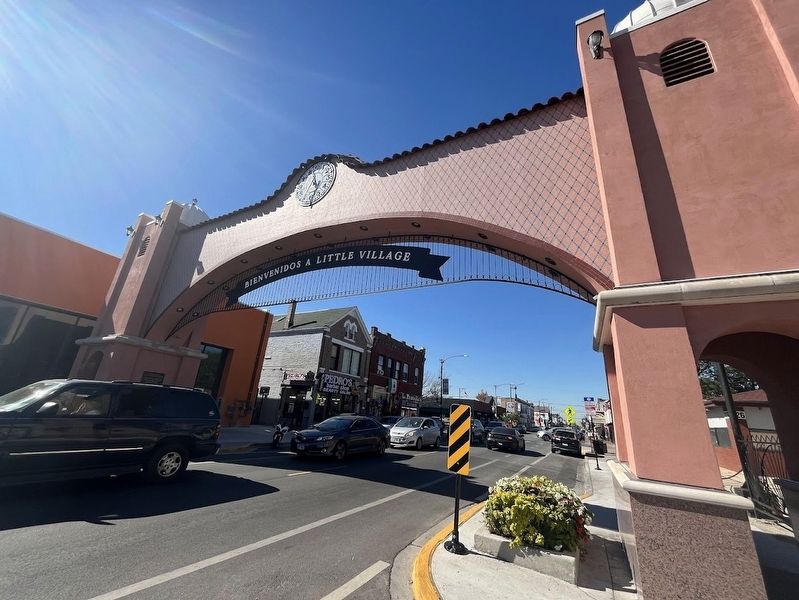
2. Little Village Arch
The Chicago Landmark plaque is partially obscured by a car on the left side of this northeast-facing photo.
More about this marker. The restored arch was re-dedicated on Sept. 11, 2024, in a ceremony that included Mayor Brandon Johnson and other dignitaries. While Johnson's name is on the plaque, the arch's designation as a Chicago Landmark occurred in early 2022, during the administration of Johnson's predecessor, Lori Lightfoot, and her name is on official documents related to the arch's landmark designation.
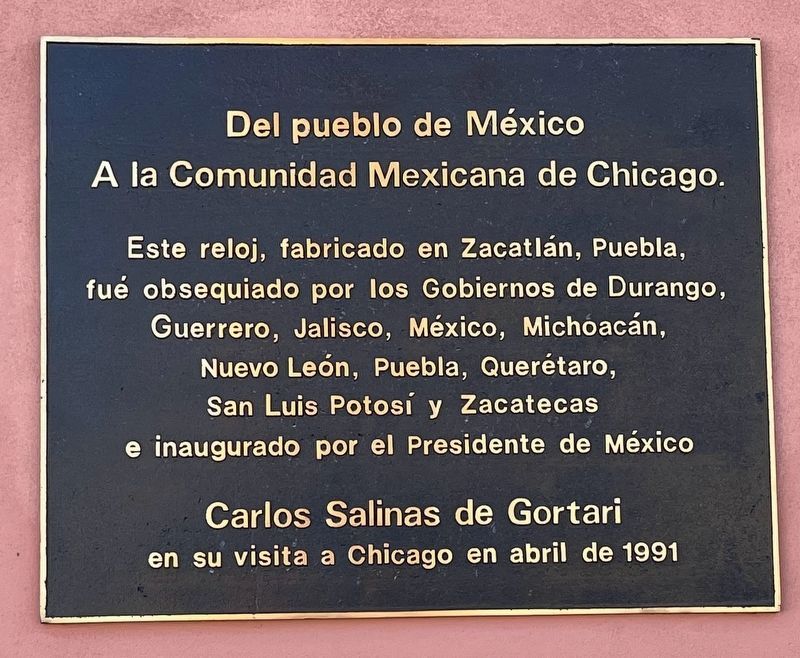
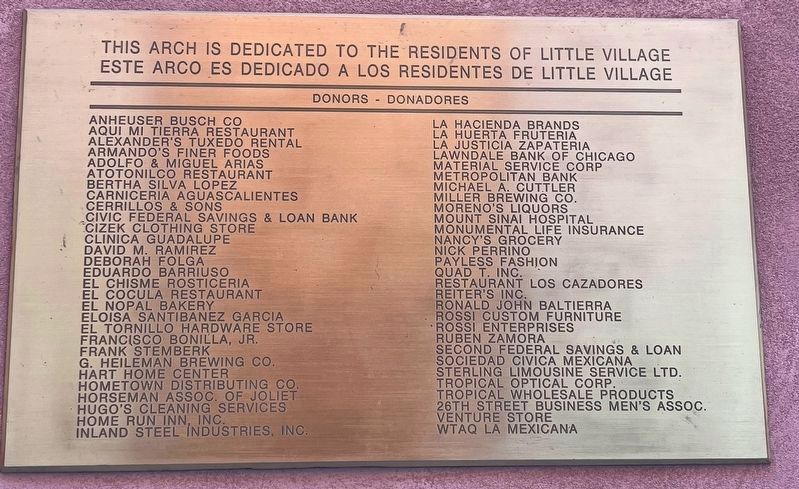
In addition to this Chicago Landmark plaque on the arch's north side, the south side of the arch includes two plaques. One facing the street commemorates Mexican President Carlos Salinas de Gortari's visit to the city in 1991 and Mexico's donation of the clock atop the arch. An outward-facing plaque dedicates the arch to the residents of Little Village and includes a list of donors.
Regarding Little Village Arch. The arch is one of the youngest (if
Photographed by Sean P. Flynn, October 10, 2024
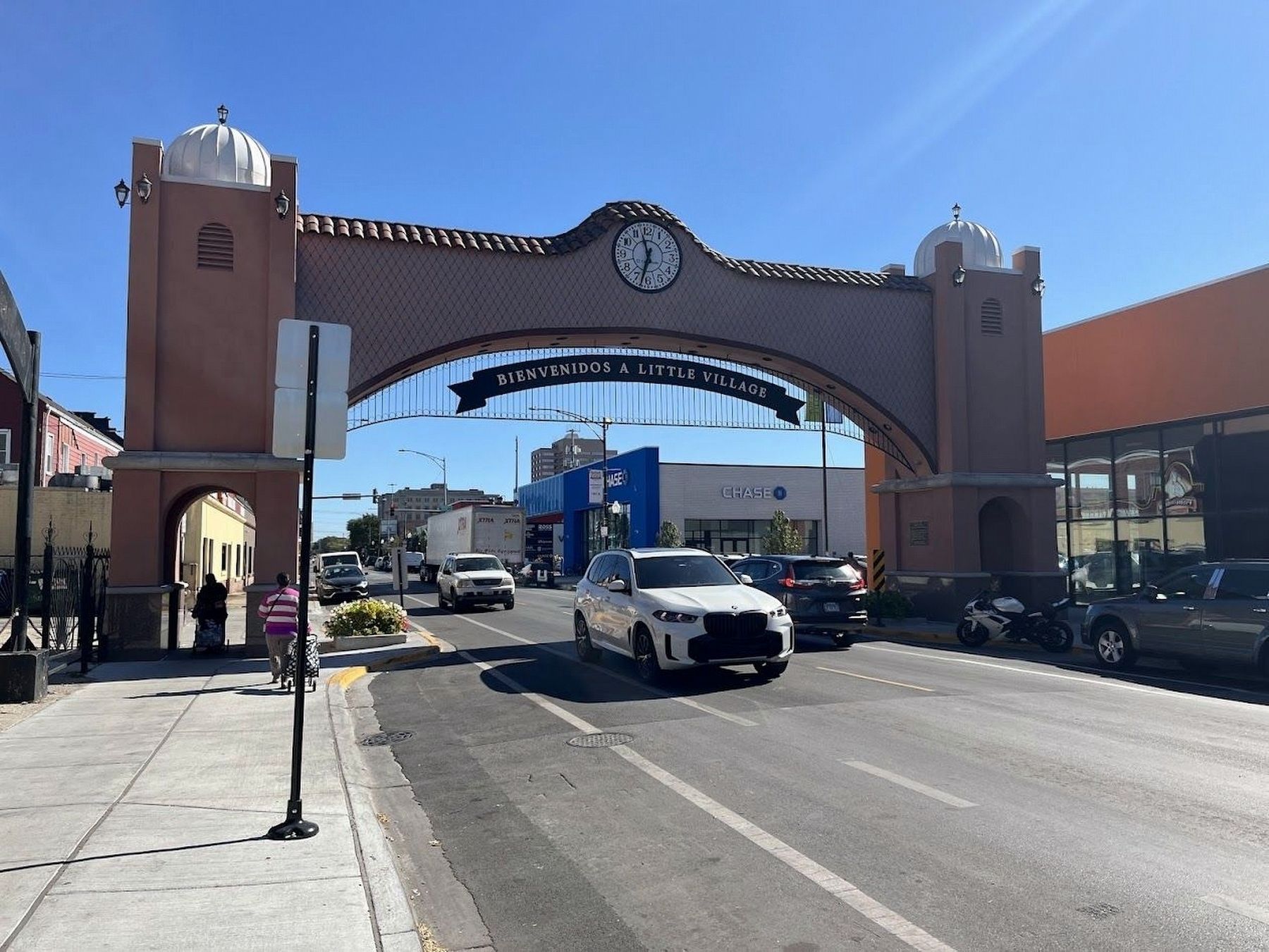
3. Little Village Arch
26th Street runs east in this photograph.
The area that is today known as Little Village was annexed into the city in 1869, and was originally known as South Lawndale. After the Great Chicago Fire, South Lawndale became an enclave for Bohemians, Germans and other Eastern European immigrants, many moving west from a rapidly growing city. At its height in the post-World War II era, this neighborhood was known as "Czech California," referring
Photographed by Sean P. Flynn, October 10, 2024
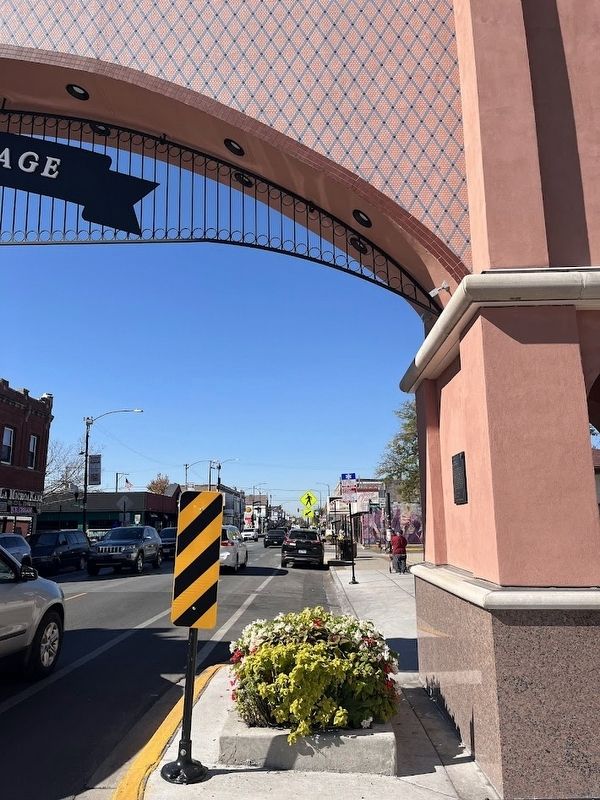
4. Little Village Arch Marker
A west-facing view of the marker
The neighborhood was renamed in 1965 to Little Village. Inspired by the name of a local restaurant and an attempted reflection of the myriad Eastern Europeans who lived here, the name change was an attempt to dissociate the neighborhood from nearby North Lawndale, which had faced economic decline and also had become majority Black. Nevertheless, many of those Eastern European residents moved out of the city over the 1960s and 1970s to suburbs like Cicero and Berwyn. Meanwhile, the growth of the University of Illinois at Chicago near Pilsen forced out some of the area’s Mexican families, and Little Village fast became a Mexican enclave. The neighborhood went from 4% Hispanic in 1970 to 40% in 1980 and 85% in 1990. As of 2020, the neighborhood remains more than 80% Hispanic.
Also see . . .
1. Iconic Little Village Arch Unveiled After Extensive Renovation. From Block Club Chicago
Excerpt: "The arch, serving as a gateway to the neighborhood, was designed by architect Adrian Lozano, who also contributed to the National Museum of Mexican Art and Benito Juarez Community(Submitted on October 10, 2024, by Sean P. Flynn of Oak Park, Illinois.)Academy. Lozano was born in Aguascalientes, Mexico, and moved to Chicago as a child.Photographed by Sean P. Flynn, October 10, 20245. Plaque related to Mexican president's visit in 1991 and the donation of the clock atop the arch
"Former Mexican President Carlos Salinas de Gortari visited Chicago in 1991 and spoke at a rally of about 2,000 Little Village residents. The president donated a bronze clock from clock manufacturer Relojes Centenario in Mexico that was installed on the arch."
2. Encyclopedia of Chicago: South Lawndale. From the Chicago Historical Society, a look at the history of the South Lawndale neighborhood, which today is known as Little Village. (Submitted on October 10, 2024, by Sean P. Flynn of Oak Park, Illinois.)
3. This week in history: Architect Adrian Lozano goes underground. From the Chicago Sun-Times website (free signup may be required), a look back at a 1970 interview with Adrian Lozano, who designed the Little Village Arch. (Submitted on October 10, 2024, by Sean P. Flynn of Oak Park, Illinois.)
Photographed by Sean P. Flynn, October 10, 2024
6. Little Village Arch donor plaque
Credits. This page was last revised on December 2, 2025. It was originally submitted on October 10, 2024, by Sean P. Flynn of Oak Park, Illinois. This page has been viewed 537 times since then and 144 times this year. Photos: 1, 2, 3, 4, 5, 6. submitted on October 10, 2024, by Sean P. Flynn of Oak Park, Illinois.
