Near Salisbury in Wicomico County, Maryland — The American Northeast (Mid-Atlantic)
Pemberton Hall
1741
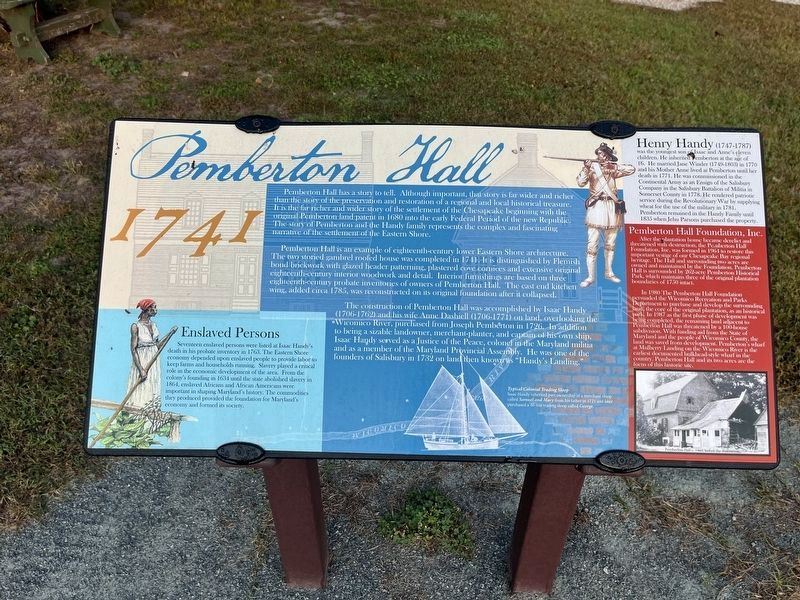
Pemberton Hall has a story to tell. Although important, that story is far wider and richer than the story of the preservation and restoration of a regional and local historical treasure. It is the far richer and wider story of the settlement of the Chesapeake beginning with the original Pemberton land patent in 1680 into the early Federal Period of the new Republic. The story of Pemberton and the Handy family represents the complex and fascinating narrative of the settlement of the Eastern Shore.
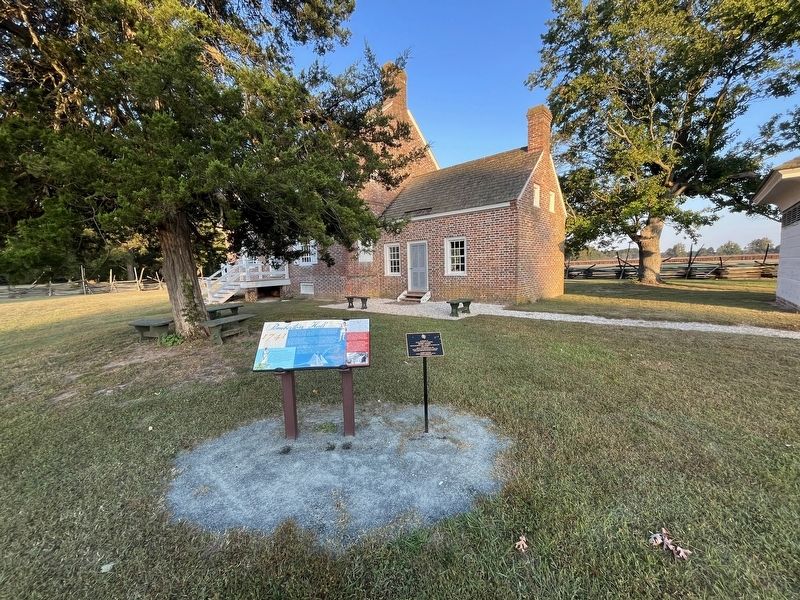
Pemberton Hall is an example of eighteenth-century lower Eastern Shore architecture. The two storied gambrel roofed house was completed in 1741. It is distinguished by Flemish bond brickwork with glazed header patterning, plastered cove cornices and extensive original eighteenth-century interior woodwork and detail. Interior furnishings are based on three eighteenth-century probate inventories of owners of Pemberton Hall. The east end kitchen wing, added circa 1785, was reconstructed on its original foundation after it collapsed.
The construction of Pemberton Hall was accomplished by Isaac Handy (1706-1762) and his wife
this page online
Enslaved Persons
Seventeen enslaved persons were listed at Isaac Handy's death in his probate inventory in 1763. The Eastern Shore economy depended upon enslaved people to provide labor to keep farms and households running. Slavery played a critical role in the economic development in the area. From the colony's founding in 1634 until the state abolished slavery in 1864, enslaved Africans and African Americans were important in shaping Maryland's history. The commodities they produced provided the foundation for Maryland's economy and formed its society.
Henry Handy (1747-1787) was the youngest son of Isaac and Anne's eleven children. He inherited Pemberton at the age of 16. He married Jane Winder (1749-1803) in 1770
Pemberton Hall Foundation, Inc.
After the plantation house became derelict and threatened with destruction, the Pemberton Hall Foundation, Inc. was formed in 1964 to restore this important vestige of our Chesapeake Bay regional heritage. The Hall and surrounding two acres are owned and maintained by the Foundation. Pemberton Hall is surrounded by 262-acre Pemberton Historical Park, which maintains three of the original plantation boundaries of 1750 intact.
In 1980 The Pemberton Hall Foundation persuaded the Wicomico Recreation and Parks Department to purchase and develop the surrounding land, the core of the original plantation, as an historical park. In 1987 as the first phase of development was being completed, the remaining land adjacent to Pemberton Hall was threatened by a 100-house subdivision. With funding aid from the State of Maryland and the people of Wicomico County, the land was saved from development. Pemberton's wharf at Mulberry Landing on the Wicomico River is the earliest documented bulkhead-style wharf in the country. Pemberton Hall and its two acres are the focus of this historic site.
Erected by The Pemberton Hall Foundation.
Topics. This historical marker is listed in these topic lists: Agriculture • Architecture • Colonial Era • War, US Revolutionary. A significant historical year for this entry is 1680.
Location. 38° 20.86′ N, 75° 38.661′ W. Marker is near Salisbury, Maryland, in Wicomico County. It is on Plantation Lane 0.4 miles south of Pemberton Drive, on the left when traveling east. Touch for map. Marker is at or near this postal address: 5595 Plantation Ln, Salisbury MD 21801, United States of America. Touch for directions.

Regionally, this marker is on the Eastern Shore. It is also in the American Mid-Atlantic, on the Delmarva Peninsula, in the Tidewater, and on the Eastern Seaboard. Globally, it is in the North Atlantic Region, North America, the Western Hemisphere, the Western World, and the Anglosphere. Historically, it finds itself in what was once one of the original Thirteen Colonies and also the Antebellum South.
Other nearby markers. At least 8 other markers are within walking distance of this marker: Henry Handy (here, next to this marker); A Show of Wealth (within shouting distance of this marker); The "Peculiar Institution" at Pemberton Plantation (within shouting distance of this marker); Welcome to Pemberton Historical Park (about 400 feet away, measured in a direct line); A Drop to Drink (about 400 feet away); Plantation Barnyard (about 400 feet away); Nature's Pasture (about 500 feet away); An Apple a Day (about 500 feet away). Touch for a list and map of all markers in Salisbury.
Another marker is no longer nearby. Pemberton Hall (was a few steps from this marker but has been replaced with another marker now near it).
Related marker. Click here for another marker that is related to this marker. This marker has replaced the linked marker.
Credits. This page was last revised on October 12, 2024. It was originally submitted on October 12, 2024, by Devry Becker Jones of Washington, District of Columbia. This page has been viewed 524 times since then and 40 times this year. Photos: 1, 2. submitted on October 12, 2024, by Devry Becker Jones of Washington, District of Columbia.
