New Edinburgh in Ottawa, Ontario — Central Canada (North America)
The International Peace Garden/Le Jardin International de la Paix
Photographed by William Fischer, Jr., October 12, 2024
1. The International Peace Garden/Le Jardin International de la Paix Marker

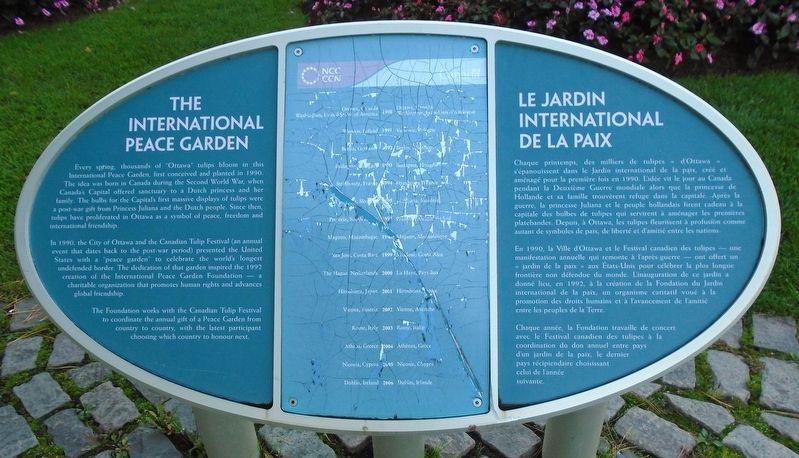
THE INTERNATIONAL PEACE GARDEN
Every spring, thousands of "Ottawa" tulips bloom in this International Peace Garden, first conceived and planted in 1990. The idea was born in Canada during the Second World War, when Canada's Capital offered sanctuary to a Dutch princess and her family. The bulbs for the Capital's first massive displays of tulips were a post-war gift from Princess Juliana and the Dutch people. Since then, tulips have proliferated in Ottawa as a symbol of peace, freedom and international friendship.
In 1990, the City of Ottawa and the Canadian Tulip Festival (an annual event that dates back to the post-war period) presented the United States with a "peace garden" to celebrate the world's longest undefended border. The dedication of that garden inspired the 1992 creation of the International Peace Garden Foundation charitable organization that promotes human rights and advances global friendship.
The Foundation works with the Canadian Tulip Festival to coordinate the annual gift of a Peace Garden from country to country, with the latest participant choosing which country to honour next.
Chaque
this page online
En 1990, la Ville d'Ottawa et le Festival canadien des tulipes — une manifestation annuelle qui remonte à l'après-guerre — ont offert un « jardin de la paix » aux États-Unis pour célébrer la plus longue frontière non défendue du monde. L'inauguration de ce jardin a donné lieu, en 1992, à la création de la Fondation du Jardin international de la paix, un organisme caritatif voué à la promotion des droits humains et à l'avancement de l'amitié entre les peuples de la Terre.
Chaque année, la Fondation travaille de concert avec le Festival canadien des

Photographed by William Fischer, Jr., October 12, 2024
2. The International Peace Garden/Le Jardin International de la Paix and Marker
1990 • Ottawa, Canada [&] Washington, United States of America/États-Unis d'Amérique
Warsaw, Poland • 1991 • Varsovie, Pologne
Berlin, Germany • 1992 • Berlin, Allemagne
Budapest, Hungary • 1993 • Budapest, Hongrie
Strasbourg, France • 1994 • Strasbourg, France
Ljubljana, Slovenia • 1995 • Ljubljana, Slovénie
Pretoria, South Africa • 1996 • Pretoria, Afrique du Sud
Maputo, Mozambique • 1998 • Maputo, Mozambique
San José, Costa Rica • 1999 • San José, Costa Rica
The Hague, Netherlands • 2000 • La Haye, Pays-Bas
Hiroshima, Japan • 2001 • Hiroshima, Japon
Vienna, Austria • 2002 • Vienne, Autriche
Rome, Italy • 2003 • Rome, Italie
Athens, Greece • 2004 • Athènes, Grèce
Nicosia, Cyprus • 2005 • Nicosie, Chypre
Dublin, Ireland • 2006 • Dublin, Irlande
Erected 2006 by National Capital Commission/Commission de la Capitale nationale.
Topics. This historical marker is listed in these topic lists: Horticulture & Forestry
Photographed by William Fischer, Jr., October 12, 2024
3. The International Peace Garden/Le Jardin International de la Paix
Location. 45° 26.518′ N, 75° 41.722′ W. Marker is in Ottawa, Ontario. It is in New Edinburgh. It is at the intersection of Sussex Drive (County Highway 93) and Stanley Avenue, on the left when traveling north on Sussex Drive. Marker and garden are in Rideau Falls Park. Touch for map. Marker is at or near this postal address: 1 Sussex Drive, Ottawa ON K1M 2K1, Canada. Touch for directions.

Regionally, this marker is in Eastern Ontario. It is also in Central Canada. Globally, it is in North America, the Western Hemisphere, the Western World, and the Anglosphere. Historically, it finds itself in what was once a British colony, the Viceroyalty of New France, the Haudenosaunee (Iroquois) Confederacy, and Rupert’s Land.
Other nearby markers. At least 8 other markers are within walking distance of this marker: Iznik Tiles/Céramique d'Iznik (a few steps from this marker); Reflection/Réflexion (within shouting distance of this marker); Canada's Discovery Route/La voie de la découverte du Canada (within shouting distance of this marker); Ten Years of Democracy in South Africa (about 90 meters away, measured in a direct line); CANLOAN Memorial (about 120 meters away); Mackenzie-Papineau Battalion/Le bataillon Mackenzie-Papineau (about 120 meters away); Spain Remembers/L'Espagne se souvient/España no os olvida (about 120 meters away); WWII British Commonwealth/Empire Air Forces Honored Dead in Canada and the United States of America (about 120 meters away). Touch for a list and map of all markers in Ottawa.
Also see . . . International Peace Gardens. (Submitted on October 14, 2024, by William Fischer, Jr. of Reynoldsburg, Ohio.)
Credits. This page was last revised on October 14, 2024. It was originally submitted on October 14, 2024, by William Fischer, Jr. of Reynoldsburg, Ohio. This page has been viewed 157 times since then and 17 times this year. Photos: 1, 2, 3. submitted on October 14, 2024, by William Fischer, Jr. of Reynoldsburg, Ohio.
