Boyle Park in Little Rock in Pulaski County, Arkansas — The American South (West South Central)
Lynching in America
⎯⎯⎯
Lynching in Little Rock
Community Remembrance Project
Photographed by Duane and Tracy Marsteller, November 5, 2022
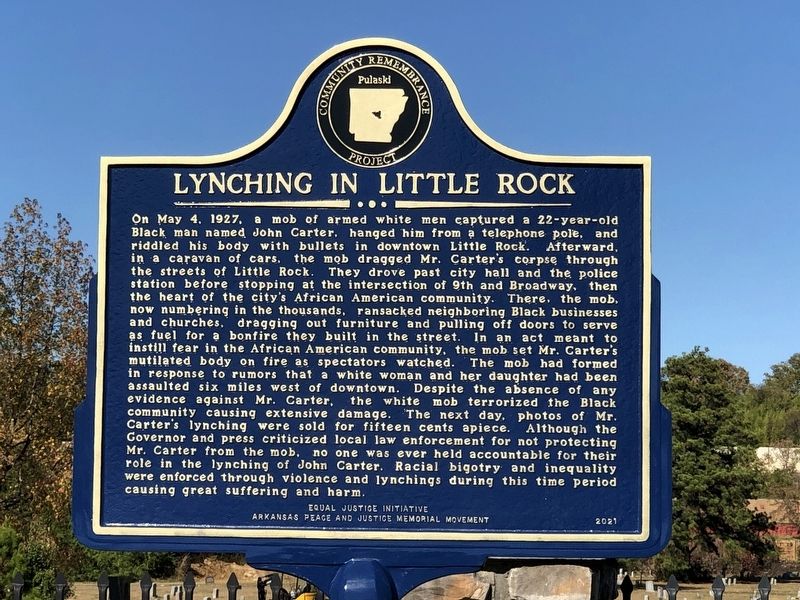
1. Lynching in Little Rock Marker
Lynching in America. Racial terror lynching between 1877 and 1950 claimed the lives of thousands of African Americans and created a legacy of injustice that can still be felt today. Following the Civil War and the premature end of Reconstruction. white Southerners sought to uphold an ideology of white supremacy and used intimidation and fatal violence to re-enforce racial subordination and segregation. Lynching emerged as the most public and notorious form of racial terrorism. and state and federal officials largely tolerated these lawless killings of Black women. men. and children by not holding white mobs accountable for their crimes. Many African Americans were lynched for resisting economic exploitation. violating perceived social customs, engaging in interracial relationships. or being accused of crimes, even when there was no evidence tying the accused to any offense. Almost 25 percent of documented lynchings were sparked by charges of sexual assault, at a time when Black men were considered dangerous threats to white womanhood. White people's allegations against Black people were rarely subject to scrutiny and
this page online
Lynching in Little Rock. On May 4, 1927, a mob of armed white men captured a 22-year-old Black man named John Carter, hanged him from a telephone pole, and riddled his body with bullets in downtown Little Rock. Afterward, in a caravan of cars. the mob dragged Mr. Carter's corpse through the streets of Little Rock. They drove past city hall and the police station before stopping at the intersection of 9th and Broadway, then the heart of the city's African American community. There, the mob, now numbering in the thousands, ransacked neighboring Black businesses and churches, dragging out furniture and pulling off doors to serve as fuel for a bonfire they built in the street. In an act meant to instill fear in the African American community, the mob set Mr. Carter's mutilated body on fire as spectators watched. The mob had formed in response to rumors that a white woman and her daughter
Photographed by Duane and Tracy Marsteller, November 5, 2022
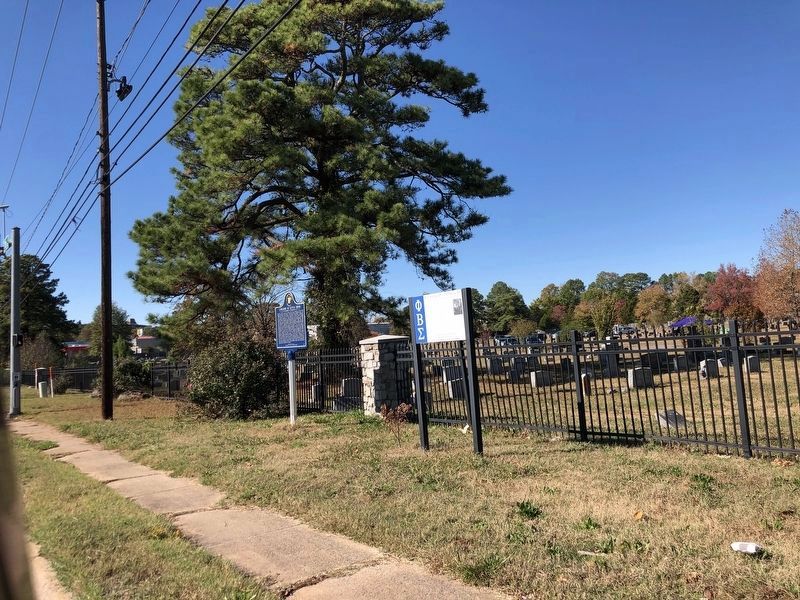
2. Lynching in Little Rock Marker
Featured marker (left) is in front of Haven of Rest Cemetery, near the site where Carter was first hanged and where some believe his remains were buried.
Erected 2021 by Equal Justice Initiative • Arkansas Peace and Justice Memorial Movement.
Topics and series. This historical marker is listed in these topic lists: African Americans • Civil Rights • Law Enforcement. In addition, it is included in the Lynching in America series list. A significant historical date for this entry is May 4, 1927.
Location. 34° 44.514′ N, 92° 21.179′ W. Marker is in Little Rock, Arkansas, in Pulaski County. It is in Boyle Park. It is at the intersection of West 12th Street and Westpark Drive, on the right when traveling west on West
Photographed by Brandon D Cross
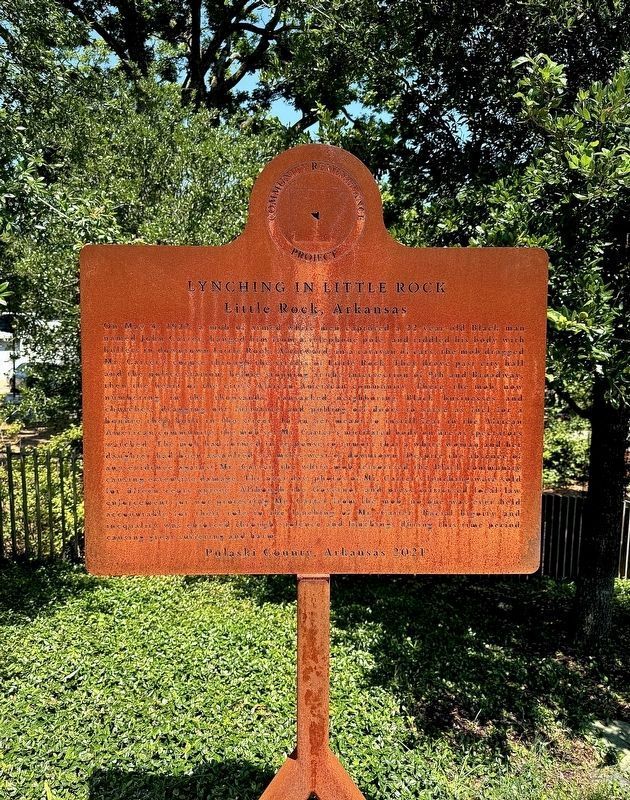
3. Lynching in Little Rock Replica
A replica marker of one side of this marker is located at the Equal Justice Initiatives' National Memorial for Peace and Justice in Montgomery, Alabama. The Equal Justice Initiative supports efforts to locally memorialize documented victims of racial violence and to educate communities about the history of racial injustice.

Regionally, this marker is in the Quapaw Homeland. It is also in the American South and specifically in the Upper South. Globally, it is in North America, the Western Hemisphere, the Western World, and the Anglosphere. Historically, it finds itself in what was once the territory of the Mississippian Culture, the Louisiana Purchase, one of the Confederate States of America, and the Antebellum South.
Other nearby markers. At least 8 other markers are within 3 miles of this marker, measured as the crow flies: Bro. Samuel Proctor Massie Sr. (here, next to this marker); Buhler House (approx. 1.1 miles away); War Memorial Golf Course (approx. 1.2 miles away); A Wild Look Back (approx. 1.3 miles away); Over the Jumps (approx. 1.3 miles away); Wild Boar (approx. 1.3 miles away); Memorial Stadium (approx. 1½ miles away); The Heights • A History (approx. 2.1 miles away). Touch for a list and map of all markers in Little Rock.
Also see . . . John Carter (Lynching of). Carter’s lynching and the rioting that followed is one of the most notorious incidents of racial violence in the state’s history. This event reveals much about the history of race relations in Little Rock, as well as the state’s struggle with its national image. (Brian D. Greer and Stephanie Harp, Encyclopedia of Arkansas) (Submitted on November 25, 2022, by Duane and Tracy Marsteller of Murfreesboro, Tennessee.)
Credits. This page was last revised on October 28, 2024. It was originally submitted on November 25, 2022, by Duane and Tracy Marsteller of Murfreesboro, Tennessee. This page has been viewed 881 times since then and 73 times this year. Last updated on October 15, 2024, by Brandon D Cross of Flagler Beach, Florida. Photos: 1, 2. submitted on November 25, 2022, by Duane and Tracy Marsteller of Murfreesboro, Tennessee. 3. submitted on October 14, 2024, by Brandon D Cross of Flagler Beach, Florida. • Devry Becker Jones was the editor who published this page.
Editor’s want-list for this marker. Photo of "Lynching in America" side of marker. • Can you help?
