Near Eastport in Washington County, Maine — The American Northeast (New England)
USS Wabash
⎯⎯⎯
USS Franklin
Photographed by Steve Stoessel, September 30, 2024
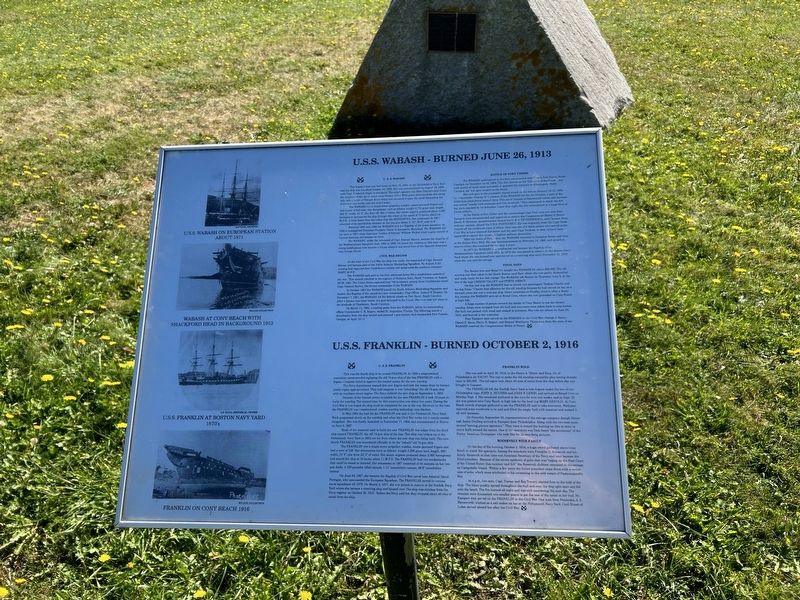
1. USS Wabash / USS Franklin Marker
The Wabash was a single screw propeller, wooden. steam-powered frigate and had a crew of 642 men. Her dimensions were as follows: weight 4,774 gross tons; length, 262' 6"; width, 51' 4"; she drew 23' feet of water. Her steam engines produced about 1,038 horsepower and moved the ship through the water at the speed of 11 knots, about 14 mph., a little faster than her sister ship the Minnesota. Her armament in 1861 consisted of 44 smoothbore cannons on her two run decker 2 10”, 28 09” and 14 8”.
Between 1856 and 1358 the Wabash was the flagship of the home squadron. In 1856 it transported President Franklin Pierce
this page online
The Wabash, under the command of Capt. Samuel Barron, became the flagship of the Mediterranean Squadron from 1858 to 1859. On board the warship at this time was a young midshipman who became a future admiral and naval hero of the Spanish-American war, George Dewey,
Civil War Begins
At the start of the Civil War the ship was under the command of Capt. Samuel Mercer and became part of the North Atlantic Blockading Squadron. By August 3 the warship had captured four Confederate vessels and recaptured the northern schooner Mary Alice.
The Wabash took part in the first combined Army-Navy amphibious assault of the war. This assault resulted in the capture of Hatteras Inlet, North Carolina , on August 28-29, 1861. The Union forces captured over 700 prisoners, among them Confederate naval Capt. Samuel Barron, the former commander of the Wabash.
In October 1861 the Wabash joined the South Atlantic Blockading Squadron and became the flagship of the squadron's new commander,
Photographed by Steve Stoessel, September 30, 2024
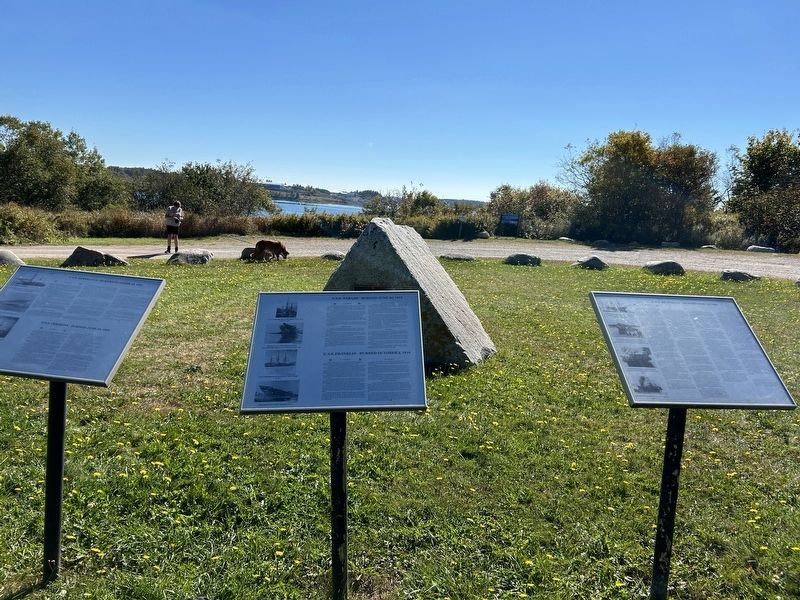
2. USS Wabash / USS Franklin Marker
On March 11, 1862, a landing party from the Wabash, led by its commanding officer Commander C. R. Rogers, raided St. Augustine, Florida. The following month a detachment from the ship landed and manned a gun battery that bombarded Fort Pulaski, Georgia, on April 10-11.
The Wabash participated in the first unsuccessful attack upon Fort Fisher, North Carolina, on December 24-25, 1864. This fort, known as the ”Gibraltar” of the South” was built mostly of beach sand and earth. It guarded the entrance to Wilmington, North Carolina, the last open seaport in the South.
She took part in the successful second attack on the fort on January 13-15, 1865. Lt. Commander Charles H. Cushman of the Wabash led the 1st. Division, a part of the 2.000-man amphibious assault force. This naval brigade of determined sailors and marines was armed “mostly with cutlass and Colt revolers.” They attempted
Photographed by Steve Stoessel, October 2, 2024
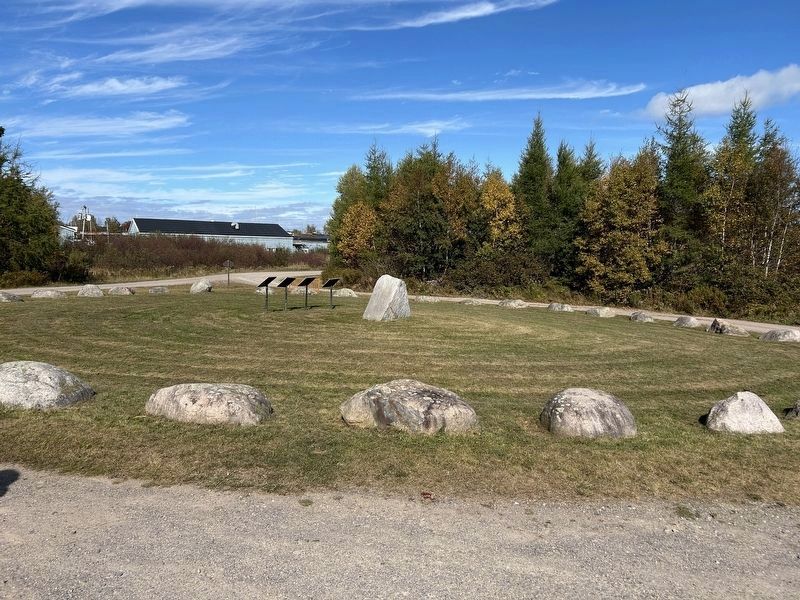
3. Civil War Ships Burned Markers
At the Battle of Fort Fisher and the surrounding Cape Fear area two men from Eastport were recommended and approved to receive the Congressional Medal of Honor: Edwin R. Bowmanr aboard the U.S. S. Ticonderoga, and Clement Dees, ordinary seamen, aboard the U.S.S. Pontoosuc. He was originally from the Cape Verde Islands off the northwest coast of Africa. Dees was one of 8 black sailors who served in the Civil War to have received this honor and the only Cape Verdean, to date, to have been approved to receive this country a highest military decoration
After the battle of Fort Fisher the Wabash returned to Hampton Roads and then to the Boston Navy Tard. She was decommissioned on February 14, 1865, and placed in reserve where she remained the next 4 years.
In 1871 the Wabash was overhauled and became the flagship of the Mediterranean Squadron until 1874. In 1875 she was placed in reserve at the Boston Navy Yard where she was housed over and served as a receiving ship until November 15, 1912, when she was sold for salvage.
Final Days
The Boston Iron and Metal Co. bought the Wabash for about $26,000. The old warship was first taken to the South Boston mud flats where she was partly dismantled and made ready for her last voyage. The Wabash left Boston on Thursday, June 5, in the tow of the tugs Lehigh Valley and Perth Amboy.
On this last trip the Wabash had on board, two passengers "Indian Charlie and his dog Swea." Charlie had affection for the old warship because he had served on her as a steward when she was a training ship. About noontime on Sunday, June 8, after a three-day journey, the Wabash arrived at Broad Cove, where she was grounded on Cony Beach at high tide.
A large number of people covered the banks at Cony Beach to see the former warship. Items were stripped from the hull and souvenirs were taken back to area homes. Her hull was packed with wood and soaked in kerosene. She was set ablaze on June 26, 1913, and burned to her waterline.
Four Eastport men served on the Wabash in the Civil War: George J. Barry, Daniel E. Knox, Henry R. Bogart, and Samuel Matthews. Three men from the crew of the Wabash received the Congressional Medal of Honor.
The Navy department wanted this new frigate and took the money from its limited yearly repair appropriations. They told congress it was "rebuilding" the old 74-gun ship with an auxiliary steam engine. The Navy ordered the new ship on September 1, 1853,
Because of the limited money available for the new Franklin it took 10 years to build the warship. The normal time for this construction was about two years. During the Civil War it was hoped the ship could be completed for use in the war. However, by the time the Franklin was commissioned wooden warship technology was obsolete.
In May 1854 the keel for the Franklin was laid in the Portsmouth Navy Yard. Work progressed slowly on the warship and when the Civil War broke out it nearly ceased altogether. She was finally launched on September 17, 1864, and commissioned at Boston on June 3, 1867.
Much of the material used to build the new Franklin was taken from the third ship named Franklin , the old 74-gun ship of the line. This ship was broken up at the Portsmouth Navy Yard in 1852 not far from where the new ship was being built. This new fourth Franklin was considered officially to be the "rebuilt" old 74-gun ship.
The Franklin was a single screw propeller, wooden, steam-powered frigate and had a crew of 228. Her dimensions were as follows; weight 5,298 gross tons; length, 265'; width, 53'8"; she drew 24' 3" of water. Her steam engines produced about 2,065 horsepower and moved the ship at 10 knots, about 11 mph. The Franklin had two smokestacks that could be raised or lowered. Her armament in 1867 consisted of 44 cannons on her two gun decks: 4 100-pounder rifled cannon; 1 11" smoothbore cannon; 39 9" smoothbore cannon.
On June 28, 1867, she became the flagship of Civil War naval hero Admiral David Farragut, who commanded the European Squadron. The Franklin served in various naval squadrons till 1876. On March 2, 1877, she was placed in reserve at the Norfolk Navy Yard where she became a receiving ship and housed over. The ship was stricken from the Navy register on October 26, 1915. Before the Navy sold her they stripped about 45 tons of metal from the ship.
Franklin Sold
She was sold on April 29, 1916, to the Henry A. Hitner and Sons. Co. of Philadelphia for $16,787. The cost to make the old warship seaworthy plus towing charges came to $25,000. The salvagers took about 40 tons of metal from the ship before she was brought to Eastport.
The Franklin left the Norfolk Navy Yard in late August under the tow of two Philadelphia tugs, John A. Hughes and John F. Lewis, and arrived at Broad Cove on Monday, Sept. 4. She remained anchored in the cove for over two weeks, and on Sept. 20 she was pushed onto Cony Beach at high tide by the local tug Mary Arnold. At Cony Beach crowds of people gathered to see the Franklin and to take souvenirs. Workmen removed some woodwork to be sold and filled the empty hull with material and soaked it all with kerosene.
On Saturday, September 30, representatives of the salvage company Joseph Hitner and James Drelling arrived in Eastport from Philadelphia. Along with the two men came several "moving picture operators." They were to record the burning on film to show in movie halls around the nation. One of the operators was Dick Sears "the movieman" of the Boston American Newspaper who took film for Hearst-Selig pictures.
Roosevelt with Family
On the day of the burning, October 2, 1916, a huge crowd gathered above Cony Beach to watch the spectacle. Among the onlookers were Franklin D. Roosevelt and his family. Roosevelt at that time was Assistant Secretary of the Navy and later became the 32nd president. Because of the severe epidemic of polio that was "raging on the East Coast of the United States that summer and fall," the Roosevelt children remained at the cottage on Campobello Island. Within a few years the future president came down with a severe case of polio, which some attributed to his swimming in the cold waters of Passamaquoddy Bay.
At 4 p.m., two men, Capt. Turner and Roy Towers, started fires in the hold of the ship. The blaze quickly spread throughout the hull and soon the ship split open and fell onto the beach. The fire burned all night and was still smoldering the next day. The remains were dynamited into smaller pieces to get the rest of the metal in her hull. No Eastport men served on the Franklin in the Civil War. One man from Pembroke, A. S. Farnsworth, worked as a sail maker on her at the Portsmouth Navy Yard. Cecil Stuart of Lubec served aboard her after the Civil War.
Topics. This historical marker is listed in these topic lists: War, US Civil • Waterways & Vessels.
Location. 44° 54.336′ N, 67° 0.762′ W. Marker is near Eastport, Maine, in Washington County. It can be reached from Deep Cove Road. The marker is at the end of the entrance road to Shackford Head State Park. Touch for map. Marker is in this post office area: Eastport ME 04631, United States of America. Touch for directions.

Regionally, this marker is in Downeast Maine. It is also in the American Northeast, in New England, and on the Eastern Seaboard. Globally, it is in the North Atlantic Region, North America, the Great North Woods, the Western Hemisphere, the Western World, and the Anglosphere. Historically, it finds itself in what was once the Viceroyalty of New France and also Acadia.
Other nearby markers. At least 8 other markers are within 2 miles of this marker, measured as the crow flies: U.S.S. Richmond (here, next to this marker); Civil War Ships Burned at Cony Beach (here, next to this marker); Civil War Ships on Cony Beach (here, next to this marker); U.S.S. Minnesota / U.S.S. Vermont (here, next to this marker); Aquaculture’s Place in a Working Harbor (within shouting distance of this marker); The Tumultuous History of Cony Park (about 600 feet away, measured in a direct line); Eastport Civil War Memorial (approx. 1.2 miles away); Cobscook Bay (approx. 1.3 miles away). Touch for a list and map of all markers in Eastport.
Also see . . .
1. USS Wabash (Wikipedia). (Submitted on October 18, 2024, by Steve Stoessel of Niskayuna, New York.)
2. USS Franklin (Wikipedia). (Submitted on October 18, 2024, by Steve Stoessel of Niskayuna, New York.)
Credits. This page was last revised on October 18, 2024. It was originally submitted on October 18, 2024, by Steve Stoessel of Niskayuna, New York. This page has been viewed 400 times since then and 83 times this year. Photos: 1, 2, 3. submitted on October 18, 2024, by Steve Stoessel of Niskayuna, New York.
