
Grimsby in Niagara Region, Ontario — Central Canada (North America)
The Biggar Farm Through Time

Photographed by Tim Boyd, October 5, 2024
1. The Biggar Farm Through Time Marker
The farm came to be after the American Revolution when United Empire Loyalists (UEL), people who were loyal to the British, left the United States for Canada. Travelling with a group of 46 UEL families from New Jersey and Pennsylvania was John Biggar, 26, with his first wife Jemima (nee Pettit) and their first two children. They arrived at the Forty in 1786. The families with them included the Nelles, Carpenters, Greens, Lewis', Glovers, Nixons, Beamers and Smiths. There were seven separate Pettit families alone that came from New Jersey. These family names are common today throughout Niagara.
John and Jemima were given 348 acres, reaching from this site on Lake Ontario to the Niagara Escarpment, by her father Charles Pettit in 1798. Their family grew to 12 children before Jemima died in 1812. Two years later, John married Margaret Fisher and they had another 8 children. Their first son, Jacob, was born in 1815.
The Forty became known as Grimsby after the War of 1812.
Jacob married Rachel (nee Pettit) and they had 10 children. Their
this page online
In 1925 Elmer died but his wife Jessie continued to run the farm with hired help until her death in 1954. James and his sister Mary lived with their mother Jessie until James married Sarah (nee Evans) in 1935. James and Sarah moved to their newly purchased 9 acre farm, a little bit west of the original Biggar farm. They had two children, Sandra ("Sandy") in 1935 and James ("Jim") in 1939.
During the Second World War, when Sandy and Jim were still quite young, their father James was away in England with the Canadian Army. His wife Sarah ran the small farm while his sister Mary stayed with their mother Jessie to run the family farm.
Sandy and Jim enjoyed the pleasures of two farms growing up, their parents and their Grandmother Jessie's farm.
Education was important in the Biggar family with Sandy being the first in her family to get a university degree. She married Gerald Boswell, a doctor, in 1959 and later, she

Photographed by Tim Boyd, October 5, 2024
2. The Biggar Farm Through Time Marker
To help with the farm they had horses and two tractors, a Case and a Ford. Sandy was allowed to drive the big Case. Jim and Sandy attended Hagar School, a 2 room school on Hwy #8 in Grimsby, a long bike ride away.
Grandmother Jessie Biggar lived on the farm until she died in 1954. Around 1960 the Biggar farm was sold to the Town of Grimsby.
The majestic White Pines ahead of you frame the site of the former Biggar farm house. It was a large two storey frame house built around 1900. To the east of the house was the tennis court and to the north was the barn and some outbuildings. Peaches, pears, plums and grapes were the main crops on the Biggar farm.
Remnants of the orchards can be seen today by the eastern boundary. It is said that John Biggar arrived in Canada with Peach pits and was the first to grow Peaches in Canada.
Erected by Hamilton Naturalists’ Club.
Topics. This historical marker is listed in these topic lists: Agriculture • Settlements & Settlers • War, US Revolutionary. A significant historical year for this entry is 1798.
Location. 43° 12.818′ N,

Photographed by Tim Boyd, October 5, 2024
3. The Biggar Lagoons Bird Viewing Platform

Regionally, this marker is on Ontario’s Golden Horseshoe and in Niagara Canada. It is also in Central Canada. Globally, it is in North America, on the Great Lakes, in the Western Hemisphere, in the Western World, and in the Anglosphere. Historically, it finds itself in what was once a British colony, the Viceroyalty of New France, the Haudenosaunee (Iroquois) Confederacy, and Rupert’s Land.
Other nearby markers. At least 8 other markers are within 5 kilometers of this marker, measured as the crow flies: History of the Biggar Lagoons (within shouting distance of this marker); Echo Hall 1850 (approx. 2.5 kilometers away); Pettit House Replica 2007 Original circa 1880 (approx. 2.8 kilometers away); The Stone Shop 1800 (approx. 3.5 kilometers
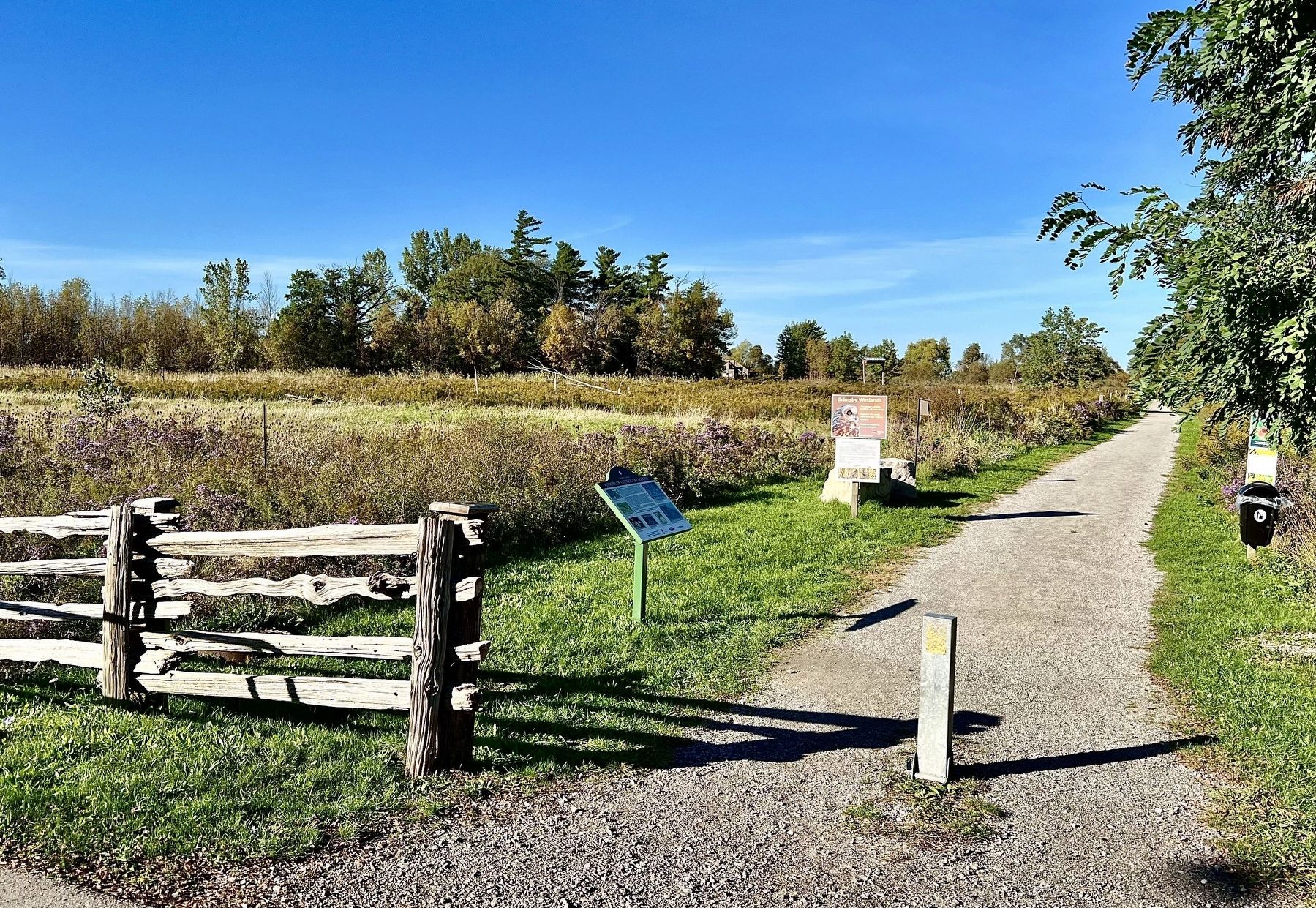
Photographed by Tim Boyd, October 5, 2024
4. Entrance to the Biggar Lagoons Wildlife Area from Winston Road.
Credits. This page was last revised on October 25, 2024. It was originally submitted on October 22, 2024, by Tim Boyd of Hamilton, Ontario. This page has been viewed 328 times since then and 61 times this year. Photos: 1, 2, 3, 4. submitted on October 22, 2024, by Tim Boyd of Hamilton, Ontario. • Andrew Ruppenstein was the editor who published this page.
