
Derry Township in Hershey in Dauphin County, Pennsylvania — The American Northeast (Mid-Atlantic)
American Elk
Aristocrat of the deer family
Cervus elaphus
| — | Big Sky Country | — |
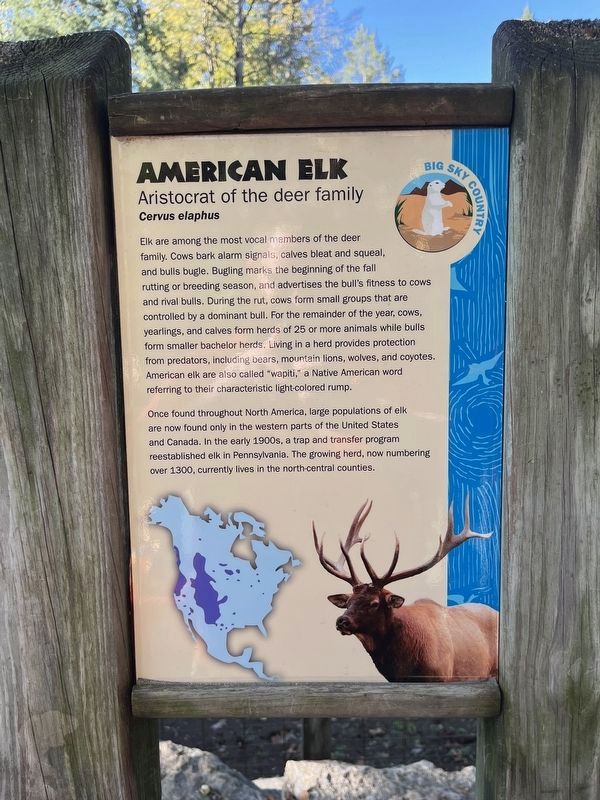
Elk are among the most vocal members of the deer family. Cows bark alarm signals, calves bleat and squeal, and bulls bugle. Bugling marks the beginning of the fall rutting or breeding season, and advertises the bull's fitness to cows and rival bulls. During the rut, cows form small groups that are controlled by a dominant bull. For the remainder of the year, cows, yearlings, and calves from herds of 25 or more animals while bulls form smaller bachelor herds. Living in a herd provides protection from predators, including bears, mountain lions, wolves, and coyotes. American elk are also called "wapiti," a Native American word referring to their characteristic light-colored rump.
Once found throughout North America, large populations of elk are now found only in the western parts of the United States and Canada. In the early 1900s, a trap and transfer program reestablished elk in Pennsylvania. The growing herd, now numbering over 1300, currently lives in the north-central counties.
Erected by ZooAmerica.
Topics. This historical marker is listed in these topic lists: Animals • Environment • Science & Medicine. A significant historical year for this entry is 1300.
Location. 40° 17.333′ N,
this page online

Regionally, this marker is in South-Central Pennsylvania, specifically in Pennsylvania Dutch Country, in the Susquehanna Valley, and in Greater Harrisburg. It is also in the American Northeast and in the Mid-Atlantic. Globally, it is in North America, the Western Hemisphere, the Western World, and the Anglosphere. Historically, it finds itself in what was once the Haudenosaunee (Iroquois) Confederacy and also one of the original Thirteen Colonies.
Other nearby markers. At least 8 other markers are within walking distance of this marker: Regal Fritillary Conservation (within shouting distance of this marker); Pronghorn (within shouting distance of this marker); a different marker also named Pronghorn (within shouting distance of this marker); Monarch Habitat

Credits. This page was last revised on October 23, 2024. It was originally submitted on October 23, 2024, by Devry Becker Jones of Washington, District of Columbia. This page has been viewed 123 times since then and 6 times this year. Photos: 1, 2. submitted on October 23, 2024, by Devry Becker Jones of Washington, District of Columbia.
