Tahlequah in Cherokee County, Oklahoma — The American South (West South Central)
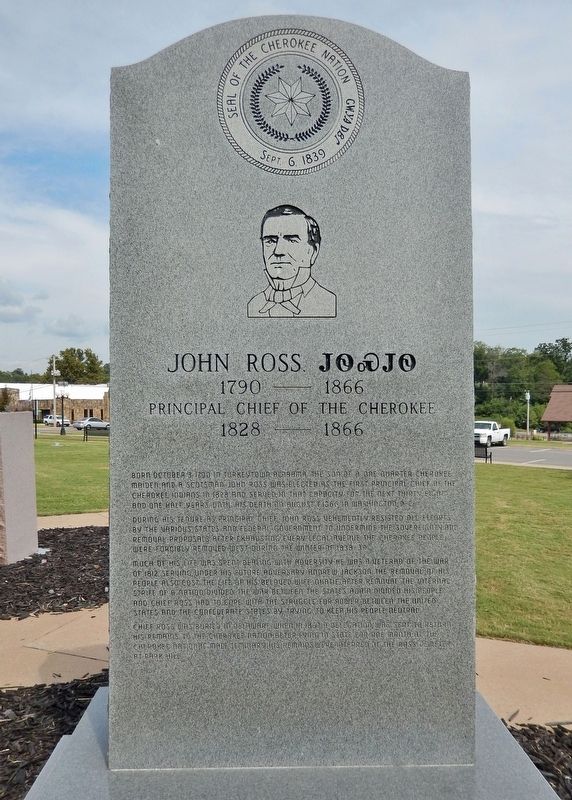
John Ross ᎫᏫᏍᎫᏫ
1790-1866
Photographed by Cosmos Mariner, September 11, 2024
1. John Ross Marker
1828-1866
Born October 3, 1790 in Turkeytown, Alabama. The son of a one-quarter Cherokee maiden and a Scotsman, John Ross was elected as the first Principal Chief of the Cherokee Indians in 1828 and served in that capacity for the next thirty-eight and one half years until his death on August 1, 1866 in Washington, D. C.
During his tenure as Principal Chief, John Ross vehemently resisted all efforts by the various states and federal government to undermine the sovereignty and removal proposals. After exhausting every legal avenue, the Cherokee people were forcibly removed west during the winter of 1838-39.
Much of his life was spent dealing with adversity. He was a veteran of the War of 1812, serving under his future adversary Andrew Jackson. The removal of his people also cost the life of his beloved wife Quantie. After removal the internal strife of a nation divided, the war between the states again divided his people and Chief Ross had to cope with the struggle for power between the United States and the Confederate States by trying to keep his people neutral.
Chief Ross was buried in Delaware,
this page online
[back side]
“The surest safeguard for the government of the nation must be found in the respect and confidence of the people, and these can be secured only by its affording that protection to life and property for which it was instituted.”
~Principle Chief John Ross,
Address to the National Council
Tahlequah, Indian Territory,
October 5, 1857
Dedicated this 27th day of October 1990
Monument erected through a co-operative effort of the following:
Cherokee Nation, Wilma P. Mankiller, Principal Chief
John A. Ketcher, Deputy Chief
City of Tahlequah, Sally Ross, Mayor
Trail of Tears Sesquicentennial Commemorative Committee,
Bruce Ross, CHMN.
Citizens of the Cherokee Nation, Tahlequah and Cherokee county.
Erected 1990.
Topics and series. This historical marker is listed in these topic lists: Government & Politics • Indigenous Peoples and Communities • War of 1812 • War, US Civil. In addition, it is included in

Photographed by Cosmos Mariner, September 11, 2024
2. John Ross Marker (back side)
Location. 35° 54.735′ N, 94° 58.239′ W. Marker is in Tahlequah, Oklahoma, in Cherokee County. It can be reached from East Keetoowah Street just east of South Muskogee Avenue (Business U.S. 62), on the left when traveling east. The marker is located on the south side of the Cherokee National History Museum grounds. Touch for map. Marker is at or near this postal address: 101 South Muskogee Avenue, Tahlequah OK 74464, United States of America. Touch for directions.

Regionally, this marker is in the Cherokee Nation and in Northeast Oklahoma—Green Country. It is also in the American South, specifically in the Ozarks, on the prairies, and on the Southern Plains. Globally, it is in North America, the Western Hemisphere, the Western World, and the Anglosphere. Historically, it finds itself in what was once the territory of the Mississippian Culture and also the Louisiana Purchase.
Other nearby markers. At least 8 other markers are within walking distance of this marker: Judge John Martin, Jr. (here,

Photographed by Cosmos Mariner, September 11, 2024
3. John Ross Marker
Looking north from East Keetoowah Street, the Cherokee National History Museum is in the background.
Also see . . .
1. John Ross (Wikipedia).
Excerpt: John Ross led the [Cherokee] nation through such tumultuous events as forced removal to Indian Territory and the American Civil War. As an educated and socially prominent Cherokee, he was bilingual and bicultural. His parents sent him for formal schooling to institutions that served other bicultural Cherokee people. And while non-Native historians have fixated on his blood quantum of one-eighth Cherokee was less than most prominent Cherokees of his time, he was an accepted and effective leader among his people.(Submitted on October 25, 2024, by Cosmos Mariner of Cape Canaveral, Florida.)
2. The Cherokee Leader Who Tried to Prevent the Trail of Tears (history.com).
Excerpt: The longest-serving chief in the history of the Cherokee nation, John Ross dedicated much of his life to fighting against his people’s forced removal from their homelands. Tragically, he did so at a time when the U.S. government viewed Native Americans as little more than an obstacle to the new nation’s aggressive westward expansion.(Submitted on October 25, 2024, by Cosmos Mariner of Cape Canaveral, Florida.)Ross rose to power during the most promising period in Cherokee history. During the 1820s, they built a new capital city, developed their own written language and drafted a constitution. But his tenure as principal chief (1828-1866) coincided with the most tumultuous era in the tribe’s history, during which he faced ferocious pressure to relinquish their vast ancestral territory in the fertile Southeast.
Credits. This page was last revised on October 25, 2024. It was originally submitted on October 24, 2024, by Cosmos Mariner of Cape Canaveral, Florida. This page has been viewed 329 times since then and 25 times this year. Photos: 1, 2, 3. submitted on October 25, 2024, by Cosmos Mariner of Cape Canaveral, Florida.
