Tahlequah in Cherokee County, Oklahoma — The American South (West South Central)
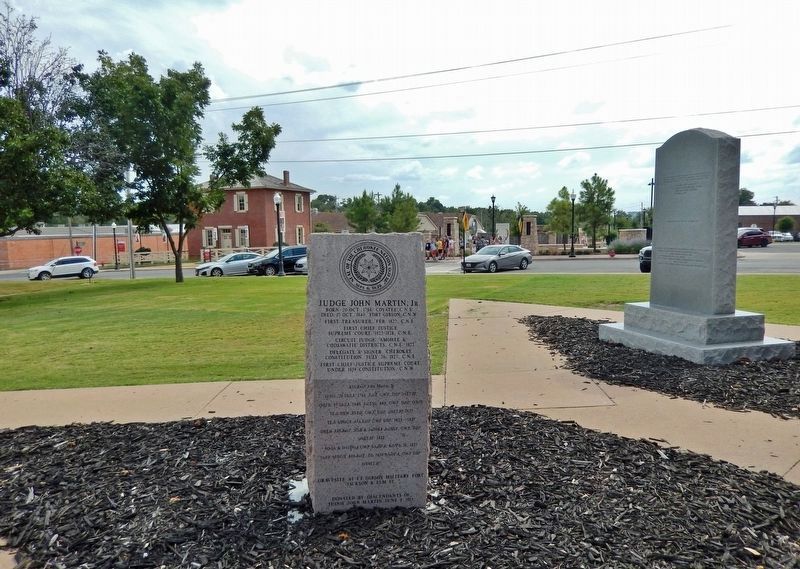
Judge John Martin, Jr.

Photographed by Cosmos Mariner, September 11, 2024
1. Judge John Martin, Jr. Marker
Died: 17 Oct., 1840, Fort Gibson, C.N.W.
First Treasurer, Feb. 1827, C.N.E.
First Chief Justice
Supreme Court, 1823-1828, C.N.E.
Circuit Judge, Amohee & Coosawatie Districts, C.N.E. 1822
Delegate & Signer, Cherokee Constitution, July 26, 1827, C.N.E.
First Chief Justice Supreme Court
under 1839 Constitution, C.N.W.
Gravesite at Ft. Gibson Military Fort
Jackson & Elm St.
Donated by descendants of
Judge John Martin June 8, 2013
Erected 2013.
Topics. This historical marker is listed in these topic lists: Indigenous Peoples and Communities • Law Enforcement • Settlements & Settlers. A significant historical date for this entry is October 20, 1784.
Location. 35° 54.738′ N, 94° 58.237′ W. Marker is in Tahlequah, Oklahoma, in Cherokee County. It can be reached from East Keetoowah Street just east of South Muskogee Avenue (Business U.S. 62), on the left when traveling east. The marker is located on the south side of the Cherokee National History Museum grounds. Touch for map. Marker is at or near this postal address: 101 South Muskogee Avenue, Tahlequah OK 74464, United States of America. Touch for directions.

Regionally, this marker is in the Cherokee Nation and in Northeast Oklahoma—Green Country. It is also in the American South, specifically in the Ozarks, on the prairies, and on the Southern Plains. Globally, it is in North America, the Western Hemisphere, the Western World, and the Anglosphere. Historically, it finds itself in what was once the territory of the Mississippian Culture and also the Louisiana Purchase.
Other nearby markers. At least 8 other markers are within walking distance of this marker: John Ross ᎫᏫᏍᎫᏫ (here, next to this marker); Cherokee Advocate (here, next to this marker); Veterans Memorial (a few steps from this
this page online
Also see . . .
1. 1st CN chief justice to be honored (Cherokee Phoenix).
Excerpt: (May 3, 2013) A ceremony to honor the first chief justice of the Cherokee Nation, John Martin Jr., is set for June 8 at the lawn of the Cherokee Courthouse in downtown Tahlequah. During the ceremony, a Judge Martin monument will be dedicated on the courthouse square and unveiled by the oldest and youngest Martin descendants. This is the first monument to be established in Martin's honor and the first attempt of a nationwide Judge John Martin Jr. family reunion. Several hundred descendants from throughout the country, in addition to the many local citizens, are expected to attend the monument ceremony and reunion.(Submitted on October 25, 2024, by Cosmos Mariner of Cape Canaveral, Florida.)
2. John Martin (Wikipedia).
Photographed by Cosmos Mariner, September 11, 2024
2. Judge John Martin, Jr. Marker
Looking south across the Cherokee National History Museum grounds; East Keetoowah Street is in the background.
Excerpt: John Martin was a notable judge of the Cherokee Tribal Court. He had no formal training in law, but he was one of the first men appointed to serve as a judge on the Cherokee Tribal Court, which was established in 1822. After his term as judge ended in 1828, he was addressed as Judge Martin for the rest of his life. He was also a member of the Cherokee Constitutional Convention that led to the formation of a real national government. In 1837, he removed from Georgia to Indian Territory, where he was elected as the first Chief Justice of the newly created Cherokee Supreme Court in 1839. He served until his death the following year.(Submitted on October 25, 2024, by Cosmos Mariner of Cape Canaveral, Florida.)
Credits. This page was last revised on October 25, 2024. It was originally submitted on October 24, 2024, by Cosmos Mariner of Cape Canaveral, Florida. This page has been viewed 453 times since then and 58 times this year. Photos: 1, 2. submitted on October 24, 2024, by Cosmos Mariner of Cape Canaveral, Florida.
