Rheinau in Schwetzingen in Rhein-Neckar-Kreis, Baden-Württemberg, Germany — Central Europe
Jungsteinzeitliches Gräberfeld
⎯⎯⎯
Neolithic Burial Ground
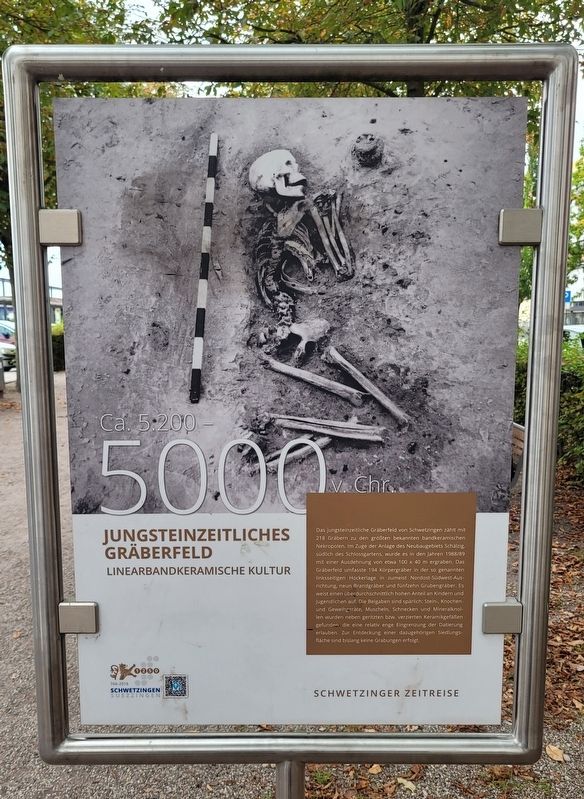
Photographed by James Hulse, September 23, 2024
1. Jungsteinzeitliches Gräberfeld / Neolithic Burial Ground Marker

Ca. 5.200-5000 v. Chr.
Jungsteinzeitliches Gräberfeld
Linearbandkeramische Kultur
Das jungsteinzeitliche Gräberfeld von Schwetzingen zählt mit 218 Gräbern zu den größten bekannten bandkeramischen Nekropolen. Im Zuge der Anlage des Neubaugebiets Schälzig, südlich des Schlossgartens, wurde es in den Jahren 1988/89 mit einer Ausdehnung von etwa 100 x 40 m ergraben. Das Gräberfeld umfasste 194 Körpergräber in der so genannten linksseitigen Hockerlage in zumeist Nordost-Sudwest-Ausrichtung, neun Brandgräber und fünfzehn Grubengräber. Es weist einen überdurchschnittlich hohen Anteil an Kindern und Jugendlichen auf. Die Beigaben sind spärlich: Stein-, Knochen- und Geweihgeräte, Muscheln, Schnecken und Mineralknollen wurden neben geritzten bzw. verzierten Keramikgefäßen gefunden, die eine relativ enge Eingrenzung der Datierung erlauben. Zur Entdeckung einer dazugehörigen Siedlungsfläche sind bislang keine Grabungen erfolgt.
Approx. 5,200-5000 BC
Neolithic Burial Ground
Linear Pottery Culture
The Neolithic cemetery of Schwetzingen, with 218 graves, is one of the largest known Linear
this page online
Erected by Schwetzinger Zeitreise.
Topics. This historical marker is listed in these topic lists: Anthropology & Archaeology • Cemeteries & Burial Sites • Settlements & Settlers. A significant historical year for this entry is 5000 BCE.
Location. 49° 23.086′ N, 8° 34.653′ E. Marker is in Schwetzingen, Baden-Württemberg, in Rhein-Neckar-Kreis. It is in Rheinau. It is on Bahnhofanlage just south of Carl-Theodor-Straße.
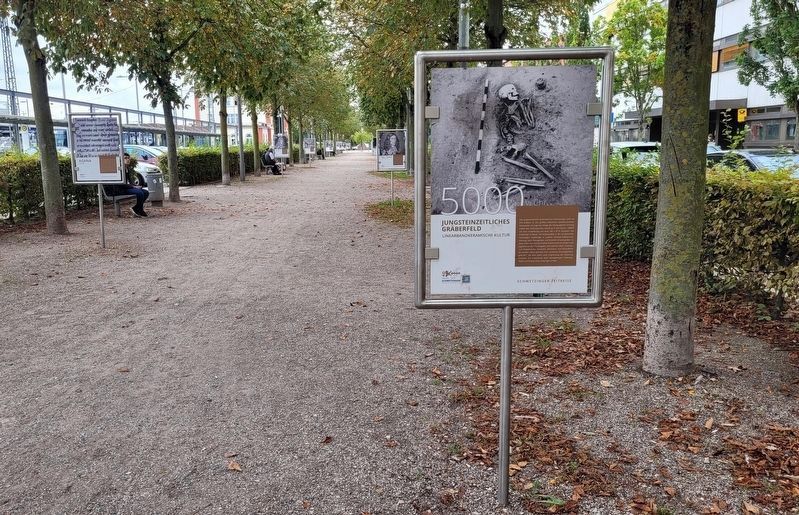
Photographed by James Hulse, September 23, 2024
2. The view of the Neolithic Burial Ground Marker along the pathway

Regionally, this marker is on the German Upper Rhine. Globally, it is in Europe, the European Union, Atlantic Europe, Central Europe, the Schengen Area, Western Europe, and the Western World. Historically, it finds itself in what was once the Roman Empire, the Holy Roman Empire, and the former West Germany.
Other nearby markers. At least 8 other markers are within walking distance of this marker: Suezzo (here, next to this marker); Agana (here, next to this marker); Rittergeschlecht der Erligheimer / Knightly Family of Erligheim (a few steps from this marker); Elisabeth Charlotte (a few steps from this marker); Karl I. Ludwig (a few steps from this marker); Franziskaner-Kloster / Franciscan Monastery (within shouting distance of this marker); Johann Wilhelm (within shouting distance of this marker); Carl Philipp (within shouting distance of this marker). Touch for a list and map of all markers in Schwetzingen.
More about this marker. There is a non-related marker attached on the other side of the post.
Credits. This page was last revised on October 27, 2024. It was originally submitted on October 25, 2024, by James Hulse of Medina, Texas. This page has been viewed 138 times since then and 19 times this year. Photos: 1, 2. submitted on October 26, 2024, by James Hulse of Medina, Texas.
