Centennial Hill in Montgomery in Montgomery County, Alabama — The American South (East South Central)
Victor H. Tulane ⎯⎯⎯ The Tulane Legacy
Photographed by Shaun Rose, October 25, 2024
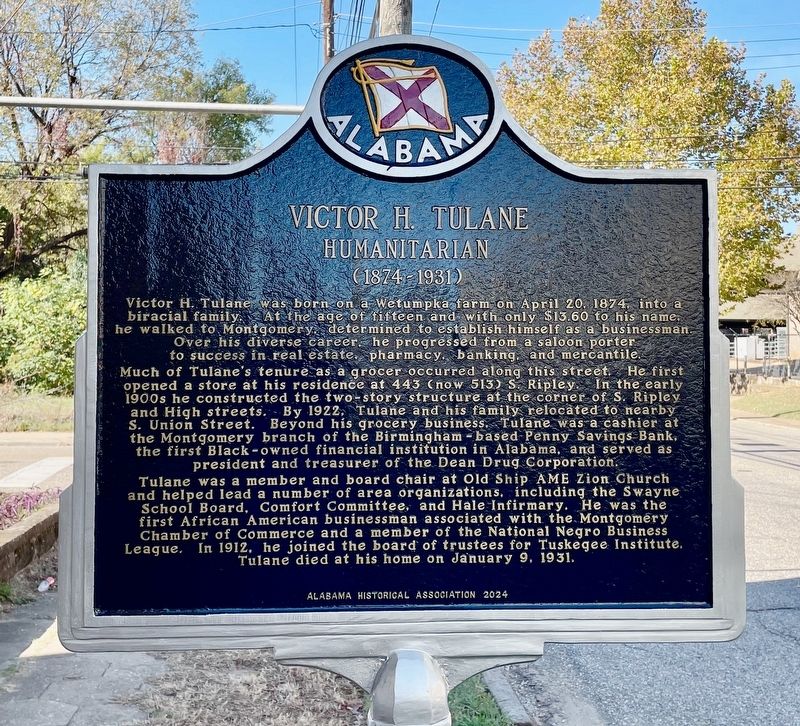
1. Victor H. Tulane Marker
Inscription.
Victor H. Tulane Humanitarian (1874-1931)
Victor H. Tulane was born on a Wetumpka farm on April 20, 1874, into a biracial family. At the age of fifteen and with only $13.60 to his name, he walked to Montgomery, determined to establish himself as a businessman. Over his diverse career, he progressed from a saloon porter to success in real estate, pharmacy, banking, and mercantile.
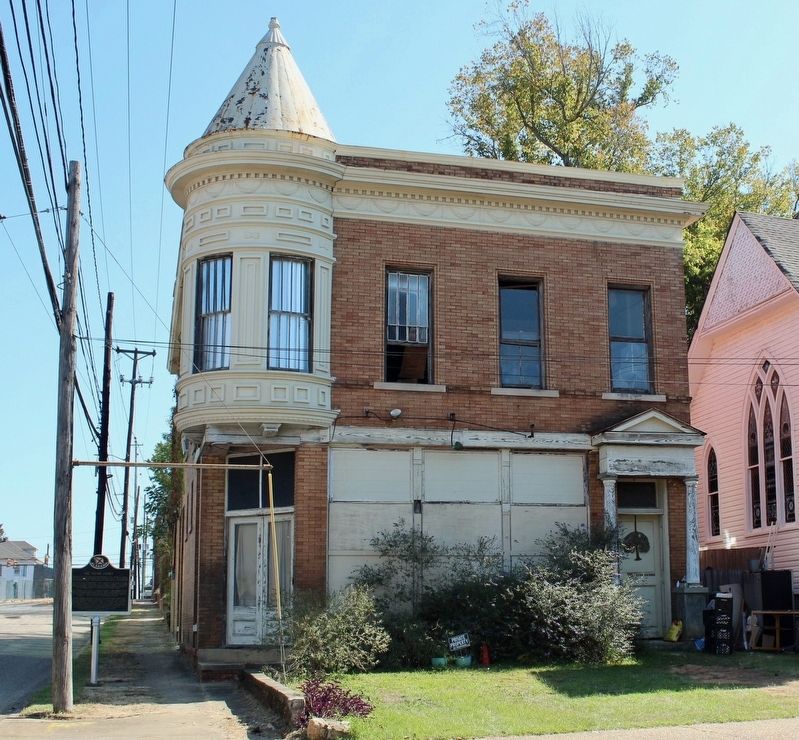
Much of Tulane’s tenure as a grocer occurred along this street. He first opened a store at his residence at 443 (now 513) S. Ripley. In the early 1900s he constructed the two-story structure at the corner of S. Ripley and High streets. By 1922, Tulane and his family relocated to nearby S. Union Street. Beyond his grocery business, Tulane was a cashier at the Montgomery branch of the Birmingham-based Penny Savings Bank, the first Black-owned financial institution in Alabama, and served as president and treasurer of the Dean Drug Corporation.
Tulane was a member and board chair at Old Ship AME Zion Church and helped lead a number of area organizations, including the Swayne School Board, Comfort Committee, and Hale Infirmary. He was the first
Click or scan to see this page online
African American businessman associated with the Montgomery Chamber of Commerce and a member of the National Negro Business League. In 1912, he joined the board of trustees for Tuskegee Institute.
Tulane died at his home on January 9, 1931.
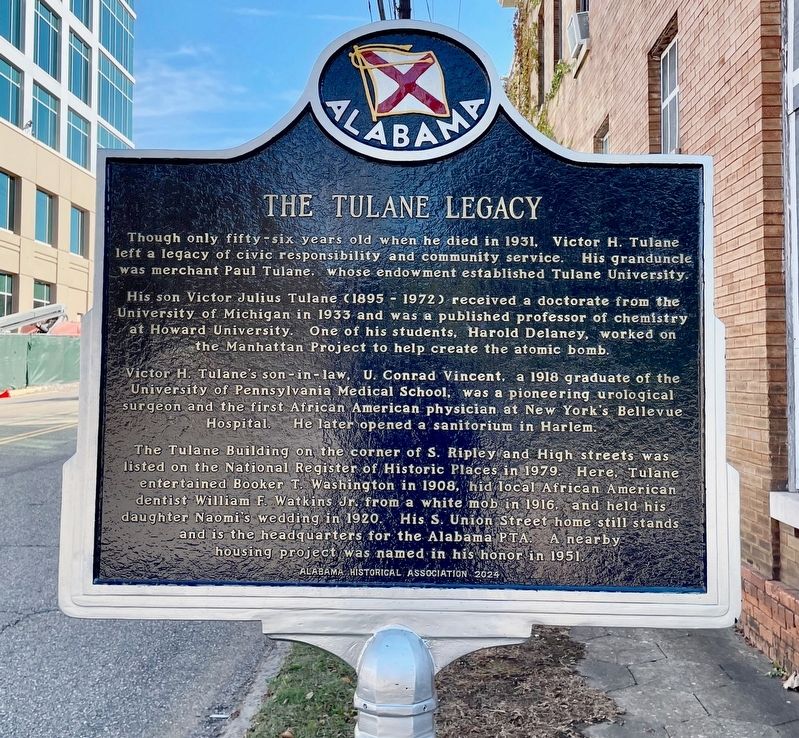
The Tulane Legacy
Though only fifty-six years old when he died in 1931, Victor H. Tulane left a legacy of civic responsibility and community service. His granduncle was merchant Paul Tulane, whose endowment established Tulane University.
His son Victor Julius Tulane (1895 – 1972) received a doctorate from the University of Michigan in 1933 and was a published professor of chemistry at Howard University. One of his students, Harold Delaney, worked on the Manhattan Project to help create the atomic bomb.
Victor H. Tulane’s son-in-law, U. Conrad Vincent, a 1918 graduate of the University of Pennsylvania Medical School, was a pioneering urological surgeon and the first African American physician at New York’s Bellevue Hospital. He later opened a sanitorium in Harlem.
The Tulane Building on the corner of S. Ripley and High streets was listed on the National Register of Historic Places
Photographed by Shaun Rose, October 25, 2024
2. The Tulane Legacy Marker
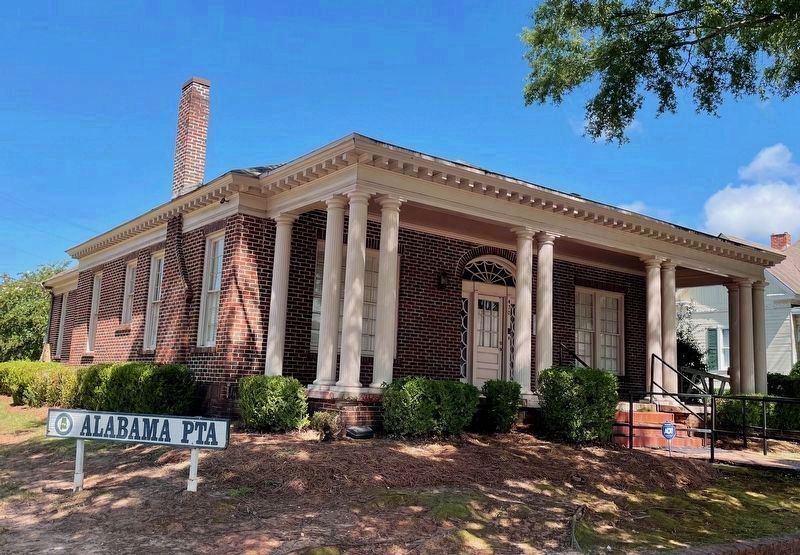
in 1979. Here, Tulane entertained Booker T. Washington in 1908, hid local African American dentist William F. Watkins Jr. from a white mob in 1916, and held his daughter Naomi’s wedding in 1920. His S. Union Street home still stands and is the headquarters for the Alabama PTA. A nearby housing project was named in his honor in 1951.
Location. 32° 22.318′ N, 86° 17.868′ W. Marker is in Montgomery, Alabama, in Montgomery County. It is in Centennial Hill. It is at the intersection of High Street and South Riley Street, on the right when traveling east on High Street. Touch for map. Marker is at or near this postal address: 800 High St, Montgomery AL 36104, United States of America. Touch for directions.
Regionally, this marker is in Alabama’s Tri-Counties River Region. It is also in the American South, specifically in the Deep South, and in the Black Belt. Globally, it is in
Photographed by Shaun Rose, October 25, 2024
3. The Tulane Building
Tulane constructed this building at 800 High St in the early 1900s.
North America, a Gulf of Mexico state, the Western Hemisphere, the Western World, and the Anglosphere. Historically, it finds itself in what was once the territory of the Mississippian Culture, one of the Confederate States of America, and the Antebellum South.
Related marker. Click here for another marker that is related to this marker.
Photographed by Mark Hilton, July 27, 2025
4. The Tulane Legacy
Final home at 470 South Union Street (now offices of the Alabama PTA) noted on marker.
Credits. This page was last revised on July 27, 2025. It was originally submitted on October 25, 2024, by Shaun Rose of Montgomery, Alabama. This page has been viewed 1,157 times since then and 180 times this year. Photos:1, 2, 3. submitted on October 25, 2024, by Shaun Rose of Montgomery, Alabama. 4. submitted on July 27, 2025, by Mark Hilton of Montgomery, Alabama. • James Hulse was the editor who published this page.