Rheinau in Schwetzingen in Rhein-Neckar-Kreis, Baden-Württemberg, Germany — Central Europe
Suezzo
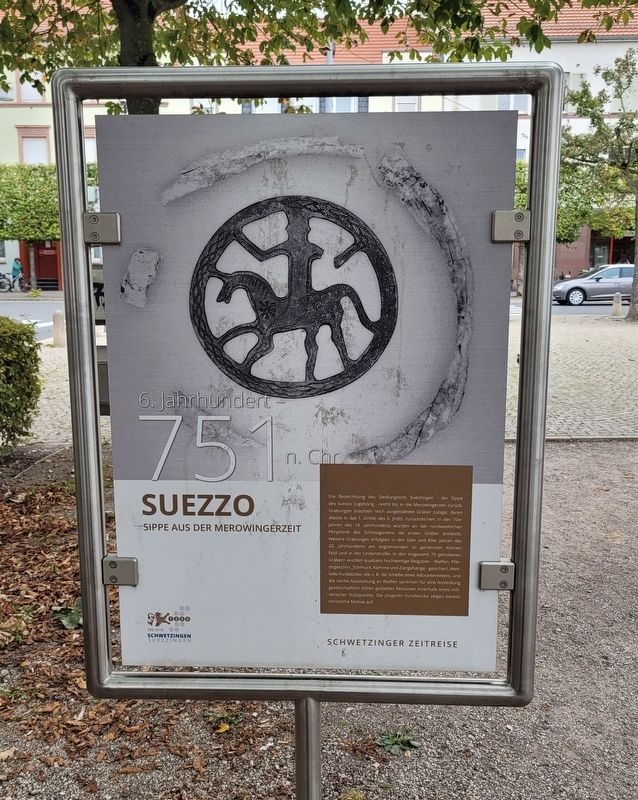
Photographed by James Hulse, September 23, 2024
1. Suezzo Marker

6. Jahrhundert-751 n. Chr.
Suezzo
Sippe Aus Der Merowingerzeit
Die Bezeichnung des des Suezzo zugehörig Siedlungsorts ungsorts Suezzingen reicht bis in die der Sippe Merowingerzeit zurück Grabungen brachten reich ausgestattete Gräber zutage, deren älteste in das 1. Drittel des 6. Jhdts, zurückreichen, in den 70er Jahren des 18. Jahrhunderts underts wurden an der nordwestlichen Peripherie des Schlossgartens die ersten Gräber entdeckt. Weitere Grabungen erfolgten in den 60er und 80er Jahren des 20. Jahrhunderts am angrenzenden so genannten Kleinen Feld und in der Linderstralle In den insgesamt 70 gehobenen Gräbem wurden qualitativ hochwertige Beigaben Waffen, Pfer degeschirr, Schmuck, Kamme und Ziengehänge gesichert. Wert volle Fundstücke, wie z. B. die Scheibe eines Adorantenreters, und die reiche Ausstattung an Waffen sprechen für reine e Ansiedlung gresellschaftlich höher sher gestellter Personen innerhalb eines mili Isärischer Stützpunkts. Die jüngeren Fundstücke zeigen bereits christiche Motive auf.
6th century-751 AD
Suezzo
Merovingian Clan
The name of the settlement
this page online
Erected by Schwetzinger Zeitreise.
Topics. This historical marker is listed in these topic lists: Anthropology & Archaeology • Cemeteries & Burial Sites • Settlements & Settlers.
Location. 49° 23.086′ N, 8° 34.653′ E. Marker is in Schwetzingen, Baden-Württemberg, in Rhein-Neckar-Kreis.
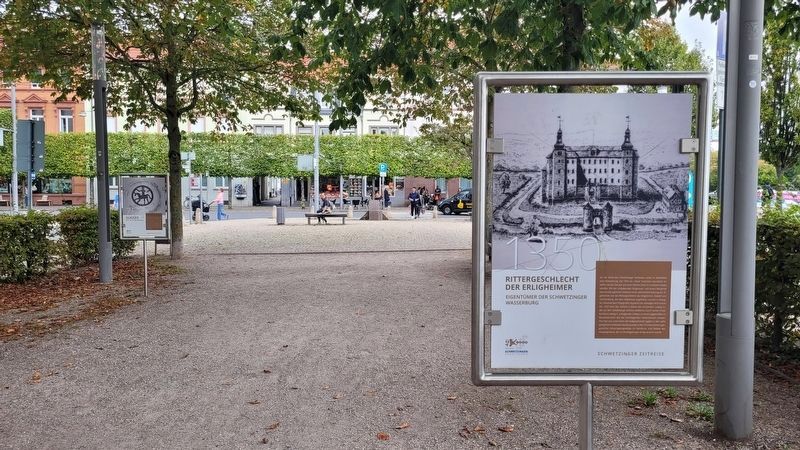
Photographed by James Hulse, September 23, 2024
2. The Suezzo Marker is the far left marker of the two markers

Regionally, this marker is on the German Upper Rhine. Globally, it is in Europe, the European Union, Atlantic Europe, Central Europe, the Schengen Area, Western Europe, and the Western World. Historically, it finds itself in what was once the Roman Empire, the Holy Roman Empire, and the former West Germany.
Other nearby markers. At least 8 other markers are within walking distance of this marker: Jungsteinzeitliches Gräberfeld / Neolithic Burial Ground (here, next to this marker); Agana (here, next to this marker); Rittergeschlecht der Erligheimer / Knightly Family of Erligheim (here, next to this marker); Elisabeth Charlotte (a few steps from this marker); Karl I. Ludwig (a few steps from this marker); Franziskaner-Kloster / Franciscan Monastery (within shouting distance of this marker); Johann Wilhelm (within shouting distance of this marker); Carl Philipp (within shouting distance of this marker). Touch for a list and map of all markers in Schwetzingen.
More about this marker. There is a non-related marker attached on the other side of the post.
Credits. This page was last revised on October 27, 2024. It was originally submitted on October 26, 2024, by James Hulse of Medina, Texas. This page has been viewed 126 times since then and 25 times this year. Photos: 1, 2. submitted on October 26, 2024, by James Hulse of Medina, Texas.
