Greenville in Greenville County, South Carolina — The American South (South Atlantic)
History of Falls Park

Photographed by Mark Parker, October 25, 2024
1. History of Falls Park Marker
The Carolina Foothills Garden Club, beginning in 1967, spearheaded efforts to reclaim the long neglected site of Greenville's birthplace and to preserve its natural beauty along the banks of the Reedy River. The City of Greenville endorsed the project and resolved to establish and maintain the park.
Furman University, whose campus was once located nearby, donated the original six areas, followed by other land grants from adjoining property owners. Over the next two decades the Garden Club, in partnership with the city, continued to protect, expand and develop the area.
In 1975, a small house, known today as Falls Cottage, was acquired and restored. A master development and beautification project was begun in 1990 with city and garden club funds augmented with generous support from foundations, corporations, and individuals. Falls Park, listed on the National Register of Historic Places, encompasses 26 acres with nature trails, landscaped gardens, a pond, expansion bridge, scenic overlooks, textile mill ruins, and historic informational plaques.
Love of history, appreciation for nature's beauties and a desire
this page online
Topics. This historical marker is listed in these topic lists: Natural Features • Notable Places • Parks & Recreational Areas. A significant historical year for this entry is 1967.
Location. 34° 50.701′ N, 82° 24.109′ W. Marker is in Greenville, South Carolina, in Greenville County. It is at the intersection of North Main Street and Falls Park Drive on North Main Street. Marker is to the left after entering Falls Park at the west entrance at South Main Street and Falls Park Drive. Touch for map. Marker is at or near this postal address: 601 South Main Street, Greenville SC 29601, United States of America. Touch for directions.

Regionally, this marker is in Upstate. It is also in the American South, specifically in the Deep South, in Appalachia, and specifically in Southern Appalachia. Globally, it is in North America, the Western Hemisphere, the Western World, and the Anglosphere. Historically, it finds itself in what was once the original Cherokee Nation, the territory of the Mississippian Culture, one of the original
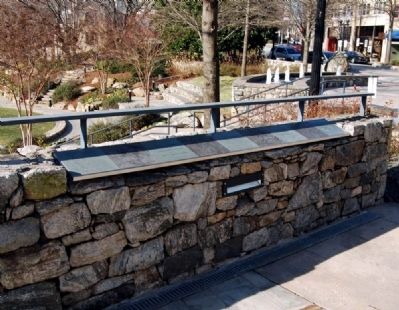
Photographed by Brian Scott, February 20, 2010
2. History of Falls Park Marker
First plaque on the left contains the history inscription.
Other nearby markers. At least 8 other markers are within walking distance of this marker: A different marker also named Liberty Bridge (a few steps from this marker); Tate Plaza (a few steps from this marker); Enjoy Falls Park (a few steps from this marker); Harriet Smith Wyche (within shouting distance of this marker); "The Cradle of Greenville" (within shouting distance of this marker); Dr. Charles Hard Townes (within shouting distance of this marker); The Touchstone House (within shouting distance of this marker); Chicora College (within shouting distance of this marker). Touch for a list and map of all markers in Greenville.
Other markers no longer nearby. Liberty Bridge (was a few steps from this marker but has been replaced with another marker now near it); Welcome to Falls Park (was a few steps from this marker but has been replaced with another marker now near it).
Also see . . .
1. Reedy River Falls Historic Park and Greenway. The Reedy River Falls are not only the geographical but also the historical center of
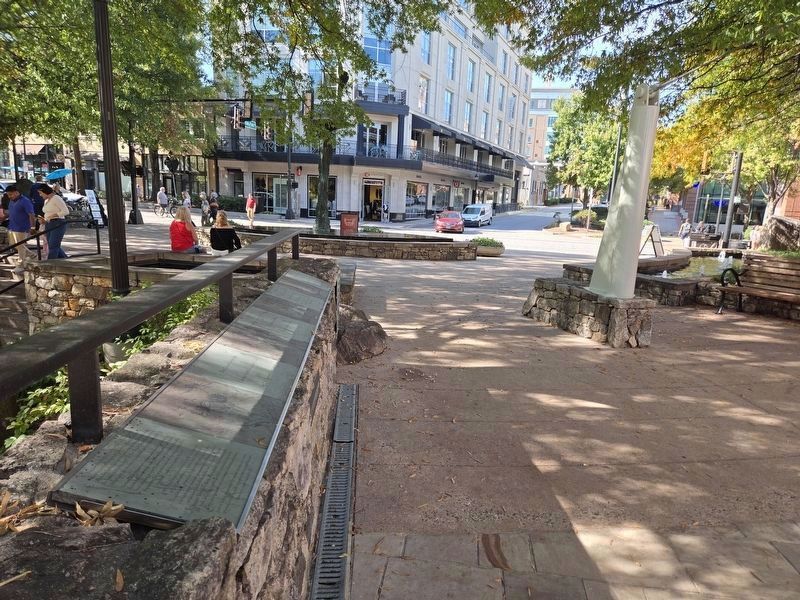
Photographed by Mark Parker, October 25, 2024
3. Full view of History of Falls Park Marker
View is looking towards the entrance to the park at South Main Street and Falls Park Drive
2. Falls Park on the Reedy. Falls Park on the Reedy is a 32-acre park adjacent to downtown Greenville, South Carolina in the historic West End district. (Submitted on February 24, 2010, by Brian Scott of Anderson, South Carolina.)
3. Reedy River. The Reedy River is a tributary of the Saluda River, about 65 mi long, in northwestern South Carolina in the United States. (Submitted on February 24, 2010, by Brian Scott of Anderson, South Carolina.)
Additional commentary.
1. Reedy River Falls Historic Park and Greenway I
The proposed Reedy River Park in an 8.13 acre plot of land which is located at the heart of present day Greenville. The site includes the forty foot high Reedy River Falls and a secondary set of rapids in a rocky gorge downstream from these. The riverbank portion of the park includes the old Furman University botanical gardens and arboretum as well as the ruins of an early mill.
The 8.13 acre park includes six acres deeded to the City of Greenville by Furman University and some 2.13 acres of additional
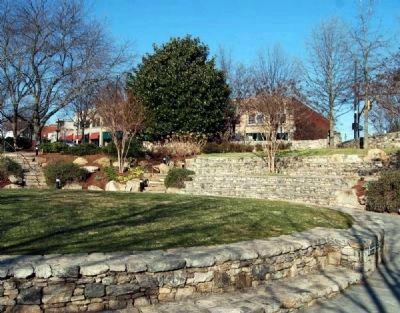
Photographed by Brian Scott, February 20, 2010
4. Bowater Amphitheatre
The Reedy River Falls lie just southeast of the South Main Street bridge and form the northernmost attraction of the park. At this point, the Reedy River plunges over a forty-foot drop into a rocky gorge which is defined on one side by the steep, rocky and heavily-wooded Camperdown Bluff. Within this area, a secondary set of falls can be found. These rapids were of key importance in the development of Greenville. Some brick ruins, presumed to be the remains of Vardry Mill built ca. 1830, are still visible on the riverbank at this point. The wide granite outcroppings below the main falls will be used for picnic facilities, walkways and footpaths. The low-lying land immediately west of this point was developed forty years ago as a botanical garden and arboretum by Furman University. The University which is no longer located in this area of Greenville has deeded these six acres of land to the city for the proposed park. Although some of the shrubs and trees of the early planting are still evident, the area
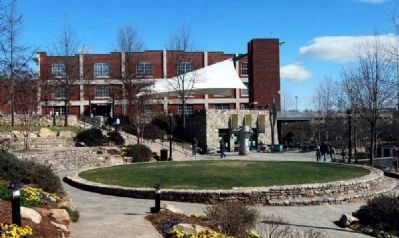
Photographed by Brian Scott, February 28, 2010
5. Community Staircase Leading from
Tate Plaza into Falls Park
Tate Plaza into Falls Park
The City of Greenville has undertaken to maintain the immediate area. Overhead lighting and underground water connections are being installed. Projects are underway to clear the area of underbrush, excavate the sites of archeological importance and curtail riverbank erosion by the rapidly moving stream. Trails, walkways, footpath and picnic areas will complete the park's development.
Significance
The Reedy River Falls are not only the geographical but also the historical center of Greenville. The speed and power of the falls and the rapids below them were indirectly responsible for the founding of the city in 1812 when the city's first building, a grist mill, was built at this site. Since that time, the mills that were the economic life of the town sat near the falls and used their power to grind flour or manufacture textiles.
Industrial Significance
The land immediately surrounding the Reedy River Falls was deeded to one Richard Pearis just prior to the American Revolutionary War. Reaction by his neighbors to his Tory-Loyalist sympathies forced him to leave the area hurriedly. The only
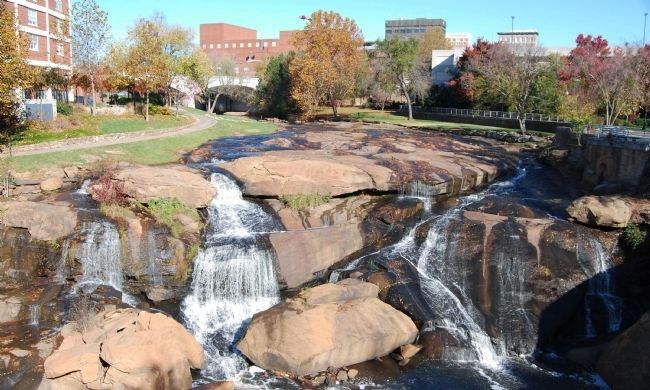
Photographed by Brian Scott, November 16, 2008
6. Reedy River Falls from the Liberty Bridge
Rehabilitation of the area began with the opening of the Furman University botanical garden and
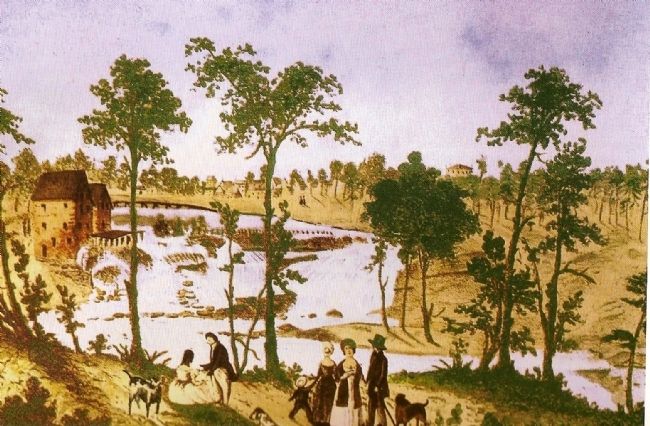
Greenville County Library, Originally Published in Orion Magazine, 1844
7. Etching of Falls Park -
Note the McBee Mill on the Left
Which Stood Until 1920
Note the McBee Mill on the Left
Which Stood Until 1920
— Submitted February 24, 2010, by Brian Scott of Anderson, South Carolina.
2. Reedy River Falls Historic Park and Greenway II
The Reedy River Park is a 14 acre property located at the heart of present day Greenville. The site includes the 50 foot Reedy River Falls and a secondary set of rapids in a rocky gorge downstream from these. The riverbank portion of the park includes the old Furman University botanical gardens and arboretum as well as the ruins of an early mill.
The park contains 6 acres deeded to the City of Greenville by Furman University and some 8 acres of additional land purchased by the City. Most of the property lies below the Reedy River Falls and provides an extremely desirable open space in this metropolitan area.
The Reedy River Falls lie just southeast of the South Main Street bridge and form the northernmost attraction of the park. At this point, the
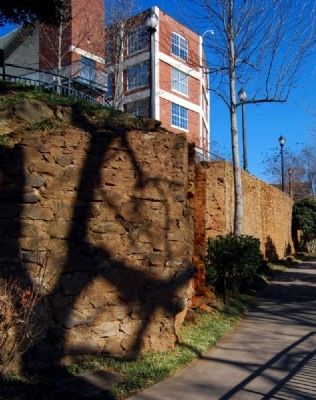
Photographed by Brian Scott, February 20, 2010
8. McBee's Mill -
Retaining Walls
Retaining Walls
The mill was dismantled in 1920 to provide materials for the Gassaway Mansion, Greenville's largest private residence.
The City of Greenville and the Carolina Foothills Garden Club have undertaken the development and maintenance of the area. Overhead lighting and underground water connections have been installed. Trails, walkways, and picnic areas have been constructed along the riverbanks. A 2.2 mile bike path has been constructed, connecting Reedy River Park with Cleveland Park, another city park. (These additions have not destroyed the historical integrity of the site.) In addition, a 19th Century structure known as the
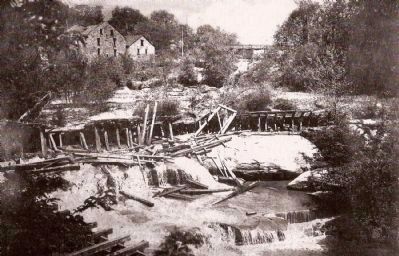
Coxe Collection, Greenville County Historical Society, circa 1915
9. Reedy River Falls and Vardry Mill
The two buildings to the far left were build by Vardry McBee.
Because the original nomination did not clearly delineate the nominated property and because the property has undergone changes, the nomination has been revised to clearly define the boundaries and to reflect the enlarged acreage.
Significance
The Reedy River Falls are not only the geographical but also the historical center of Greenville. The speed and power of the falls and rapids below them were indirectly responsible for the founding of Greenville at this site in the early 1800's. Since that time, the mills that were the economic life of the city sat near the falls and used their power to grind flour and cornmeal or manufacture textiles. In the 1930's, the area surrounding the falls acquired additional significance as the site of a botanical garden and arboretum. Today, the falls are being preserved and the surrounding area developed as the Reedy River Falls Historic Park and Greenway.
Industry
The land immediately surrounding the Reedy River Falls
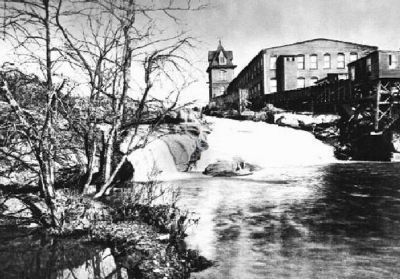
William B. Coxe Collection, Greenville County Historical Society, circa 1930
10. Camperdown Mill -
Greenville's 1st Post-bellum Textile Mill
Now the Location of Bowater, Inc.
Greenville's 1st Post-bellum Textile Mill
Now the Location of Bowater, Inc.
After changing hands several times, the property was deeded to Lemuel J. Alston in 1788. Alston remained in control of the land until 1815 when the tract which had increased to 11,018 acres was sold to Vardry McBee. The Town of Pleasantburg having been founded in 1812, McBee began development of the area with the construction of two mills, the remains of which can still be discerned. The surrounding Town of Pleasantburg continued to prosper with income derived from its thriving industry and in its 1831 charter, the town changed its name to Greenville. The continuing growth of the town enticed further industry. The construction of the Camperdown Mills about 1870 was responsible for the decline of the area surrounding the falls and the eventual erosion of the banks below the mill outlet.
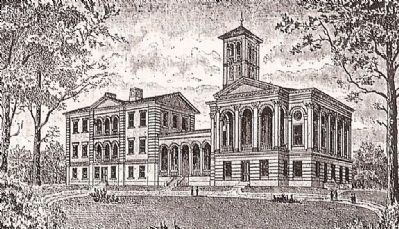
Special Collections, Greenville County Library, Greenville, 1901
11. Furman University
The music building to the left of the bell tower and the right building made up the entire Furman campus. This engraving comes from a 1901 Greenville city directory.
Conservation
The rocky gorge and bluff site below old Camperdown Mills have profuse and distinctive natural foliage, helping to produce an area described in 1907 as "the most distinctive feature of the topography and landscape of the City of Greenville." Rehabilitation of the area began with the opening of the Furman University botanical garden and arboretum in 1929-30. Since 1967, the Carolina Foothills Garden Club and the City of Greenville have been working to develop the park. The gorge and falls site now serve as a focal point of the greenway and bike path which connect Reedy River Park and Cleveland Park, another municipal recreational facility. Preservation of this area is therefore not only of historical importance, but also provides a valuable recreational asset for downtown Greenville. (Source: Revised National Register nomination form.)
— Submitted February 24, 2010, by Brian Scott of Anderson, South Carolina.
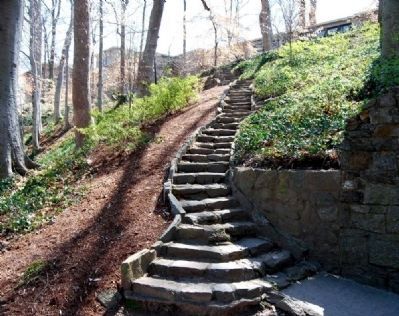
Photographed by Brian Scott, March 22, 2009
12. Stone Staircase Leading to Furman College Way
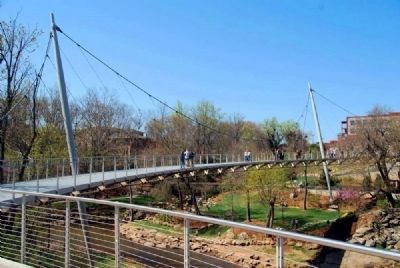
Photographed by Brian Scott, March 22, 2009
13. Liberty Bridge
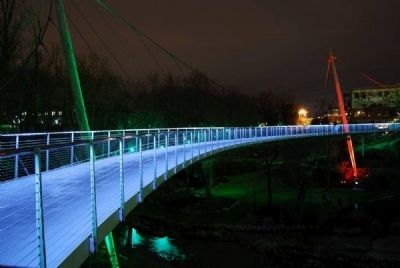
Photographed by Brian Scott, December 23, 2008
14. Liberty Bridge at Night
Credits. This page was last revised on October 31, 2024. It was originally submitted on February 24, 2010, by Brian Scott of Anderson, South Carolina. This page has been viewed 2,962 times since then and 217 times this year. Last updated on October 27, 2024, by Mark Parker of Hickory, North Carolina. Photos: 1. submitted on October 27, 2024, by Mark Parker of Hickory, North Carolina. 2. submitted on February 24, 2010, by Brian Scott of Anderson, South Carolina. 3. submitted on October 27, 2024, by Mark Parker of Hickory, North Carolina. 4. submitted on February 24, 2010, by Brian Scott of Anderson, South Carolina. 5. submitted on April 2, 2010, by Brian Scott of Anderson, South Carolina. 6. submitted on November 21, 2008, by Brian Scott of Anderson, South Carolina. 7, 8. submitted on February 24, 2010, by Brian Scott of Anderson, South Carolina. 9. submitted on April 15, 2009, by Brian Scott of Anderson, South Carolina. 10. submitted on March 28, 2009, by Brian Scott of Anderson, South Carolina. 11. submitted on April 13, 2009, by Brian Scott of Anderson, South Carolina. 12. submitted on April 2, 2009, by Brian Scott of Anderson, South Carolina. 13, 14. submitted on March 30, 2009, by Brian Scott of Anderson, South Carolina. • Devry Becker Jones was the editor who published this page.
