
Near Weldon Spring in St. Charles County, Missouri — The American Midwest (Upper Plains)
Busch Greenway - Trail to Missouri Research Park
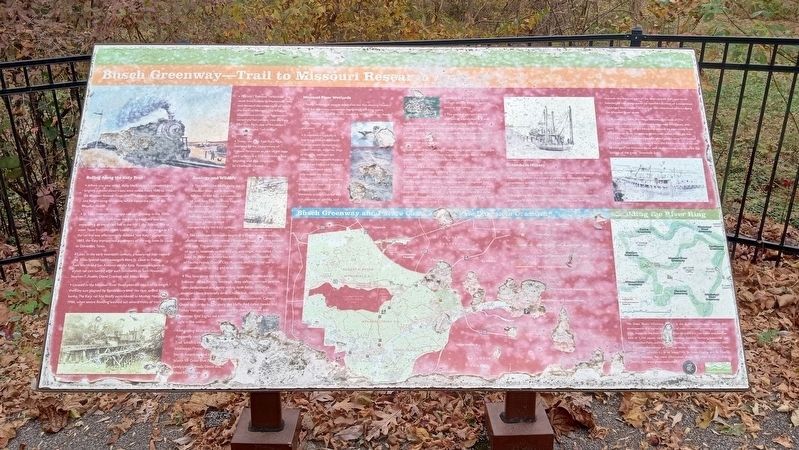
Photographed by Jason Voigt, October 28, 2024
1. Busch Greenway - Trail to Missouri Research Park Marker
Some parts of the marker have suffered from lots of wear, making it unreadable
Rolling Along the Katy Trail
• Where you now stand, shiny black steam locomotives and brightly painted diesel trains once rolled. From 1870 to 1988, the Missouri-Kansas-Texas (MKT) Railroad carried passengers and freight along this route, which traces the path of the Missouri River.
• St. Louis emerged as a major railroad gateway in the 1890s when the rail line from New Franklin to Machens was built, completing an important link in the MKT, the first rail line to enter Texas from the north. Listed on the stock exchange as KT, the rail line was affectionately dubbed "the Katy." Completed in 1893, the Katy transported passengers all the way from St. Louis to Galveston, Texas.
• Later, in the early twentieth century, a luxury rail liner named the Texas Special took passengers from St. Louis to Dallas Fort Worth and San Antonio via the Katy. Passengers rode in stylish rail cars named after such luminaries as Sam Houston, Stephen F. Austin, David Crockett and James Bowie.
• Located in the Missouri River flood plain for much of its length, the Katy was plagued by floods every time the river spilled its banks. The
this page online
• The MKT Railroad "railbanked" the route from Sedalia to Machens in 1988 and donated the entire right-of-way to the State of Missouri. The Missouri Department of Natural Resources turned the rail corridor into the Katy Trail State Park, one of the nation's first and longest "rail to trail" conversions.
• Today, the Katy Trail State Park, operated by the Department of Natural Resources as part of the state park system, is a 225-mile hiking and bicycling trail that runs from St. Charles to Clinton.
Geology and Wildlife
• The prominent bluffs along the Missouri River, some reaching heights of 500 feet, are comprised of Jefferson City dolomite topped by thick layers of St. Peter sandstone. Silica mined from this sandstone was one of the many products once transported by the Katy railroad.
• The sandstone formation began as a layer of sand in the clear, shallow waters of the ancient Paleozoic Era that once covered this area. The sandstone consists of fine to medium-sized grams of quartz, relatively uniform
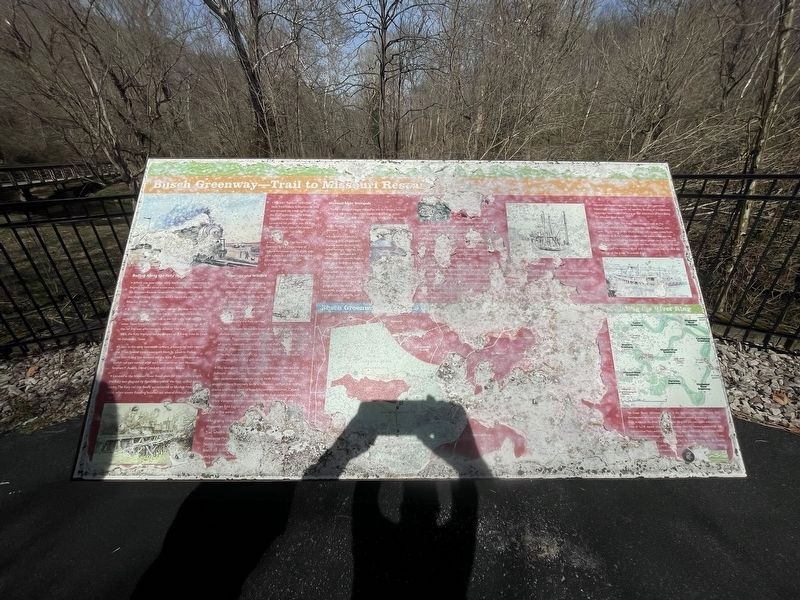
Photographed by Garrett Koch, March 13, 2026
2. Busch Greenway - Trail to Missouri Research Park Marker continues to weather
• This land along the Missouri River provides diverse wildlife habitats: dense forests, wetlands, deep valleys, remnant prairies, open pastureland and gently rolling farm fields. Wildlife is abundant here, especially birds. Chickadees, nuthatches, robins, orioles and many types of woodpeckers are common. Canada Geese nest in the ledges along the bluffs. Red-tailed Hawks and Turkey Vultures are often seen soaring above the trail, and American Bald Eagles are a common sight in the winter.
Missouri River Wetlands
• Today, millions of people depend on the fast-moving Missouri River for electricity, recreation, navigation, drinking water, irrigation and industrial needs. Since the 1930s, the river channel has been modified to keep the water flowing for those purposes.
• A wetland is typically a low-lying area covered with shallow water. Sometimes called swamps, marshes, bogs or sloughs, wetlands are important ecosystems

Photographed by Jason Voigt, October 28, 2024
3. Busch Greenway - Trail to Missouri Research Park Marker
Marker is located along the Busch Greenway, near its terminus at the Katy Trail
Wetlands provide habitat to a rich diversity of wildlife, and consequently provide recreation through wildlife viewing, boating, hunting and fishing.
• The wetland you see here is a remnant of a landscape that was typical before the river channel was modified. When Lewis and Clark explored the Missouri River 200 years ago the "Big Muddy" floodplain consisted of hundreds of thousands of acres of wetlands, backwater sloughs and oxbow lakes, all home to plentiful fish and wildlife.
• This wetland receives clean, treated water year-round from the Duckett Creek Sanitary District plant above the bluffs, and seasonally from the Missouri River below.
• Wetlands are critical resting locations for migrating birds. Wetlands also provide breeding habitats for numerous species of native birds, fish, reptiles and amphibians. One such amphibian is the Northern Leopard Frog. Once the most widespread frog species in North America, their numbers have declined in

Photographed by Jason Voigt, October 28, 2024
4. Busch Greenway - Trail to Missouri Research Park Marker
Southwest view of the Katy Trail - the marker is near the turn-off along Busch Greenway
Steamboat History
• Traveling by steamboat on the Missouri River was common in the 1800s, before the advent of railroads. Mississippi River steamboats were about 250 feet long and could carry 300 to 400 passengers and up to 700 tons of freights.
• Navigating the Missouri River in a steamboat was dangerous, particularly during storms in the current was fast, and the channel - the deepest part of the river would shift over time. Submerged tree snags could rip open the bottom of a steamboat. Historians have located as many as 400 steamboat wrecks along the Missouri River alone.
• On June 22, 1884, the mega-steamboat known as the Montana collided with a railroad bridge near Bridgeton, and sank. The remains of the Montana can still be seen today from the Missouri River Greenway when river water levels are low. This 282-foot-long luxury paddle wheel could carry 939 tons of cargo and had a 60-man crew. It was the first riverboat of its size to navigate the Missouri River and its disastrous end signaled the decline of the great "Riverboat Era."
Erected by Great Rivers Greenway.
Topics and series. This historical marker is listed in these topic lists: Disasters • Parks & Recreational Areas • Railroads & Streetcars • Waterways & Vessels. In addition, it is included in the Katy Trail State Park series list. A significant historical year for this entry is 1870.
Location. 38° 41.187′ N, 90° 40.957′ W. Marker is unreadable. Marker is near Weldon Spring, Missouri, in St. Charles County. It is on Busch Greenway near Katy Trail, on the right when traveling north. Marker is located at the junction of the Busch Greenway and Katy Trails. The nearest road and parking lot is 0.7 miles off the Busch Greenway trail. Touch for map. Marker is at or near this postal address: 18 Research Park Circle, Saint Charles MO 63304, United States of America. Touch for directions.

Regionally, this marker is in the Missouri River Corridor and in Greater St. Louis. It is also in the American Midwest, in the Lewis & Clark Corridor, in the Corn Belt, and in the Great River Road Region. Globally, it is in North America, the Western Hemisphere, the Western World, and the Anglosphere. Historically, it finds itself in what was once the territory of the Mississippian Culture, the Louisiana Purchase, and the Antebellum South.
Other nearby markers. At least 8 other markers are within 2 miles of this location, measured as the crow flies: Weldon Spring Conservation Area and Wetlands (about 300 feet away, measured in a direct line); Missouri Research Park and Vicinity (approx. 0.6 miles away); What is the White Globe Over the Trees? (approx. one mile away); Pecan Legacy Park (approx. 1.6 miles away); Pecan Tree (approx. 1.6 miles away); Prairie Lake (approx. 1.7 miles away); Renewing Grasslands with Fire (approx. 1.8 miles away); "TNT" (approx. 1.8 miles away). Touch for a list and map of all markers in Weldon Spring.
Regarding Busch Greenway - Trail to Missouri Research Park. In 2011 (after this marker was placed), the expansion between St. Charles and Machens was complete and opened.
Also see . . . Busch Greenway (Great Rivers Greenway). This near five mile trail connects the Katy Trail to August A. Busch Conservation Area. (Submitted on October 29, 2024, by Jason Voigt of Glen Carbon, Illinois.)
Credits. This page was last revised on March 20, 2026. It was originally submitted on October 29, 2024, by Jason Voigt of Glen Carbon, Illinois. This page has been viewed 218 times since then and 29 times this year. Photos: 1. submitted on October 29, 2024, by Jason Voigt of Glen Carbon, Illinois. 2. submitted on March 14, 2026, by Garrett Koch of Saint Louis, Missouri. 3, 4. submitted on October 29, 2024, by Jason Voigt of Glen Carbon, Illinois.
