Shanty Bay in Simcoe County, Ontario — Central Canada (North America)
Black Settlement in Oro Township
⎯⎯⎯
La Colonie Noire du Canton d'Oro
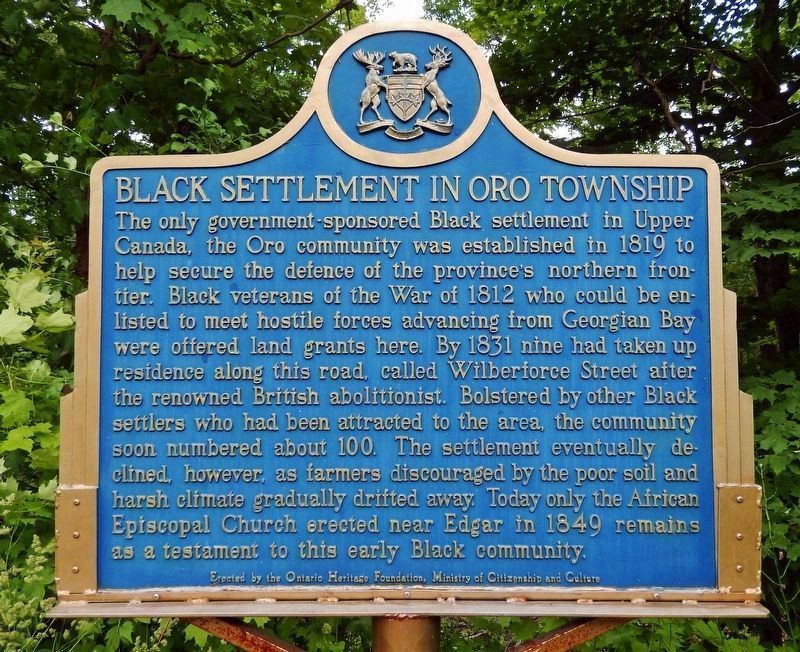
Photographed by Cosmos Mariner, June 6, 2024
1. Black Settlement in Oro Township
(marker north side • English)
(marker north side • English)

this page online
Erected by Ontario Heritage Foundation, Ministry of Citizenship and Culture/Fondation du patrimoine ontarien, Ministère des Affaires civiques et culturelles.
Topics and series. This historical marker is listed in these topic lists: Abolition & Underground RR • Colonial Era • Settlements & Settlers • War of 1812. In addition, it is included in the Canada, Ontario Heritage Trust series list. A significant historical year for this entry is 1819.
Location. 44° 23.936′ N, 79° 37.375′ W. Marker is in Shanty Bay, Ontario, in Simcoe County. It is on Line 1 South 0.9 kilometers east
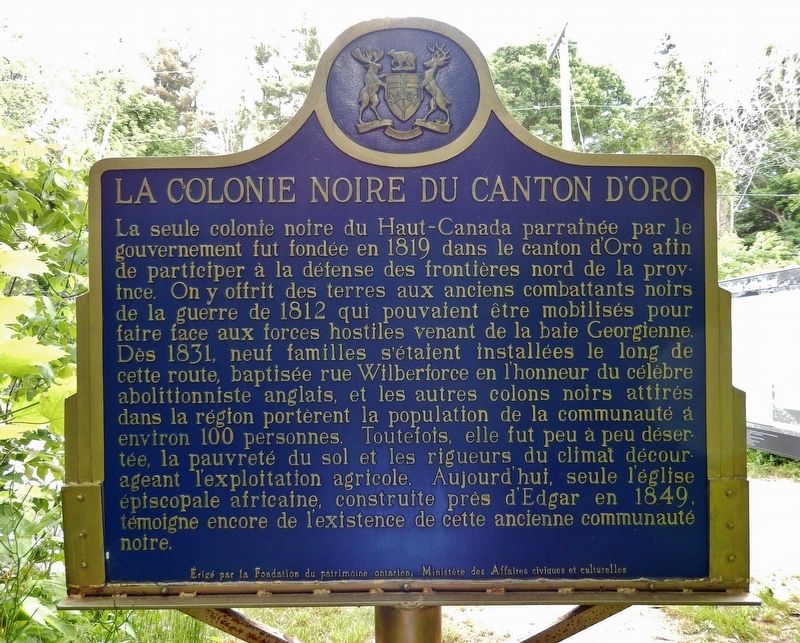
Photographed by Cosmos Mariner, June 6, 2024
2. La Colonie Noire du Canton d'Oro
(marker south side • Français)
(marker south side • Français)

Regionally, this marker is in Central Ontario Cottage Country and specifically in Georgian Bay Country. It is also in Central Canada. Globally, it is in North America, on the Great Lakes, in the Western Hemisphere, in the Western World, and in the Anglosphere. Historically, it finds itself in what was once a British colony, the Viceroyalty of New France, the Haudenosaunee (Iroquois) Confederacy, and Rupert’s Land.
Other nearby markers. At least 8 other markers are within 6 kilometers of this marker, measured as the crow flies: The Ice Industry (here, next to this marker); Early Settlement (here, next to this marker); Site of the Village of Kempenfelt (approx. 2.2 kilometers away); The Lost Village of Kempenfelt (approx. 2.3 kilometers away); St. Thomas' Church 1838 (approx. 3.5 kilometers away); Hon. Ernest Charles Drury (approx. 4.9 kilometers away);

Photographed by Cosmos Mariner, June 6, 2024
3. Black Settlement in Oro Township /
La Colonie Noire du Canton d'Oro Marker
La Colonie Noire du Canton d'Oro Marker
Looking south from the Oro-Medonte Rail Trail Parking Area.
Related markers. Click here for a list of markers that are related to this marker. The Black Settlement in Oro Township
Also see . . .
1. Oro-Medonte (Wikipedia).
Excerpt: Townships were created and surveyed on both sides of the Penetanguishene Rd c. 1820. Oro Township was one of those townships. Although there is no documentation about the origin of the name "Oro" it is assumed it came from the Spanish word for gold. After the War of 1812, Sir Peregrine Maitland, then Lieutenant-Governor of Upper Canada, offered Black veterans grants of land in what was to become the Township of Oro. Within a few years all Blacks of any origin could acquire land in Oro Township on an equal basis as any other settler. The Oro Black Settlement grew to about 90 families, then diminished as the settlers found steady income elsewhere (mainly on railway trains and ships on the Great Lakes). The last Oro Black retired to Barrie in the 1940s, and when he died, he was buried in the cemetery beside the Oro African Church.(Submitted on November 2, 2024, by Cosmos Mariner of Cape Canaveral, Florida.)
2. William Wilberforce (1759–1833) (Wikipedia).
Excerpt: A British politician, philanthropist, and a leader of the movement to abolish the slave trade. Wilberforce supported the campaign for the complete abolition of slavery and continued his involvement after 1826, when he resigned from Parliament because of his failing health. That campaign led to the Slavery Abolition Act 1833, which abolished slavery in most of the British Empire. Wilberforce died just three days after hearing that the passage of the Act through Parliament was assured. He was buried in Westminster Abbey, close to his friend William Pitt the Younger.(Submitted on November 2, 2024, by Cosmos Mariner of Cape Canaveral, Florida.)
Credits. This page was last revised on November 3, 2024. It was originally submitted on November 1, 2024, by Cosmos Mariner of Cape Canaveral, Florida. This page has been viewed 247 times since then and 39 times this year. Photos: 1, 2, 3. submitted on November 1, 2024, by Cosmos Mariner of Cape Canaveral, Florida.
