Near Barrie in Simcoe County, Ontario — Central Canada (North America)
Hon. Ernest Charles Drury

Photographed by Cosmos Mariner, June 6, 2024
1. Hon. Ernest Charles Drury Marker
A descendant of one of this area's pioneer families, Drury was born on this farm in 1878. His father, the Hon. Charles Drury, had served (1888-1890) as Ontario's first minister of agriculture. A graduate of the Ontario Agricultural College, E.C. Drury was appointed secretary of the Canadian Council of Agriculture in 1909, and became first president of the United Farmers of Ontario in 1914. The U.F.O. formed a political party in 1918, and with support from labour, won the general election of 1919. Returned as member for Halton, Drury became Ontario's eighth prime minister. Following his party's defeat in 1923, he retired from provincial politics, but later held various public offices in Simcoe County.
Erected by Ontario Archaeological and Historic Sites Board.
Topics and series. This historical marker is listed in these topic lists: Agriculture • Charity & Public Work • Government & Politics • Labor Unions. In addition, it is included in the Canada, Ontario Heritage Trust series list. A significant historical year for this entry is 1878.
Location. 44° 26.362′ N, 79° 38.822′ W. Marker is near Barrie, Ontario,
this page online

Regionally, this marker is in Central Ontario Cottage Country and specifically in Georgian Bay Country. It is also in Central Canada. Globally, it is in North America, on the Great Lakes, in the Western Hemisphere, in the Western World, and in the Anglosphere. Historically, it finds itself in what was once a British colony, the Viceroyalty of New France, the Haudenosaunee (Iroquois) Confederacy, and Rupert’s Land.
Other nearby markers. At least 8 other markers are within 6 kilometers of this marker, measured as the crow flies: Early Settlement (approx. 4.9 kilometers away); The Ice Industry (approx. 4.9 kilometers away); Black Settlement in Oro Township / La Colonie Noire du Canton d'Oro (approx. 4.9 kilometers away); Site of the Village of Kempenfelt (approx.
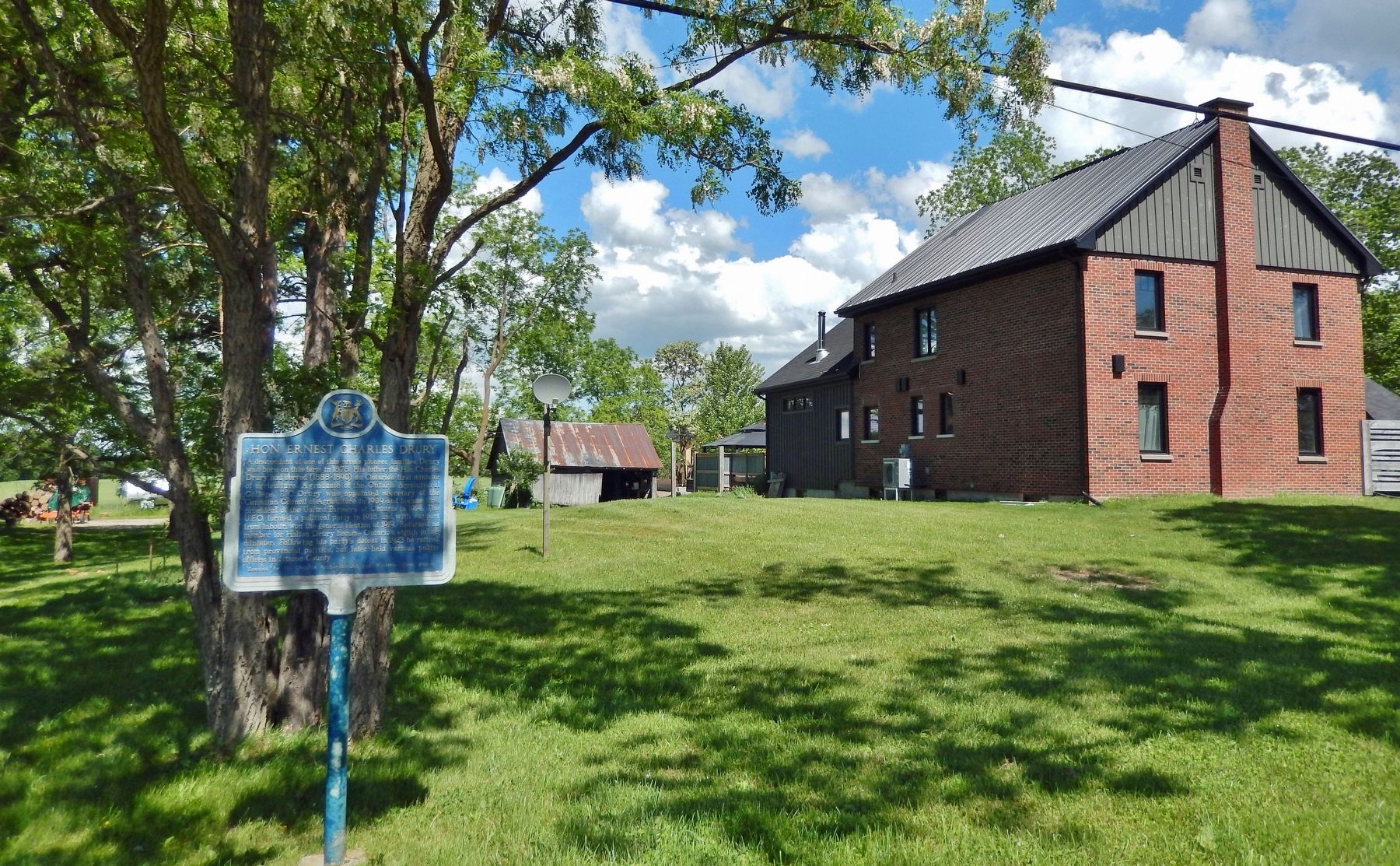
Photographed by Cosmos Mariner, June 6, 2024
2. Hon. Ernest Charles Drury Marker
Looking east from Penetanguishene Road; the former Drury farm is in the background.
More about this marker. Both sides of this marker have the same English inscription.
Also see . . .
1. Ernest Charles Drury (Canadian Encyclopedia).
Excerpt: After WWI the UFO became a political force, but Drury was not a candidate when it challenged the Conservative government in the Ontario general election of 1919. With the support of labour it won enough seats to form a government, and it called on Drury to lead it. His administration was noted for important social legislation and for the strict enforcement of the Ontario Temperance Act. In 1934 he was appointed sheriff and registrar of Simcoe County and devoted considerable time to writing on public affairs and preparing local histories. His memoirs, Farmer Premier, were published shortly before his death.(Submitted on November 1, 2024, by Cosmos Mariner of Cape Canaveral, Florida.)
2. Ernest Charles Drury (Wikipedia).
Excerpt: The Drury government had a significant impact on the Province:(Submitted on November 1, 2024, by Cosmos Mariner of Cape Canaveral, Florida.)• It introduced allowances for widows and children, a minimum wage for women, a mandatory weekly day of rest, broadened workmen's compensation benefits improved the support mechanisms for parents and children born out of wedlock, and standardized adoption procedures.
• Ontario Hydro saw greater expansion in the field of rural electrification.
• The Province of Ontario Savings Office was created, effectively a provincially-owned bank that was designed to lend money to farmers at a lower rate.
• It began the first major reforestation program in North America, and initiated construction of the modern highway system.
• Drury also arranged for a grant to Frederick Banting and Charles Best, at that time relatively unknown researchers, as a result of their discovery of insulin.
3. Hon. Ernest Charles Drury (Canadian Agricultural Hall of Fame).
Excerpt: Following his academic training at the Ontario Agricultural College, Ernest Drury returned to the home farm where he became a leader in his community and later the first citizen of the province. As a young farmer he applied the knowledge gained at college and thereby became a teacher by example. Among his innovations, which were widely copied, was that of building the first cement silo in Simcoe County.(Submitted on November 1, 2024, by Cosmos Mariner of Cape Canaveral, Florida.)
Credits. This page was last revised on November 1, 2024. It was originally submitted on November 1, 2024, by Cosmos Mariner of Cape Canaveral, Florida. This page has been viewed 176 times since then and 35 times this year. Photos: 1, 2. submitted on November 1, 2024, by Cosmos Mariner of Cape Canaveral, Florida.
