Penetanguishene in Simcoe County, Ontario — Central Canada (North America)
Penetanguishene/Pénétanguishene
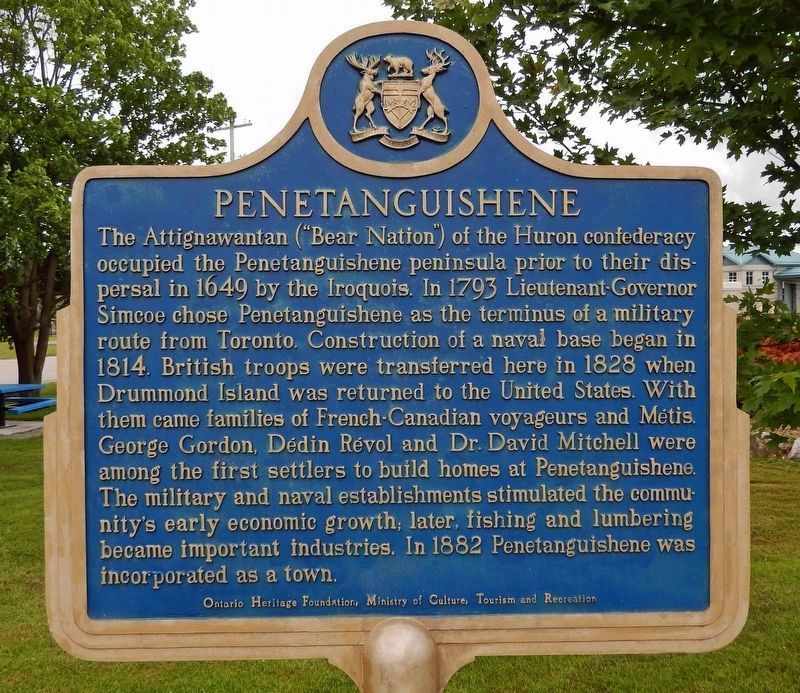
Photographed by Cosmos Mariner, June 7, 2024
1. Penetanguishene (marker east side • English)

this page online
Erected by Ontario Heritage Foundation, Ministry of Culture, Tourism and Recreation/Fondation du patrimoine ontarien, Ministère de la Culture, du Tourisme et des Loisirs.
Topics and series. This historical marker is listed in these topic lists: Indigenous Peoples and Communities • Industry & Commerce • Roads & Vehicles • Settlements & Settlers. In addition, it is included in the Canada, Ontario Heritage Trust series list. A significant historical year for this entry is 1882.
Location. 44° 46.335′ N, 79° 56.229′ W. Marker is in Penetanguishene, Ontario, in Simcoe
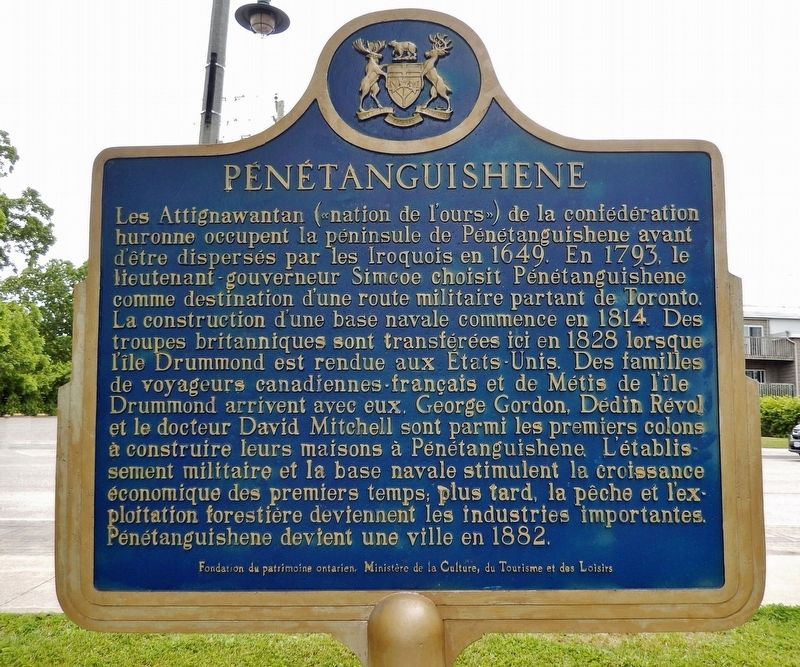
Photographed by Cosmos Mariner, June 7, 2024
2. Pénétanguishene (marker west side • Français)

Regionally, this marker is in Central Ontario Cottage Country and specifically in Georgian Bay Country. It is also in Central Canada. Globally, it is in North America, on the Great Lakes, in the Western Hemisphere, in the Western World, and in the Anglosphere. Historically, it finds itself in what was once a British colony, the Viceroyalty of New France, the Haudenosaunee (Iroquois) Confederacy, and Rupert’s Land.
Other nearby markers. At least 8 other markers are within walking distance of this marker: Penetanguishene Tercentenary Polar Sea Expedition (within shouting distance of this marker); “Bound Together” (Huron Wendat Canoe) / Étroitement liés (canot huron-wendat) (approx. 0.3 kilometers away); The Wendat (approx. 0.3 kilometers away); Champlain in Ontario, 1615 (approx. 0.3 kilometers away); The Meeting / La rencontre (approx. 0.3 kilometers

Photographed by Cosmos Mariner, June 7, 2024
3. Penetanguishene/Pénétanguishene Marker
Looking west across Penetanguishene Rotary Park from Main Street.
Also see . . . Penetanguishene (Wikipedia).
Excerpt: In 1793, John Graves Simcoe, the first Lieutenant Governor of Upper Canada, visited the area and saw the location's potential as a Royal Navy naval base. He wanted to use the bay to shelter warships to protect Upper Canada, which had coasts on lakes Huron, Erie and Michigan opposite the Northwest Territory and New York State of the United States of America, from American military aggression and territorial expansion. The Penetanguishene Naval Yard was built by the Royal Navy in 1813. In 1817, naval units from Michilimackinac and Schooner Town (near modern-day Wasaga Beach) were consolidated at the Penetanguishene Naval Yard. In 1828, the main British military establishment on the Upper Lakes moved from Drummond Island to Penetanguishene. In the 1840s, French-speaking families from Canada East (mainly from the area immediately east of Montreal), attracted by promises of cheap and fertile land, joined the French-speaking Drummond Island settlers already in the area. Many of Penetanguishene's families today are descended from the Québécois settlers who arrived in the 1800s, giving the town a marked bilingual nature.(Submitted on November 4, 2024, by Cosmos Mariner of Cape Canaveral, Florida.)
Credits. This page was last revised on November 4, 2024. It was originally submitted on November 2, 2024, by Cosmos Mariner of Cape Canaveral, Florida. This page has been viewed 200 times since then and 32 times this year. Photos: 1, 2, 3. submitted on November 4, 2024, by Cosmos Mariner of Cape Canaveral, Florida.
