Downtown Halifax in Halifax Region, Nova Scotia — The Atlantic Provinces (North America)
Citadel Hill/La Colline de la Citadelle/Kuowaqe'jk
Photographed by Sandra Hughes Tidwell, October 15, 2024
1. Citadel Hill/La Colline de la Citadelle/Kuowaqe'jk Marker
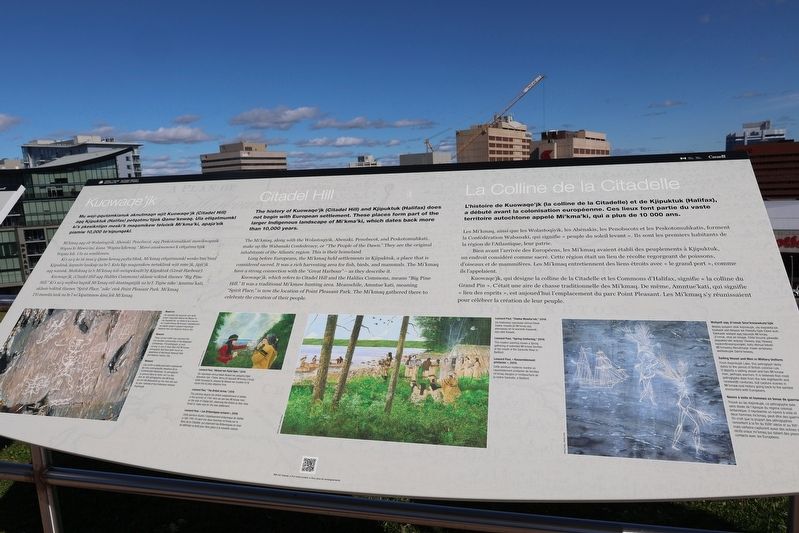
The Mi’k’maq, along with the Wolastoqiyik, Abenaki, Penobscot, and Peskotomuhkati, make up the Wabanaki Confederacy, or “The People of the Dawn.” They are the original inhabitants of the Atlantic region. This is their homeland.
Long before Europeans, the Mi’kmaq held settlements in Kijipunktuk, a place that is considered sacred. It was a rich harvesting area for fish, birds, and mammals. The Mi’kmaq have strong connections with the “Great Harbor” - as they describe it.
Kuowaqe`jk, which refers to Citadel Hill and the Halifax Commons, means “Big PineHill.” It was a traditional Mi’kaw hunting area. Meanwhile, Ante’kati, meaning “Spirit Place, “ is now the location of Point Pleasant Park. The Mi’kmaq gathered there to celebrate the creation of their people.
Kuowaqe’jk Mu weji-pqutamkianuk aknutmaqn wijit Kuowage’jk (Citidal Hill) Aqq Kilpunktuk (Halifax) petqatmu’tijek Qame’kewaq. Ula etiqatmumkl
this page online
Mi’kmaq aqq elt Wolastoqiyik, Abenki, Penobscot,, aqq Peskotmuhkati mawikwapnik Wapna’ki Mawio’mi, kisna “Wapna’kikewaq.” “Mawi-amskwesewe’k etlqatmu’tijik Wapna’kik. Ula na wmitkiwew.
Ki’s’qke’sk mna’q Qame’kewaq peija’tikek, Mi’kmaq etlqatmumkl wesko’tmi’tisnl Kjipuktuk, kepmite’tasiksip na’te’l. Kelu’kip maqamikew netuklimk wjit nme’jk, jipji’k aqq waisisk. Melkiknaq ta’n Mi’kmaq teli-wetapeksulti’tij Kijpuktuk (Great Harbour).
Kuwaqe’jk, (Citadel Hill aqq Halifax Commons) aklasie’wiktuk trueness “Big PineHill.” Ki’s sh’q wejkaw’taqnik Mi’kmaq etli-ktantaqatijik na’te’l. Tujw nike’Amntue’kati, aklasi’wiktuk tluenes “Spirit Place, “ nike’etek Point Pleasant Park. Mi’kmaq I’tl-mawita’snik na’ta’l wi’kapatmnew kisu’jek Mi’kmaq.
La Colline de la Citadelle
French: L’histoire de Kuowaqe’jk (la collins de la Citadelle) et de Kipuktuk (Halifax), a de`bute` avant la colonisation europe`ene. Ces lieux font partie de caste territoire autochtone appele` Mi’kma’ki, qui a plus de 10 000 ans.
Les Mi’kmaq, ainsi que les Wolastoqiyik, les Abenaki’s,le Penobscots et les Peskotomuhkatis, form la Confe`deration Wabanaki, qui signify “peuple du soleil levant” Ils sont premiers habitants la re`gion de l’Atlantique, leur patrie.
Bien avant l’arrive`e des Europe`ens, les Mi’kmaq avaient e`tabli des peuplements a` Kjipuktuk, un endroit conside`re` comme sacre`. Cette re`gion e`tait un lieu de re`colte regorgeant de poissons, D’oiseaux et de mammife`res. Les Mi’kmaq entretiennent des liens e`troits ave “le grand port” comme ils l’appelaient.
Kuowaqe’jk, qui de`signe la collins de la Citadelle et les Commons d’Halifax, signifie “la colline du Grand Pin”. C’e`tait une aire de chasse traditionnelle des Mi’kmaq. De e^me, Amtue`kati, qui signifie “lieu ce`le`brer la cre`ation de leur peuple.
Captions:
Mawio’mi
Ula elapskita’siki kaqamiki wjit nanki wutani naspultjik Wapna’kik Mawio’mi. Ula Elapskita’sik, na newte’jk ta’n piaiw na’n kaskimtinaqn Mi’kmawe’l elapskita’siki we’jitasiki qaspemi Kejimkukik National Park and National Historic Site.
Mawomi
These Carved motifs may represent the five-member communities of the Wabanaki Confederacy. This petroglyph or rock carving, is one of more than 500 Mi’kaw petroglyphs that have been found on lakeshores at Kejimkujik National Park and National Historic Site.
Mawomi Ces motifs sculpte`s pruraient repre`senter les cinq communaute`s membres de la Confederation Wabanaki. Ce pe`troglyphs, ou gravure dans la roche, est i’un des plus de 500 pe`troglyphes des Mi’kmaq qui ont e`t`e de`couverts sur les rives des lacs du parc national et national ry lieu hidyotiwur national Kejimkujik.
Captions:
Leonard Paul, “Aklasie’wk Pejita’tijek,” 2019 Ula napuikaqn eakinua’tekek Aklasie’wk petqatmu’tijek Kijpuktuk nick 1749ek. Nemu’jik tapusijik Mi’kmaq ji’nmuk, Eykik Kuowaqe’jk, jikeywa’tji Aklasie’wk musikte’mi’tij Nipukt eitu’tij etiqatmu’timk.
Leonard Paul, “The British Arrive,” 2019 This painting depicts the British establishment of Halifax in the summer of 1749. Here we see two Mik’maw men, on the side of Citadel Hill, observing the British as they clear the forest to make a new settlement.
Leonard Paul, “Les Britanniques arrivent,” 2019 Cette peinture illustre l’e`tablissment britannique de Halifax a`le`te` 1749. On peut voir deux hommes mi’kmaq sur le flanc de la Citadelle, qui observent les Britanniques en train de de`fricher la forest pour faire place a` la nouvelle colony.
Captions:
Leonard Paul, “Siwkw Mawita’mk 2019 Ula kejikawey napuikaqn ekinua’tekek Siwkw mawita’jik Mi’kmaq aqq wikmawaq eti-te’wamkitk Kwipewk sipu etek Kwipek.
Leonard Paul, “Spring Gatherings,” 2019. This modern painting shows a Spring gathering of extended Mi’kmaw families at the mouth of the Sackville River in Bedford.
Leonard Paul, “Rassemblement printanier, “ 2019 Cette peinture moderne monte un rassemblememt printanier de familles mi’kmaq e`largies a` l’embouchure de la rivie`re Sackville, a` Bedford.
Walipoti aqq Ji’nmuk Sam’knisewkuta’tijik Wejiaq qosepem eaten Kejimkujik, ula elapskita’sik Kisitasik ate Aklasie’wk Pkisitu’tijek Eleke’wuti. Ewikasik talipot aqq tapusijik Mi’kmaq Ji’nmuk, etuk jel kinapk, Etlite’tmumk pikwelki Elapskita’siki wejiaql 18ewey aqq 19ewey kaskimtinaqnipunqekl, katu ekinua’tekeki Mi’kmawey Aknutmaqn mawi -amskwes Welteskujek Qame’kewaq.
Sailing Vessel and Men in Military Uniform From Kejimkujik Lake, this petroglyph likely dates to the period of British colonial rule. It depicts a sailing vessel and two Mi’kmaw men, perhaps warriors. It is believed that most petroglyphs date from the late eighteenth and nineteenth centuries, but capture scenes in Mi’kmaw oral history going back to the earliest encounters with Europeans.
Navire a` et hommes en venue de queerie Touve` au lac Kejimkujik, ce pe`troglyphe date San route de l’e`oque du re`gime colonial Britannique. Il repre`sente un navire a` voile et Deux hommes mi’kmaq, peut-e^tre des guerre. On Croat que la plupart des pe`troglyphes Remounted a` la fin du XVIII sie`cle et au XIX Mais curtains captuent jussi des scenes re`cits oraux mi’kmaq qui dates des premi Contacts avec les Europe`ens.
Topics. This historical marker is listed in these topic lists: Environment • Forts and Castles • Indigenous Peoples and Communities. A significant historical year for this entry is 2019.
Location. 44° 38.858′ N, 63° 34.735′ W. Marker is in Halifax, Nova Scotia, in Halifax Region. It is in Downtown Halifax. It is on Sackville Street. This marker is facing the entrance to the Citadel. Touch for map. Marker is at or near this postal address: 5425 Sackville St, Halifax NS B3J 3Y3, Canada. Touch for directions.

Regionally, this marker is in the Maritimes and in Atlantic Canada. Globally, it is in the North Atlantic Region, North America, the Western Hemisphere, the Western World, and the Anglosphere. Historically, it finds itself in what was once a British colony, the Viceroyalty of New France, and Acadia.
Other nearby markers. At least 8 other markers are within walking distance of this marker: The Saluting Battery / La batterie de salut (a few steps from this marker); The Convoys / Les convois (a few steps from this marker); The Acadians on George Island / Les Acadiens sur l'Île Georges (a few steps from this marker); The Jamaican Maroons/Les Marrons de la Jamaique (a few steps from this marker); The Halifax Explosion/L'explosion d'Halifax (a few steps from this marker); Fortress Halifax/La forteresse Halifax (a few steps from this marker); Halifax Citadel / La Citadelle d’Halifax (a few steps from this marker); D-Day/Jour J (a few steps from this marker). Touch for a list and map of all markers in Halifax.
Also see . . . Citadel Hill (Fort George). Citadel Hill is a hill that is a National Historic Site in Halifax, Nova Scotia, Canada. Four fortifications have been constructed on Citadel Hill since the city was founded by the English in 1749, and were referred to as Fort George—but only the third fort (built between 1794 and 1800) was officially named Fort George. According to General Orders of October 20, 1798, it was named after King George III. The first two and the fourth and current fort, were officially called the Halifax Citadel. The last is a concrete star fort. (Submitted on November 4, 2024, by Sandra Hughes Tidwell of Killen, Alabama, USA.)
Credits. This page was last revised on November 22, 2024. It was originally submitted on November 4, 2024, by Sandra Hughes Tidwell of Killen, Alabama, USA. This page has been viewed 393 times since then and 99 times this year. Photo 1. submitted on November 4, 2024, by Sandra Hughes Tidwell of Killen, Alabama, USA. • Bill Pfingsten was the editor who published this page.
