Downtown in Anchorage, Alaska — Northwest (North America)
Anchorage Area Pre 1915
Photographed by William Fischer, Jr., August 12, 2024
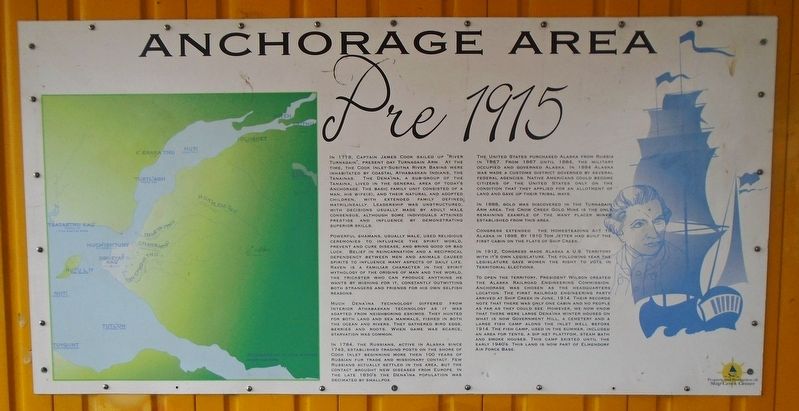
1. Anchorage Area Pre 1915 Marker
In 1778, Captain James Cook sailed up "River Turnagain", present day Turnagain Arm. At the time, the Cook Inlet-Susitna River Basins were inhabited by coastal Athabaskan Indians, the Tanainas. The Dena'ina, a sub-group of the Tanaina, lived in the general area of today's Anchorage. The basic family unit consisted of a man, his wife(s), and their natural and adopted children, with extended family defined matrilineally. Leadership was unstructured, with decisions usually made by adult male consensus, although some individuals attained prestige and influence by demonstrating superior skills.
Powerful shamans, usually male, used religious ceremonies to influence the spirit world, prevent and cure disease, and bring good or bad luck. Belief in reincarnation and a reciprocal dependency between men and animals caused spirits to influence many aspects of daily life. Raven is a familiar character in the spirit mythology of the origins of man and the world, the trickster who can produce anything he wants by wishing for it, constantly outwitting both strangers and friends for his own selfish reasons.
Much Dena'ina technology differed
this page online
In 1784, the Russians, active in Alaska since 1743, established trading posts on the shore of Cook Inlet beginning more [than] 100 years of Russian fur trade and missionary contact. Few Russians actually settled in the area, but the contact brought new diseases from Europe. In the late 1830's the Dena'ina population was decimated by smallpox.
The United States purchased Alaska from Russia in 1867. From 1867 until 1884, the military occupied and governed Alaska. In 1884 Alaska was made a customs district governed by several federal agencies. Native Americans could become citizens of the United States only on the condition that they applied for an allotment of land and gave up their tribal ways.
In 1888, gold was discovered in the Turnagain Arm area. The Crow Creek Gold Mine is the only remaining example of the many placer mines established from this area.
Congress extended the Homesteading
Photographed by William Fischer, Jr., August 12, 2024
2. Anchorage Area Pre 1915 Marker
In 1912, Congress made Alaska a U.S. Territory with it's own legislature. The following year the legislature gave women the right to vote in Territorial elections.
To open the territory, President Wilson created the Alaska Railroad Engineering Commission. Anchorage was chosen as the headquarters location. The first railroad engineering party arrived at Ship Creek in June, 1914. Their records note that there was only one cabin and no people as far as they could see. However, we now know that there were large Dena'ina winter houses on what is now Government Hill, a cemetery and a large fish camp along the inlet well before 1914. The fish camp, used in the summer, included an area for tents, a dip net plat[form], steam bath and smoke houses. This camp existed until the early 1940's. This land is now part of Elmendorf Air Force Base.
[Map with Athabaskan place names]
Erected by 4th Avenue Market Place.
Topics. This historical marker is listed in these topic lists: Environment • Exploration • Indigenous Peoples and Communities • Settlements & Settlers. A significant historical year for this entry is 1778.
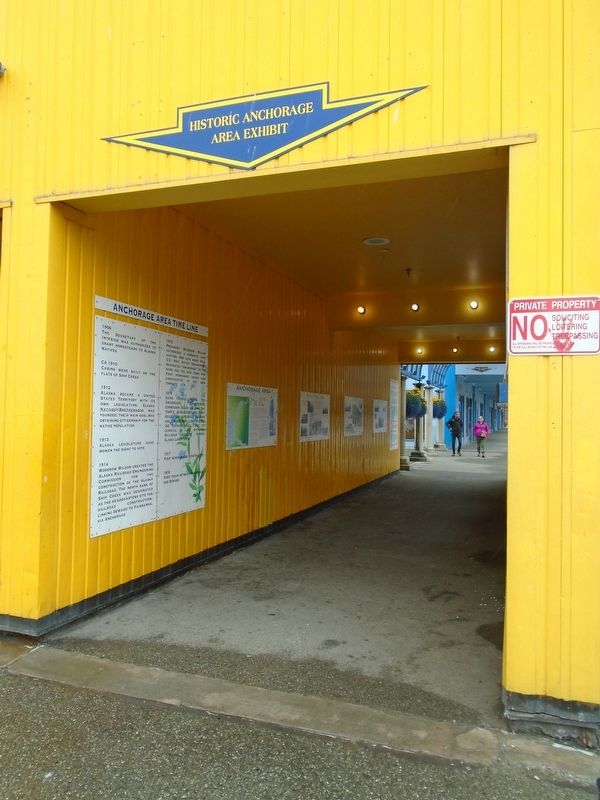
Location. 61° 13.123′ N, 149° 53.383′ W. Marker is in Anchorage, Alaska. It is in Downtown. It is on West 4th Avenue west of C Street, on the right when traveling west. Marker is under the covered 4th Avenue Market Place colonnade between C and D Streets. Touch for map. Marker is at or near this postal address: 333 West 4th Avenue, Anchorage AK 99501, United States of America. Touch for directions.

Regionally, this marker is in the Alaska Railroad Corridor, in the Athabascan Region, in the Prince William Sound, and in Southcentral Alaska. It is also on the American Pacific Coast. Globally, it is in North America, on the Ring of Fire, on the Pacific Rim, in the Western Hemisphere, in the Western World, and in the Anglosphere. Historically, it finds itself in what was once the Russian Empire.
Other nearby markers. At least 8 other markers are within walking distance of this marker: Anchorage Area 1915 (here, next to this marker); Anchorage Area 1920s (here, next to this marker); Anchorage Area 1916-1920 (here, next to this marker); Alaska Territorial Guard (here, next to this marker); Anchorage Area 1930-1939 (within shouting distance of this marker); Iditarod Sled Dog Race History (within shouting distance of this marker); Racing in the Footsteps of a Legend (within shouting distance of this marker); Suk Du (within shouting distance of this marker). Touch for a list and map of all markers in Anchorage.
Credits. This page was last revised on November 5, 2024. It was originally submitted on November 4, 2024, by William Fischer, Jr. of Reynoldsburg, Ohio. This page has been viewed 198 times since then and 27 times this year. Photos: 1, 2. submitted on November 4, 2024, by William Fischer, Jr. of Reynoldsburg, Ohio.
