Excelsior in Hennepin County, Minnesota — The American Midwest (Upper Plains)
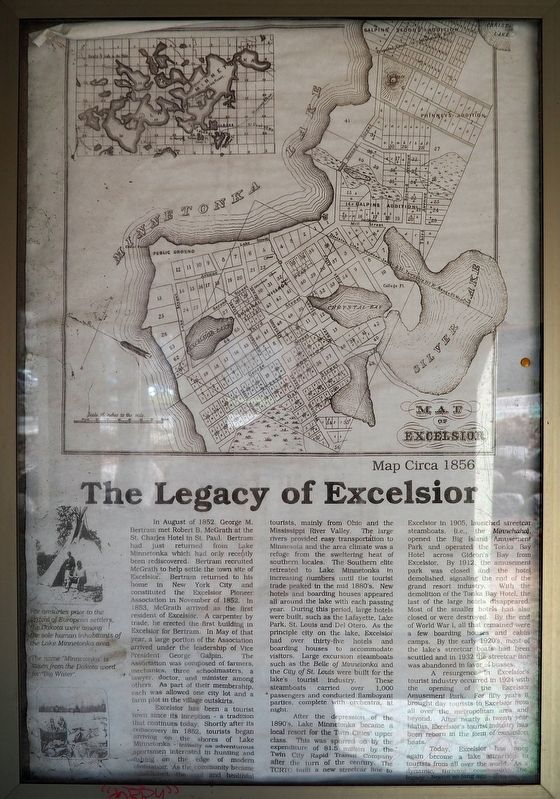
The Legacy of Excelsior
Photographed by McGhiever, April 14, 2023
1. The Legacy of Excelsior Marker
[Caption:] Map Circa 1856
For centuries prior to the arrival of European settlers, the Dakota were among the sole human inhabitants of the Lake Minnetonka area.
The name "Minnetonka" is taken from the Dakota word for "Big Water".
In August of 1852 George M. Bertram met Robert B. McGrath at the St. Charles Hotel in St. Paul. Bertram had just returned from Lake Minnetonka which had only recently been rediscovered. Bertram recruited McGrath to help settle the town site of Excelsior. Bertram returned to his home in New York City and constituted the Excelsior Pioneer Association in November of 1852. In 1853, McGrath arrived as the first resident of Excelsior. A carpenter by trade, he erected the first building in Excelsior for Bertram. In May of that year, a large portion of the Association arrived under the leadership of Vice President George Galpin. The Association was composed of farmers, mechanics, three schoolmasters, a lawyer, doctor, and minister among others. As part of their membership, each was allowed one city lot and a farm plot in the village outskirts.
Excelsior has been a tourist town since its inception
this page online
Photographed by McGhiever, April 14, 2023
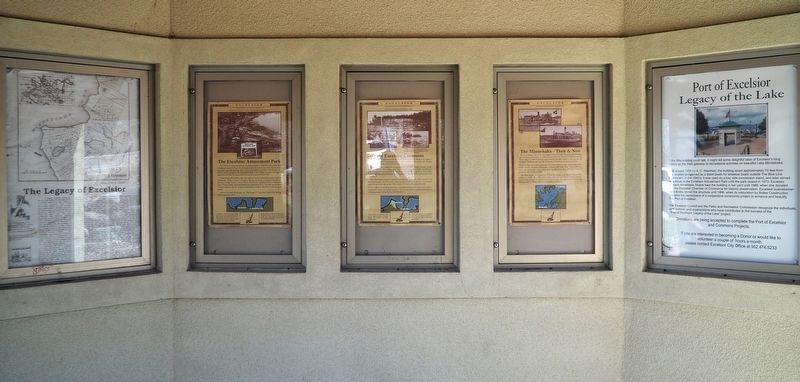
2. The Legacy of Excelsior Marker (left) inside the kiosk at the Port of Excelsior
After the depression of the 1890's, Lake Minnetonka became a local resort for the Twin Cities' upper class. This was spurred on by the expenditure of $1.5 million by the Twin City Rapid Transit Company after the turn of the century. The TCRTC built a new streetcar line to Excelsior in 1905, launched streetcar steamboats, (i.e.. the Minnehaha), opened the Big Island Amusement Park and operated the Tonka Bay Hotel across from Gideon's Bay in Excelsior. By 1912, the amusement park had closed and the hotel demolished, signaling the end of the grand resort industry. With the demolition of the Tonka Bay Hotel, the last of the large hotels disappeared. Most of the smaller hotels had also closed or were destroyed. By the end of World War I, all that remained were a few boarding houses and cabin camps. By the early 1920's, most of the lake's streetcar boats had been scuttled and in 1932 the streetcar line was abandoned in favor of busses.
A resurgence in Excelsior's tourist industry occurred in 1924 with the opening of the Excelsior Amusement Park. For fifty years it brought day tourists to Excelsior from all over the metropolitan area and beyond. After nearly a twenty-year hiatus, Excelsior's tourist industry has been reborn in the form of excursion boats.
Today, Excelsior has once again become a lake attraction to tourists from all over the world. As a dynamic, thriving community, the legacy - begun so long ago - lives on.
Topics. This historical marker is listed in these topic lists: Entertainment • Indigenous Peoples and Communities • Settlements & Settlers • Waterways & Vessels. A significant historical year for this entry is 1852.
Location. 44° 54.276′ N, 93° 33.908′ W. Marker is in Excelsior, Minnesota, in Hennepin County. It can be reached from the intersection of Water Street and Lake Street. The marker is inside the kiosk at the Port of Excelsior. Touch for map. Marker is at or near this postal address: 2 Water Street, Excelsior MN 55331, United States of America. Touch for directions.

Regionally, this marker is in the Twin Cities Metropolitan Area. It is also in the American Midwest, in the Corn Belt, and in the Great River Road Region. Globally, it is in North America, the Western Hemisphere, the Western World, and the Anglosphere. Historically, it finds itself in what was once Rupert’s Land, the territory of the Mississippian Culture, and the Louisiana Purchase.
Other nearby markers. At least 8 other markers are within walking distance of this marker: The Excelsior Amusement Park (here, next to this marker); The Belle of Minnetonka & The City of Saint Louis (here, next to this marker); Excelsior - Who We Are (here, next to this marker); The Excelsior Commons (here, next to this marker); Big Island History (here, next to this marker); A History of Excelsior (here, next to this marker); The Minnehaha - Then & Now (here, next to this marker); Your Are Here (here, next to this marker). Touch for a list and map of all markers in Excelsior.
Credits. This page was last revised on November 7, 2024. It was originally submitted on November 5, 2024, by McGhiever of Minneapolis, Minnesota. This page has been viewed 526 times since then and 149 times this year. Photos: 1, 2. submitted on November 5, 2024, by McGhiever of Minneapolis, Minnesota.
