Pelican Rapids in Otter Tail County, Minnesota — The American Midwest (Upper Plains)
Pelican Rapids
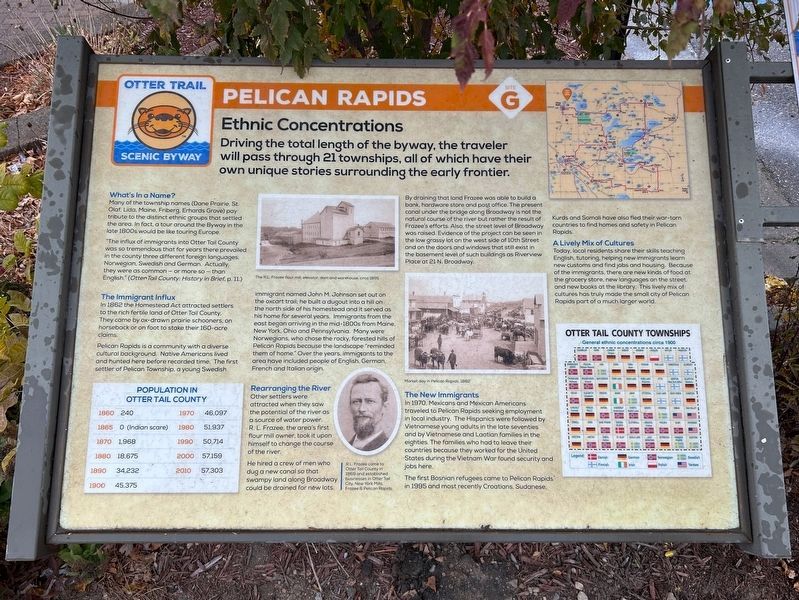
Ethnic Concentrations
| — | Otter Trail Scenic Byway Site G | — |
October 24, 2024
1. Pelican Rapids Marker
Driving the total length of the byway, the traveler will pass through 21 townships, all of which have their own unique stories surrounding the early frontier.
What's In a Name?
Many of the township names (Dane Prairie, St. Olaf, Lida, Maine, Friberg, Erhards Grove) pay tribute to the distinct ethnic groups that settled the area. In fact, a tour around the Byway in the late 1800s would be like touring Europe.
"The influx of immigrants into Otter Tail County was so tremendous that for years there prevailed in the county three different foreign languages: Norwegian, Swedish and German. Actually, they were as common — or more so — than English." (Otter Tail County: History in Brief, p. 11.)
The Immigrant Influx
In 1862 the Homestead Act attracted settlers to the rich fertile land of Otter Tail County. They came by ox-drawn prairie schooners, on horseback or on foot to stake their 160-acre claims.
Pelican Rapids is a community with a diverse cultural background. Native Americans lived and hunted here before recorded time. The first settler of Pelican Township, a young Swedish immigrant named John M. Johnson set
this page online
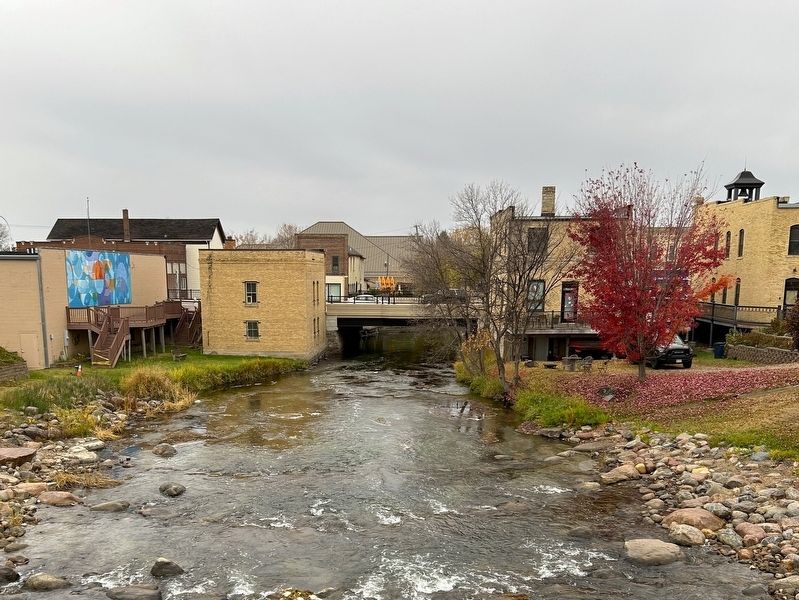
Rearranging the River
Other settlers were attracted when they saw the potential of the river as a source of water power. R. L. Frazee, the area's first flour mill owner, took it upon himself to change the course of the river.
He hired a crew of men who dug a new canal so that swampy land along Broadway could be drained for new lots.
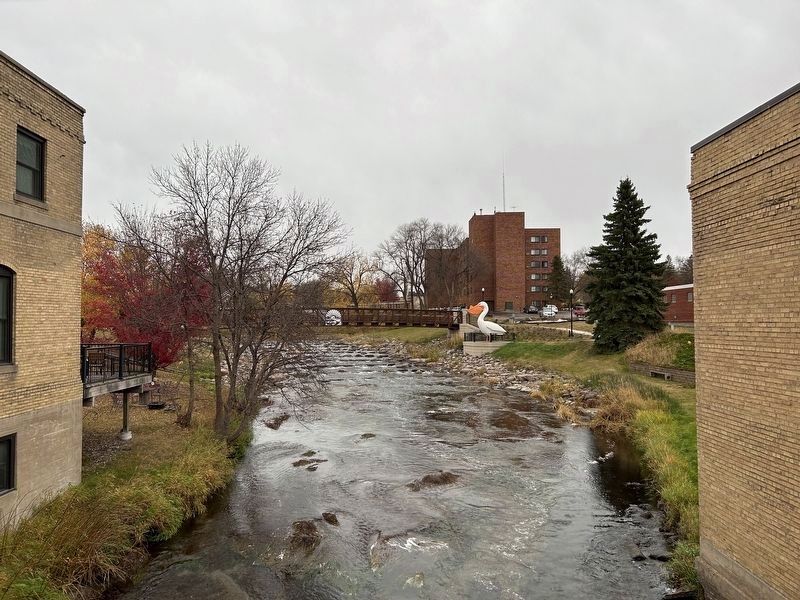
By draining that land Frazee was able to build a bank, hardware store and post office. The present canal under the bridge along Broadway is not the natural course of the river but rather the result of Frazee's efforts. Also, the street level of Broadway was raised. Evidence of the project can be seen in the low grassy lot on the west side
October 24, 2024
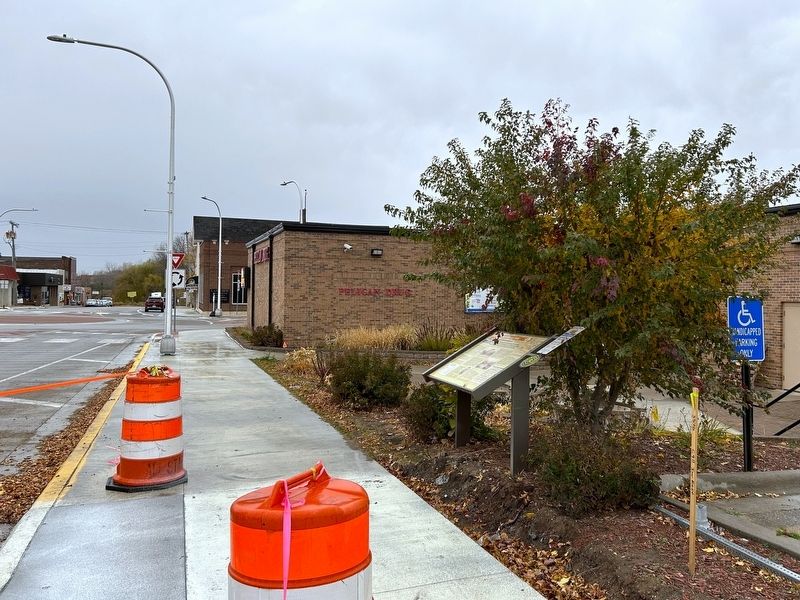
2. Pelican Rapids Marker, from the east
The New Immigrants
In 1970, Mexicans and Mexican Americans traveled to Pelican Rapids seeking employment in local industry. The Hispanics were followed by Vietnamese young adults in the late seventies and by Vietnamese and Laotian families in the eighties. The families who had to leave their countries because they worked for the United States during the Vietnam War found security and jobs here.
The first Bosnian refugees came to Pelican Rapids in 1995 and most recently Croatians, Sudanese, Kurds and Somali have also fled their war-torn countries to find homes and safety in Pelican Rapids.
A Lively Mix of Cultures
Today, local residents share their skills teaching English, tutoring, helping new immigrants learn new customs and find jobs and housing. Because of the immigrants, there are new kinds of food at the grocery store, new languages on the street, and new books at the library. This lively mix of cultures has truly made the small city of Pelican Rapids part of a much larger world.
Captions:
The R.L. Frazee flour mill, elevator, dam and warehouse, circa 1895
R.L. Frazee came to Otter Tail County in 1869 and established businesses in Otter Tail City, New York Mills, Frazee & Pelican Rapids.
Market day in Pelican Rapids, 1882
Population in Otter Tail County
1860:
October 24, 2024
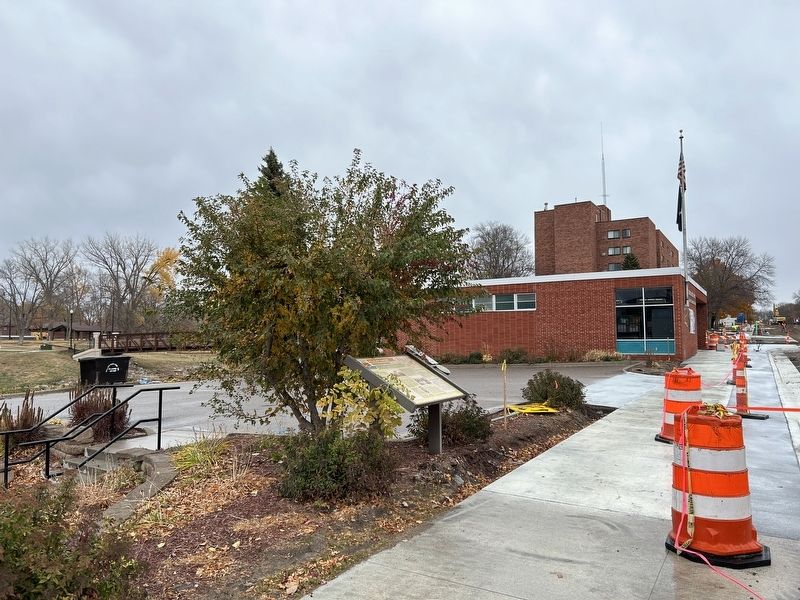
3. Pelican Rapids Marker, from the west
1970: 46,097 · 1980: 51,937 · 1990: 50,714 · 2000: 57,159 · 2010: 57,303
Otter Tail County Townships
General ethnic concentrations circa 1900
Scambler: Norwegian · Dunn: Norwegian · Candor/Vergas: German · Hobart: German · Gorman: German · Corliss: Polish · Butler: Finnish · Paddock: Finnish
Norwegian Grove: Norwegian · Pelican/Pelican Rapids: Norwegian · Lida: Swedish · Dora: German · Edna/Dent: German · Perham: German · Pine Lake: German · Homestead: Finnish · Blowers: Finnish
Trondhjem/Rothsay: Norwegian · Erhards Grove/Erhard: Norwegian · Maplewood: German · Star Lake: Irish · Dead Lake: German · Rush Lake/Richville: German · Otto: Finnish · Newton/New York Mills: Finnish · Bluffton/Bluffton: German
Oscar: Norwegian · Elizabeth/Elizabeth: German · Friberg: German · Maine: Irish · Amor: Swedish · Ottertail: German · Leaf Lake: Finnish · Deer Creek: Finnish · Compton: German
Carlisle/Carlisle: German · Fergus Falls; German · Aurdal: Norwegian · Sverdrup/Underwood: Norwegian · Everts/Battle Lake: Norwegian · Girard: Norwegian · Henning: Swedish · Inman: Yankee · Oak Valley: Yankee
Orwell: German · Buse: German · Dane Prairie: Norwegian · Tordenskjold: Danish · Clitherall: Norwegian · Nidaros/Vining: Norwegian · Folden: Norwegian · Elmo: Norwegian · Woodside: Yankee
Western: German · Aastad: Norwegian · Tumuli/Dalton: Norwegian · St. Olaf: Norwegian · Eagle Lake: Swedish · Leaf Mountain: Norwegian · Effington: German · Parkers Prairie: Swedish · Eastern: Swedish
Erected by Otter
October 24, 2024
4. Pelican River, from Broadway
Topics. This historical marker is listed in these topic lists: Immigration • Settlements & Settlers • Waterways & Vessels. A significant historical year for this entry is 1862.
Location. 46° 34.164′ N, 96° 4.978′ W. Marker is in Pelican Rapids, Minnesota, in Otter Tail County. It is on East Mill (State Highway 108) east of North Broadway (U.S. 59), on the right when traveling west. Touch for map. Marker is at or near this postal address: 11 N Broadway, Pelican Rapids MN 56572, United States of America. Touch for directions.

Regionally, this marker is in the American Midwest and in the Corn Belt. Globally, it is in North America, the Western Hemisphere, the Western World, and the Anglosphere. Historically, it finds itself in what was once Rupert’s Land, the territory of the Mississippian Culture, and the Louisiana Purchase.
Other nearby markers. At least 8 other markers are within 3 miles of this marker, measured as the crow flies: The World's Largest Pelican (within shouting distance of this marker); Arrival of the Railroad at Pelican Rapids (about 600 feet away, measured in a direct
October 24, 2024
5. Pelican River's course under Broadway
Also see . . . Early Pelican Rapids – City of Pelican Rapids. (Submitted on November 5, 2024.)
Credits. This page was last revised on November 5, 2024. It was originally submitted on November 5, 2024. This page has been viewed 344 times since then and 58 times this year. Photos: 1, 2, 3, 4, 5. submitted on November 5, 2024.
