Penetanguishene in Simcoe County, Ontario — Central Canada (North America)
Joseph Le Caron
1586-1632
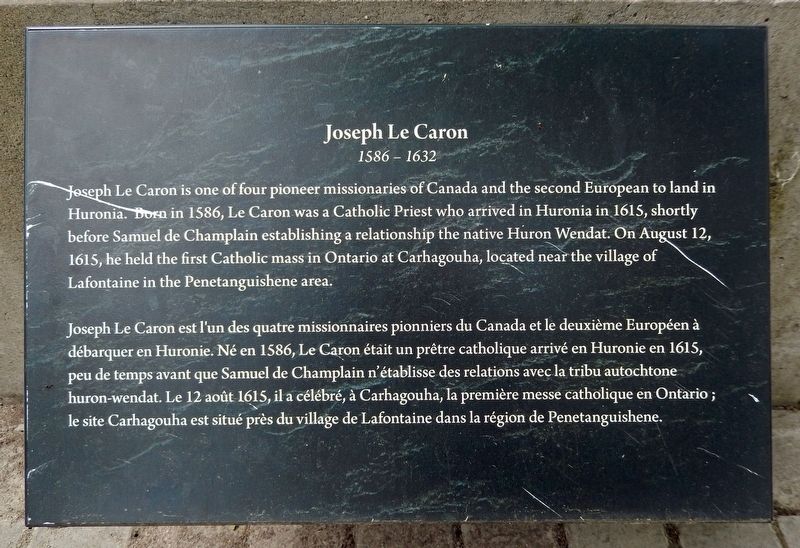
Photographed by Cosmos Mariner, June 7, 2024
1. Joseph Le Caron Marker

Topics. This historical marker is listed in these topic lists: Colonial Era • Indigenous Peoples and Communities • Religion & Religious Structures • Settlements & Settlers. A significant historical date for this entry is August 12, 1615.
Location. 44° 46.183′ N,
this page online

Regionally, this marker is in Central Ontario Cottage Country and specifically in Georgian Bay Country. It is also in Central Canada. Globally, it is in North America, on the Great Lakes, in the Western Hemisphere, in the Western World, and in the Anglosphere. Historically, it finds itself in what was once a British colony, the Viceroyalty of New France, the Haudenosaunee (Iroquois) Confederacy, and Rupert’s Land.
Other nearby markers. At least 8 other markers are within walking distance of this marker: The Wendat (a few steps from this marker); Métis (a few steps from this marker); Brûlé (a few steps from this marker); Father Laboureau (within shouting distance of this marker); Athol Murray (within shouting distance of

Photographed by Cosmos Mariner, June 7, 2024
2. Joseph Le Caron Sculpture
Also see . . . Joseph Le Caron (Wikipedia).
Excerpt: In 1615, Samuel de Champlain brought four Recollect friars to New France, including Le Caron, as missionaries to the Indians. On April 24, 1615, they sailed from Honfleur aboard the St. Étienne. Le Caron reached Canada on May 25 and immediately accompanied some fur-traders to Sault St. Louis. His intention was to meet the Huron traders there and go with them to their own country. After a short time he travelled to Quebec to provide himself with a portable altar kit. On June 24, 1615, he assisted Denis Jamet in saying the first Mass in Quebec, on the Île de Montréal. Le Caron returned to the Sault, and went into the land of the Hurons, being the first to visit their settlements and preach the Gospel, preceding even Champlain. His party(Submitted on November 7, 2024, by Cosmos Mariner of Cape Canaveral, Florida.)made the 1,100-km voyage following the Ottawa River as far as the Mattawa, the Mattawa as far as Lake Nipissing, and then the French River to Georgian Bay. He thus became one of the first Europeans to see Lake Huron, which he reached by the end of July, a few days before Champlain also arrived. On August 12, 1615, he celebrated the first Mass in Huron country, in the presence of Champlain. Le Caron stayed with the Hurons about a year (1615–16), and was again among them in 1623.Photographed by Cosmos Mariner, June 7, 20243. Joseph Le Caron Marker & Sculpture

Credits. This page was last revised on November 7, 2024. It was originally submitted on November 7, 2024, by Cosmos Mariner of Cape Canaveral, Florida. This page has been viewed 252 times since then and 49 times this year. Photos: 1, 2, 3. submitted on November 7, 2024, by Cosmos Mariner of Cape Canaveral, Florida.
