
Near Weldon Spring in St. Charles County, Missouri — The American Midwest (Upper Plains)
The Hamburg Trail
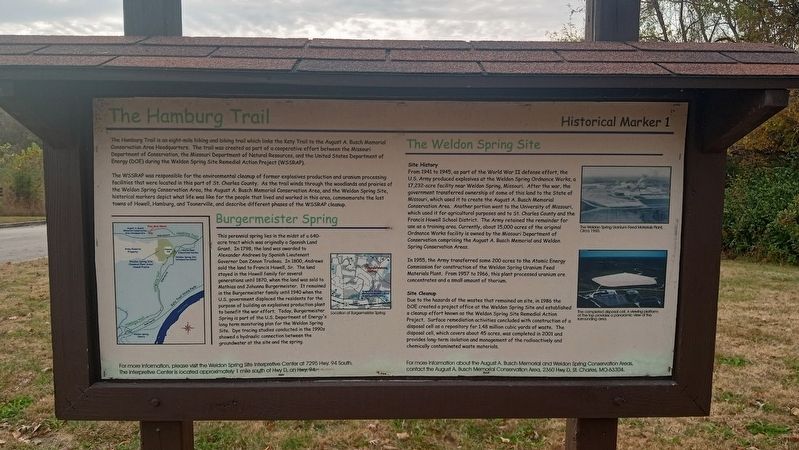
Photographed by Jason Voigt, October 28, 2024
1. The Hamburg Trail Marker
The WSSRAP was responsible for the environmental cleanup of former explosives production and uranium processing facilities that were located in this part of St. Charles County. As the trail winds through the woodlands and prairies of the Weldon Spring Conservation Area, the August A. Busch Memorial Conservation Area, and the Weldon Spring Site, historical markers depict what life was like for the people that lived and worked in this area, commemorate the lost towns of Howell, Hamburg, and Toonerville, and describe different phases of the WSSRAP cleanup.
Burgermeister Spring
This perennial spring lies in the midst of a 640-acre tract which was originally a Spanish Land Grant. In 1798, the land was awarded to
this page online
The Weldon Spring Site
Site History
From 1941 to 1945, as par of the World War II defense effort, the U.S. Army produced explosives at the Weldon Spring Ordnance Works, a 17,232-acre facility near Weldon Spring, Missouri. After the war, the government transferred ownership of some of this land to the State of Missouri, which used it to create the August A. Busch Memorial Conservation Area. Another portion went to the University of Missouri, which used

Photographed by Jason Voigt, October 28, 2024
2. The Hamburg Trail Marker
In 1955, the Army transferred some 200 acres to the Atomic Energy Commission for construction of the Weldon Spring Uranium Feed Materials Plant. From 1957 to 1966, this plant processed uranium ore concentrates and a small amount of thorium.
Site Cleanup
Due to the hazards of the wastes that remained on site, in 1986 the DOE created a project office at the Weldon Spring Site and established a cleanup effort known as the Weldon Spring Site Remedial Action Project. Surface remediation activities concluded with construction of a disposal cell as a repository for 1.48 million cubic yards of waste. The disposal cell, which covers about 45 acres, was completed in 2001 and provides long-term isolation and management of the radioactively and chemically contaminated waste materials. (Marker
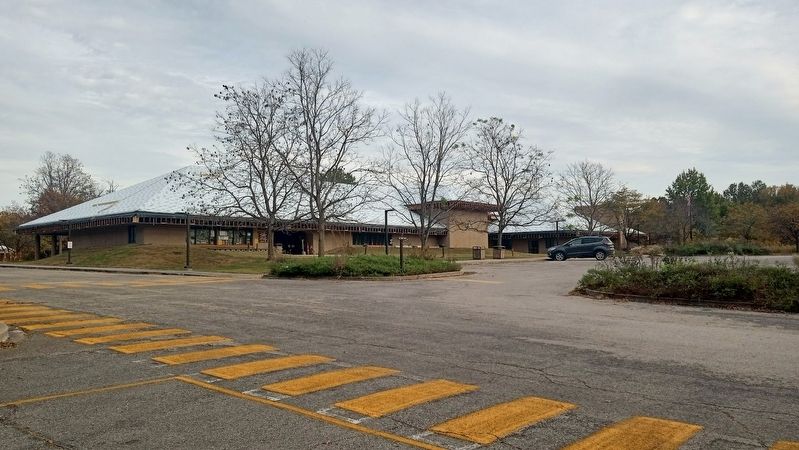
Photographed by Jason Voigt, October 28, 2024
3. The Hamburg Trail Marker
Located outside the August A. Busch Memorial Conservation Area building.
Topics. This historical marker is listed in these topic lists: Environment • Parks & Recreational Areas • Settlements & Settlers. A significant historical year for this entry is 1798.
Location. 38° 42.339′ N, 90° 44.458′ W. Marker is near Weldon Spring, Missouri, in St. Charles County. It can be reached from Missouri Route D. Marker is located at the August A. Busch Memorial Conservation Area building parking lot. It is located off Highway D. Touch for map. Marker is at or near this postal address: 2360 Hwy D, Saint Charles MO 63304, United States of America. Touch for directions.

Regionally, this marker is in the Missouri River Corridor and in Greater St. Louis. It is also in the American Midwest, in the Lewis & Clark Corridor, in the Corn Belt, and in the Great River Road Region. Globally, it is in North America, the Western Hemisphere, the Western World, and the Anglosphere. Historically, it finds itself in what was once the territory of the Mississippian Culture, the Louisiana Purchase, and the Antebellum South.
Other nearby markers. At least 8 other markers are within 4 miles of this marker, measured as the crow flies: The Weldon Spring Site (approx. one mile away); Renewing Grasslands with Fire (approx. 1.9 miles away); "TNT" (approx. 2.1 miles away); Prairie Lake (approx. 2.6 miles away); Exploring the Bottomland Forests (approx. 2.8 miles away); 9-11-01 (approx. 3.1 miles away); Missouri Research Park and Vicinity (approx. 3.2 miles away); a different marker also named Weldon Spring Site (approx. 3.2 miles away). Touch for a list and map of all markers in Weldon Spring.
Additional keywords. ghost towns
Credits. This page was last revised on November 8, 2024. It was originally submitted on November 8, 2024, by Jason Voigt of Glen Carbon, Illinois. This page has been viewed 297 times since then and 47 times this year. Photos: 1, 2, 3. submitted on November 8, 2024, by Jason Voigt of Glen Carbon, Illinois.
