Dane Prairie Township near Fergus Falls in Otter Tail County, Minnesota — The American Midwest (Upper Plains)
Dane Prairie
The Continental Divide: Dividing the Watersheds
| — | Otter Trail Scenic Byway Site R | — |
October 25, 2024
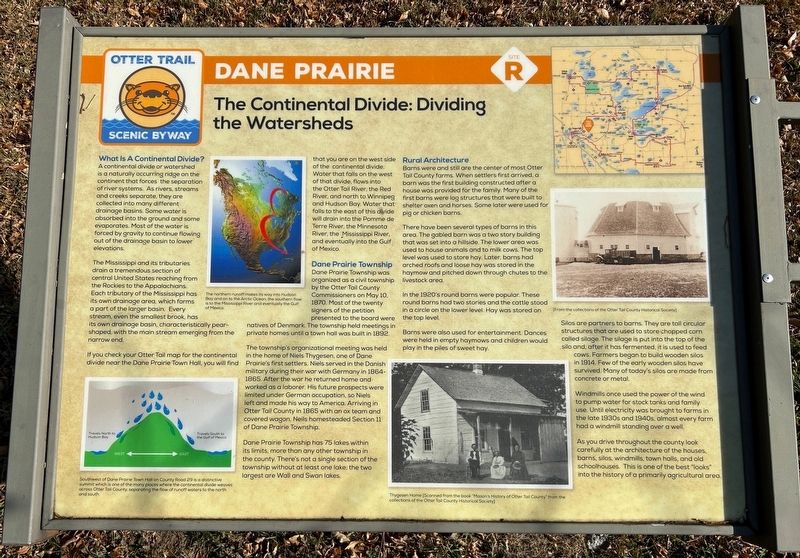
1. Dane Prairie Marker
What Is A Continental Divide?
A continental divide or watershed is a naturally occurring ridge on the continent that forces the separation of river systems. As rivers, streams and creeks separate, they are collected into many different drainage basins. Some water is absorbed into the ground and some evaporates. Most of the water is forced by gravity to continue flowing out of the drainage basin to lower elevations.
The Mississippi and its tributaries drain a tremendous section of central United States reaching from the Rockies to the Appalachians. Each tributary of the Mississippi has its own drainage area, which forms a part of the larger basin. Every stream, even the smallest brook, has its own drainage basin, characteristically pear-shaped, with the main stream emerging from the narrow end.
If you check your Otter Tail map for the continental divide near the Dane Prairie Town Hall, you will find that you are on the west side of the continental divide. Water that falls on the west of that divide, flows into the Otter Tail River, the Red River, and north to Winnipeg and Hudson Bay. Water that falls to the east
this page online
Dane Prairie Township
Dane Prairie Township was organized as a civil township by the Otter Tail County Commissioners on May 10, 1870. Most of the twenty signers of the petition presented to the board were natives of Denmark. The township held meetings in private homes until a town hall was built in 1892.
The township's organizational meeting was held in the home of Niels Thygesen, one of Dane Prairie's first settlers. Niels served in the Danish military during their war with Germany in 1864-1865. After the war he returned home and worked as a laborer. His future prospects were limited under German occupation, so Niels left and made his way to America. Arriving in Otter Tail County in 1865 with an ox team and covered wagon, Neils homesteaded Section 11 of Dane Prairie Township.
Dane Prairie Township has 75 lakes within its limits, more than any other township in the county. There's not a single section of the township without at least one lake; the two largest are Wall and Swan lakes.
Rural Architecture
Barns

October 25, 2024
2. Dane Prairie Marker at the Township Town Hall
There have been several types of barns in this area. The gabled barn was a two story building that was set into a hillside. The lower area was used to house animals and to milk cows. The top level was used to store hay. Later, barns had arched roofs and loose hay was stored in the haymow and pitched down through chutes to the livestock area.
In the 1920's round barns were popular. These round barns had two stories and the cattle stood in a circle on the lower level. Hay was stored on the top level.
Barns were also used for entertainment. Dances were held in empty haymows and children would play in the piles of sweet hay.
Silos are partners to barns. They are tall circular structures that are used to store chopped corn called silage. The silage is put into the top of the silo and, after it has fermented, it is used to feed cows. Farmers began to build wooden silos in 1914. Few of the early wooden silos have survived. Many of today's silos are made from concrete or metal.
Windmills once used the power of the wind to pump water for stock tanks and family use. Until electricity was brought to farms in the late 1930s and 1940s, almost every farm had a windmill standing over a well.
As you drive throughout the county look carefully at the architecture of the houses, barns, silos, windmills, town halls, and old schoolhouses. This is one of the best "looks" into the history of a primarily agricultural area.
Captions:
Southwest of Dane Prairie Town Hall on County Road 29 is a distinctive summit which is one of the many places where the continental divide weaves across Otter Tail County, separating the flow of runoff waters to the north and south.
The northern runoff makes its way into Hudson Bay and on to the Arctic Ocean; the southern flow is to the Mississippi River and eventually the Gulf of Mexico.
Thygesen Home [Scanned from the book "Mason's History of Otter Tail County" from the collections of the Otter Tail County Historical Society]
[From the collections of the Otter Tail County Historical Society]
Erected by Otter Tail Lakes Country Association.
Topics and series. This historical marker is listed in these topic lists: Agriculture • Settlements & Settlers • Waterways & Vessels. In addition, it is included in the Windmills series list. A significant historical date for this entry is May 10, 1870.
Location. 46° 15.361′ N, 95° 59.367′ W. Marker is near Fergus Falls, Minnesota, in Otter Tail County. It is in Dane Prairie Township. It can be reached from County Road 120 west of County Highway 33, on the left when traveling east. Touch for map. Marker is at or near this postal address: 23933 Co Rd 120, Fergus Falls MN 56537, United States of America. Touch for directions.

Regionally, this marker is in the American Midwest and in the Corn Belt. Globally, it is in North America, the Western Hemisphere, the Western World, and the Anglosphere. Historically, it finds itself in what was once Rupert’s Land, the territory of the Mississippian Culture, and the Louisiana Purchase.
Other nearby markers. At least 8 other markers are within 5 miles of this marker, measured as the crow flies: Prairie Wetlands Learning Center (approx. 3.7 miles away); Ottertail County Veterans Memorial Park (approx. 4.2 miles away); The Fergus Falls River Walk (approx. 4.3 miles away); Fergus Falls Woolen Mill (approx. 4.3 miles away); Fergus Falls: River City (approx. 4.3 miles away); Bridges (approx. 4.4 miles away); Otter Tail Dams (approx. 4.4 miles away); Water Power (approx. 4.4 miles away). Touch for a list and map of all markers in Fergus Falls.
Credits. This page was last revised on November 9, 2024. It was originally submitted on November 9, 2024. This page has been viewed 267 times since then and 120 times this year. Photos: 1, 2. submitted on November 9, 2024.
