Buse Township near Fergus Falls in Otter Tail County, Minnesota — The American Midwest (Upper Plains)
Prairie Wetlands Learning Center
Where People & Wildlife Are Welcome
| — | Otter Trail Scenic Byway Site S | — |
October 25, 2024
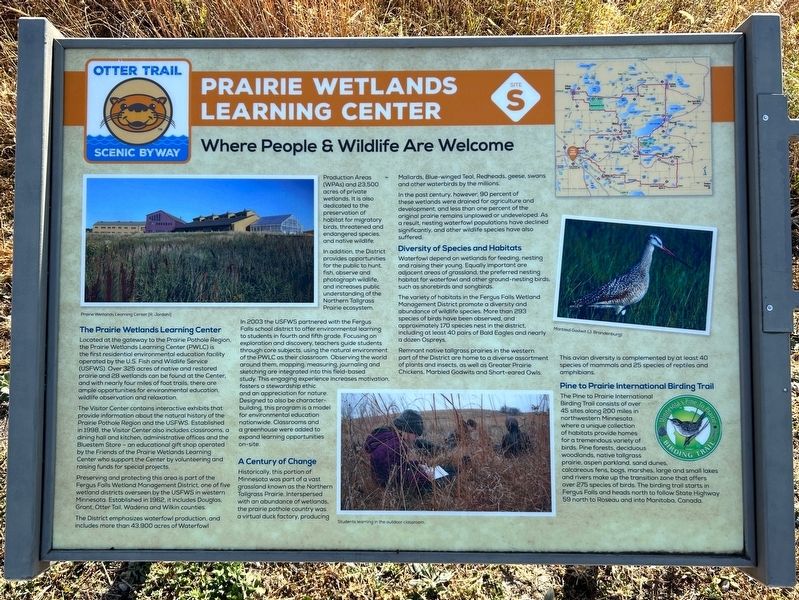
1. Prairie Wetlands Learning Center Marker
The Prairie Wetlands Learning Center
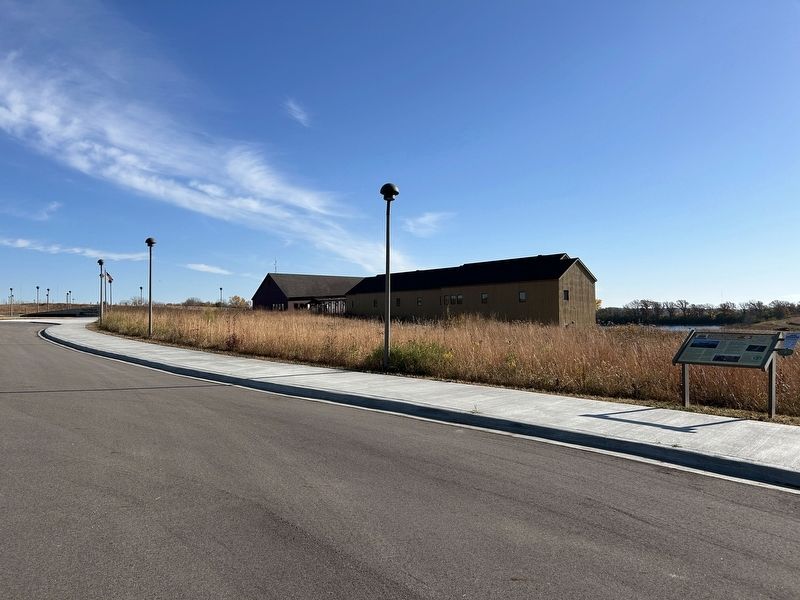
Located at the gateway to the Prairie Pothole Region, the Prairie Wetlands Learning Center (PWLC) is the first residential environmental education facility operated by the U.S. Fish and Wildlife Service (USFWS). Over 325 acres of native and restored prairie and 28 wetlands can be found at the Center, and with nearly four miles of foot trails, there are ample opportunities for environmental education, wildlife observation and relaxation.
The Visitor Center contains interactive exhibits that provide information about the natural history of the Prairie Pothole Region and the USFWS. Established in 1998, the Visitor Center also includes classrooms, a dining hall and kitchen, administrative offices and the Bluestem Store – an educational gift shop operated by the Friends of the Prairie Wetlands Learning Center who support the Center by volunteering and raising funds for special projects.
Preserving and protecting this area is part of the Fergus Falls Wetland Management District, one of five wetland districts overseen by the USFWS in western Minnesota. Established in 1962, it includes
this page online
The District emphasizes waterfowl production, and includes more than 43,900 acres of Waterfowl Production Areas (WPAs) and 23,500 acres of private wetlands. It is also dedicated to the preservation of habitat for migratory birds, threatened and endangered species, and native wildlife.
In addition, the District provides opportunities for the public to hunt, fish, observe and photograph wildlife, and increases public understanding of the Northern Tallgrass Prairie ecosystem.
In 2003 the USFWS partnered with the Fergus Falls school district to offer environmental learning to students in fourth and fifth grade. Focusing on exploration and discovery, teachers guide students through core subjects, using the natural environment of the PWLC as their classroom. Observing the world around them, mapping, measuring, journaling and sketching are integrated into this field-based study. This engaging experience increases motivation, fosters a stewardship ethic and an appreciation for nature. Designed to also be character-building, this program is a model for environmental education nationwide.
October 25, 2024
2. Prairie Wetlands Learning Center & Marker
A Century of Change
Historically, this portion of Minnesota was part of a vast grassland known as the Northern Tallgrass Prairie. Interspersed with an abundance of wetlands, the prairie pothole country was a virtual duck factory, producing Mallards, Blue-winged Teal, Redheads, geese, swans and other waterbirds by the millions.
In the past century, however, 90 percent of these wetlands were drained for agriculture and development, and less than one percent of the original prairie remains unplowed or undeveloped. As a result, nesting waterfowl populations have declined significantly, and other wildlife species have also suffered.
Diversity of Species and Habitats
Waterfowl depend on wetlands for feeding, nesting and raising their young. Equally important are adjacent areas of grassland, the preferred nesting habitat for waterfowl and other ground-nesting birds, such as shorebirds and songbirds.
The variety of habitats in the Fergus Falls Wetland Management District promote a diversity and abundance of wildlife species. More than 293 species of birds have been observed, and approximately 170 species nest in the district, including at least 40 pairs of Bald Eagles and nearly a dozen Ospreys.
Remnant native tallgrass prairies in the western part of the District are home to a diverse assortment of plants and insects, as well as Greater Prairie Chickens, Marbled Godwits and Short-eared Owls. This avian diversity is complemented by at least 40 species of mammals and 25 species of reptiles and amphibians.
Pine to Prairie International Birding Trail
The Pine to Prairie International Birding Trail consists of over 45 sites along 200 miles of northwestern Minnesota where a unique collection of habitats provide homes for a tremendous variety of birds. Pine forests, deciduous woodlands, native tallgrass prairie, aspen parkland, sand dunes, calcareous fens, bogs, marshes, large and small lakes and rivers make up the transition zone that offers over 275 species of birds. The birding trail starts in Fergus Falls and heads north to follow State Highway 59 north to Roseau and into Manitoba, Canada.
Captions:
Prairie Wetlands Learning Center [R. Jordahl]
Students learning in the outdoor classroom.
Marbled Godwit (J. Brandenburg)
Erected by Otter Tail Lakes Country Association.
Topics. This historical marker is listed in these topic lists: Education • Environment • Parks & Recreational Areas. A significant historical year for this entry is 1998.
Location. 46° 15.906′ N, 96° 3.923′ W. Marker is near Fergus Falls, Minnesota, in Otter Tail County. It is in Buse Township. It can be reached from State Highway 210 0.3 miles east of South Cascade Street, on the right when traveling east. Touch for map. Marker is at or near this postal address: 602 MN-210, Fergus Falls MN 56537, United States of America. Touch for directions.

Regionally, this marker is in the American Midwest and in the Corn Belt. Globally, it is in North America, the Western Hemisphere, the Western World, and the Anglosphere. Historically, it finds itself in what was once Rupert’s Land, the territory of the Mississippian Culture, and the Louisiana Purchase.
Other nearby markers. At least 8 other markers are within 2 miles of this marker, measured as the crow flies: Fergus Falls Woolen Mill (approx. 1.2 miles away); Ottertail County Veterans Memorial Park (approx. 1.2 miles away); Fergus Falls City Hall (approx. 1.2 miles away); Water Power (approx. 1.2 miles away); The Coming City (approx. 1.2 miles away); Bridges (approx. 1.2 miles away); Federal Building / River Inn / City Hall (approx. 1.3 miles away); George Washington Memorial Tree (approx. 1.3 miles away). Touch for a list and map of all markers in Fergus Falls.
Also see . . . Fergus Falls Wetland Management District | About Us | U.S. Fish & Wildlife Service. (Submitted on November 9, 2024.)
Credits. This page was last revised on November 9, 2024. It was originally submitted on November 9, 2024. This page has been viewed 120 times since then and 12 times this year. Photos: 1, 2. submitted on November 9, 2024.
