
Golden Gate in Chicago in Cook County, Illinois — The American Midwest (Great Lakes)
Freedom Seekers and the Underground Railroad: Ton Farm Site

Photographed by Sean P. Flynn, November 16, 2024
1. Freedom Seekers and the Underground Railroad: Ton Farm Site Marker
After the removal of Indigenous people living along the Little Calumet, by 1835 families from eastern states were settling here. Dutch settlers arrived in 1847-49, acquiring land in areas that became Roseland and South Holland. These included Cornelius and Maartje Kuyper, and Jan and Aagje Ton. Here, on the north side of the Little Calumet, the Ton Farm was established in 1853. Their home and farm buildings were on this site. The Tons, often with the Kuypers, were directly
this page online
Erected 2022 by The Little Calumet River Underground Railroad Project; National Park Service Network to Freedom; Ronald Gaines and family; William G. Pomeroy Foundation; Illinois State Historical Society.
Topics and series. This historical marker is listed in these topic lists: Abolition & Underground RR • African Americans • Settlements & Settlers • Waterways & Vessels. In addition, it is included in the Illinois State Historical Society, the Network to Freedom, and the William G. Pomeroy Foundation series lists. A significant historical year for this entry is 1853.
Location. 41° 39.051′ N, 87° 36.459′ W. Marker is in Chicago, Illinois, in Cook County. It is in Golden Gate. It is at the intersection of 134th Place and St. Lawrence Avenue, on the right when traveling east on 134th Place. The marker is in front of Chicago's Finest Marina. Touch for map. Marker is at or near this postal address: 554 East 134th Place, Riverdale IL 60827,
Photographed by Sean P. Flynn, November 16, 2024
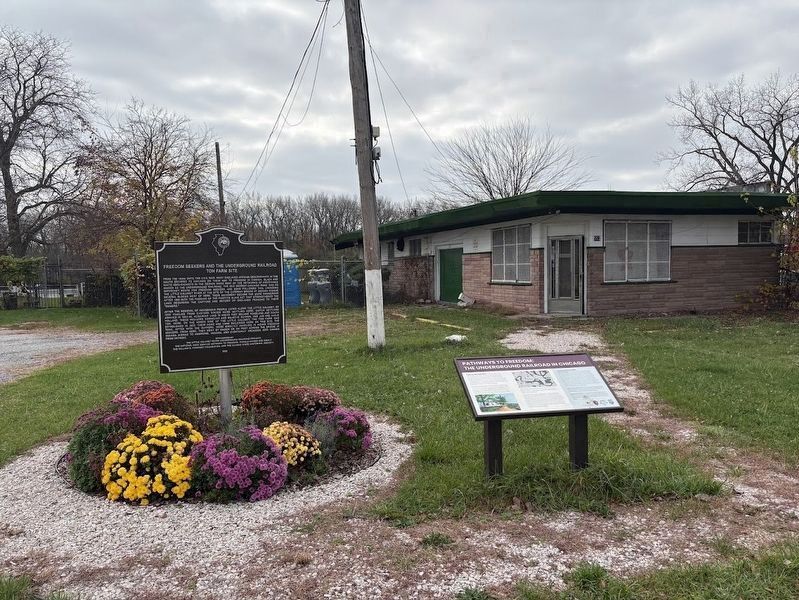
2. Two markers at the Ton Farm site
The Illinois State Historical Society marker is on the left; on the right is another marker about the site.

Regionally, this marker is in Illinois’ Calumet Region. It is also in the American Midwest. Globally, it is in North America, on the Great Lakes, in the Western Hemisphere, in the Western World, and in the Anglosphere. Historically, it finds itself in what was once the Viceroyalty of New France, the territory of the Mississippian Culture, and the Northwest Territory.
Other nearby markers. At least 8 other markers are within 3 miles of this marker, measured as the crow flies: Pathways to Freedom: The Underground Railroad in Chicago (here, next to this marker); Activists in the Anti-Slavery Movement (within shouting distance of this marker); Arcade Park & The Pullman Stables (approx. 2.8 miles away); Pullman 1894 Strike Memorial Rose & Herb Garden (approx. 2.8 miles away); The Arcade (approx. 2.8 miles away); The Pullman Freight Depot & The Gas Works (approx. 2.9 miles away); Lake Vista & Illinois Central Railroad Depot (approx. 2.9 miles away); Welcome to Pullman (approx. 2.9 miles away). Touch for a list and map of all markers in Chicago.
More about this marker.
Photographed by Sean P. Flynn, November 16, 2024
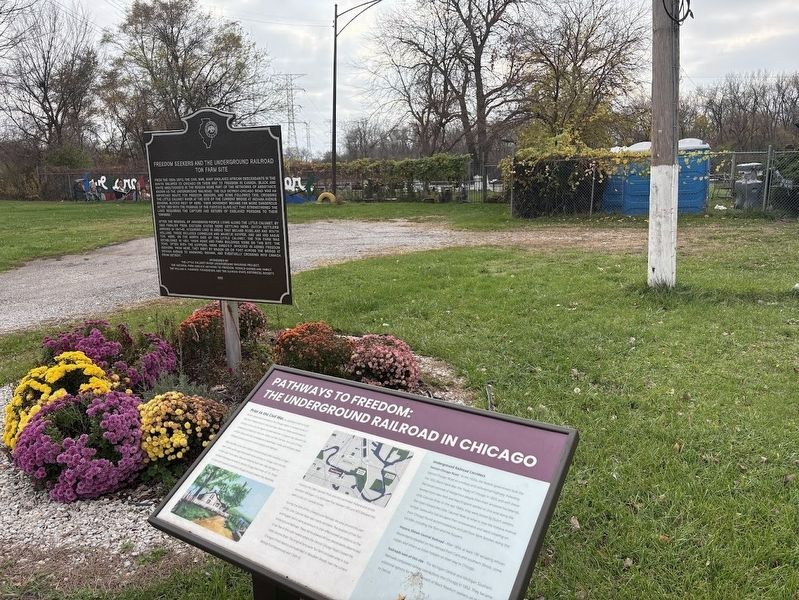
3. Ton Farm site
The Little Calumet River is just beyond the fence, about 200 feet away from these markers.
The marker is on the southern edge of a neighborhood called Golden Gate, a quiet residential section of the Riverdale community on Chicago's far south side, about 20 miles due south of the city's downtown. While the name obviously hearkens to the famous bridge and park in San Francisco, the moniker is most likely related to a golden archway that was built over the neighborhood entrance when it was built in 1964 but was removed many years ago. According to an August 1964 article in the Chicago Tribune, the Golden Gate neighborhood was developed by the Arjack Company, a home construction firm, which built 1,400 homes on 112 acres. The $20 million neighborhood "welcomes all families on an open housing concept," the
Photographed by Sean P. Flynn, November 16, 2024
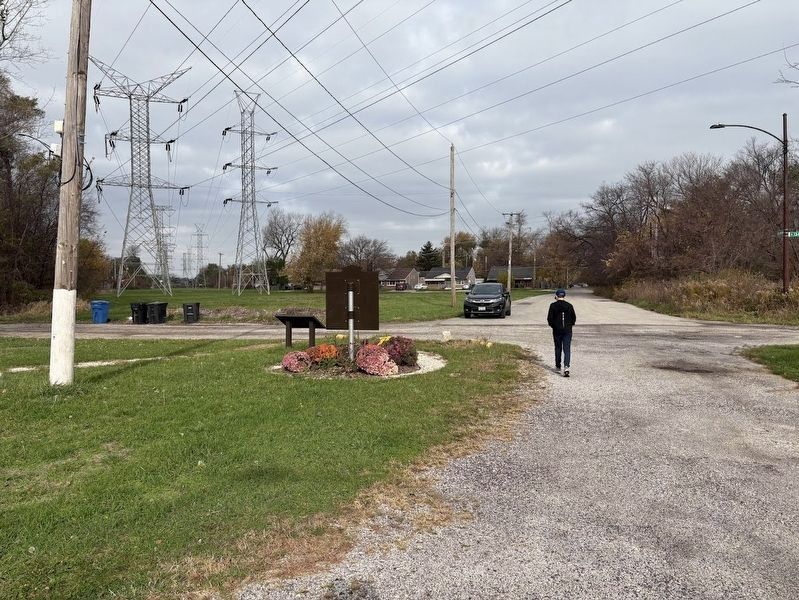
4. Ton Farm site markers from the rear
A rear view of the marker, with the southern edge of the Golden Gate neighborhood beyond the transmission towers.
Regarding Freedom Seekers and the Underground Railroad: Ton Farm Site. In 2022, this site was added to the National Park Service's Network to Freedom, celebrating Underground Railroad sites.
Also see . . .
1. Jon and Aagje Ton Farm Site. From the Illinois Underground Railroad website (Submitted on November 17, 2024, by Sean P. Flynn of Oak Park, Illinois.)
2. Underground Railroad Site In Chicago Honored At Historic Dedication Ceremony. From Block Club Chicago, on September 21, 2022.
Excerpt: "McClellan has studied the history of the Underground Railroad in Illinois for more than 30 years, he said. He’s identified dozens of sites in northeastern Illinois where 3,000-4,500 formerly enslaved people traveled to find refuge and passage to the North, he said. Among those sites are 20 spots in Chicago proper where people who wanted freedom traveled to and received aid, McClellan said. The Ton Farm, run by Dutch immigrants and abolitionists Jan and Aagje Ton, helped formerly enslaved people in their journey North, McClellan said."(Submitted on November 17, 2024, by Sean P. Flynn of Oak Park, Illinois.)
Credits. This page was last revised on November 28, 2024. It was originally submitted on November 16, 2024, by Sean P. Flynn of Oak Park, Illinois. This page has been viewed 561 times since then and 71 times this year. Photos: 1. submitted on November 16, 2024, by Sean P. Flynn of Oak Park, Illinois. 2, 3, 4. submitted on November 17, 2024, by Sean P. Flynn of Oak Park, Illinois.
