
Cape Girardeau in Cape Girardeau County, Missouri — The American Midwest (Upper Plains)
Pook's Turtles
Did you Know?
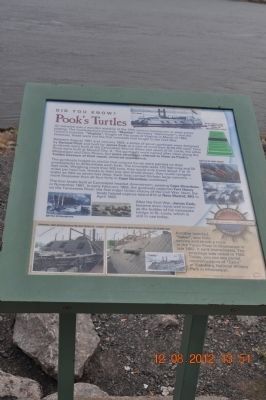
Photographed by Sandra Hughes, August 12, 2012
1. Pook's Turtles Marker
Between August 1861 and January 1862, a series of seven gunboats were designed by Samuel Pook and built by James Eads at a cost of more than $100,000 each. Four gunboats were built at the Carondelet Marine Ways just south of St. Louis; the other three were built at Mound City, IL. The gunboats were named after cities along the Mississippi and Ohio Rivers, but some observers referred to them as Pook's Turtles because of their squat, armored appearance.
The gunboats looked so similar that colored bands were painted on their smokestacks to differentiate each boat. The ironclads were 175 feet long and 50 feet wide. Weighing more than 500 tons, they could only travel about 7 to 10 miles per hour but, thanks to their low and broad shape they could navigate water as little as seven feet deep. Each boat carried thirteen large cannons - more firepower than all four forts in Cape Girardeau combined.
The four boats built at Carondelet headed downstream, passing Cape Girardeau, in November 1861. In early February 1862, the gunboats captured Fort Henry on the Tennessee River: the first major Union victory of the Civil War. Next, the boats helped capture Island #10 at New Madrid, MO in April 1862.
After the Civil War, James Eads, became even more well known as the builder of namesake bridge in St. Louis, which is still in use today.
Topics. This historical marker is listed in these topic lists: War, US Civil • Waterways & Vessels. A significant historical month for this entry is January 1862.
Location. 37° 18.349′ N, 89° 31.04′ W.
this page online

Regionally, this marker is in Southeast Missouri. It is also in the American Ozarks, in the Lewis & Clark Corridor, in the Corn Belt, and in the Great River Road Region. Globally, it is in North America, the Western Hemisphere, the Western World, and the Anglosphere. Historically, it finds itself in what was once the territory of the Mississippian Culture, the Louisiana Purchase, and the Antebellum South.
Other nearby markers. At least 8 other markers are within walking distance of this marker: A different marker also named 1735 (a few steps from this marker); a different marker also named 1793 (a few steps from this marker); 1673 (within shouting distance of this marker); a different marker also named 1673 (within
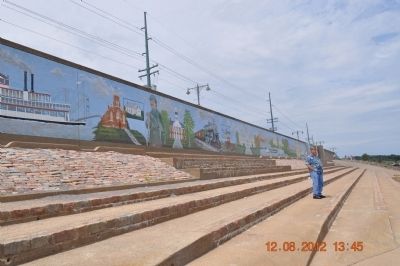
Photographed by Sandra Hughes, August 12, 2012
2. Pook's Turtles Marker
Pook's Turtles and Red Rover Markers are both at the end of the Mural and near the flood gate at the far right.
Other markers no longer nearby. "Red Rover, Red Rover" (was here, next to this marker but has been permanently removed); 1735 (was a few steps from this marker but has been replaced with another marker now near it); 1793 (was a few steps from this marker but has been replaced with another marker now near it); 1803 (was within shouting distance of this marker but has been replaced with another marker now near it); 1804 (was within shouting distance of this marker but has been replaced with another marker now near it).
Credits. This page was last revised on February 2, 2025. It was originally submitted on August 29, 2012, by Sandra Hughes Tidwell of Killen, Alabama, USA. This page has been viewed 1,113 times since then and 31 times this year. Last updated on November 22, 2024, by Edward Troxel of Creal Springs, Illinois. Photos: 1, 2. submitted on August 29, 2012, by Sandra Hughes Tidwell of Killen, Alabama, USA. • J. Makali Bruton was the editor who published this page.
