
Florence in Omaha in Douglas County, Nebraska — The American Midwest (Upper Plains)
Crossroads to the West:
The Great Florence Outfitting Post

Photographed by McGhiever, November 18, 2024
1. Crossroads to the West: Marker
Here on the banks of the Missouri River was an important outfitting site for early members of The Church of Jesus Christ of Latter-day Saints. In 1847 at an area just north of this location was the Nebraska dugway of the Upper Mormon Ferry. There they crossed the Missouri River to find their way to Winter Quarters. Goods were shipped to the location and thousands of head of cattle and other animals found their way across to Nebraska Territory.
In 1848 after many early Saints had left for the Great Salt Lake Basin and others returned to Iowa to wait their turn to travel west. The area began known [sic] in 1854 as Florence and a steam ferry began operation. To provide a thoroughfare as thousands made their way across the great plains to the Rocky Mountains and points west.
Florence became a busy outfitting post for 33,500+ pioneers heading west. The "thousands of tons of supplies … thousands of cattle, corrals, stores, storage buildings, river docks and steamboat arrivals" speak to the massive operation that was skillfully planned and successfully carried out during this time period.
Between the years 1859-1863
this page online
Eventually, as Bluff City (Council Bluffs) grew in size several steamboat ferries would transport hundreds of people across the river each week. Many individuals heading west for the California, Colorado and Montana gold rush also used Florence to outfit their company.
Florence replaced Iowa City as the main outfitting post in 1856 Brigham Young encouraged handcarts specifically due to their lower cost of moving people west. Florence was an area of repairing and outfitting of handcarts or wagons which included attaching metal rims used to reinforce the wheels. Florence was a gathering place for the Mormon pioneers as the majority were from the British Isles and stayed in the Florence area waiting for family members to arrive prior to heading west. Additionally, this area was used for the acquisition of food/supplies. For example, the Florence Mill was an integral part of the area that the pioneers would
Photographed by McGhiever, November 18, 2024
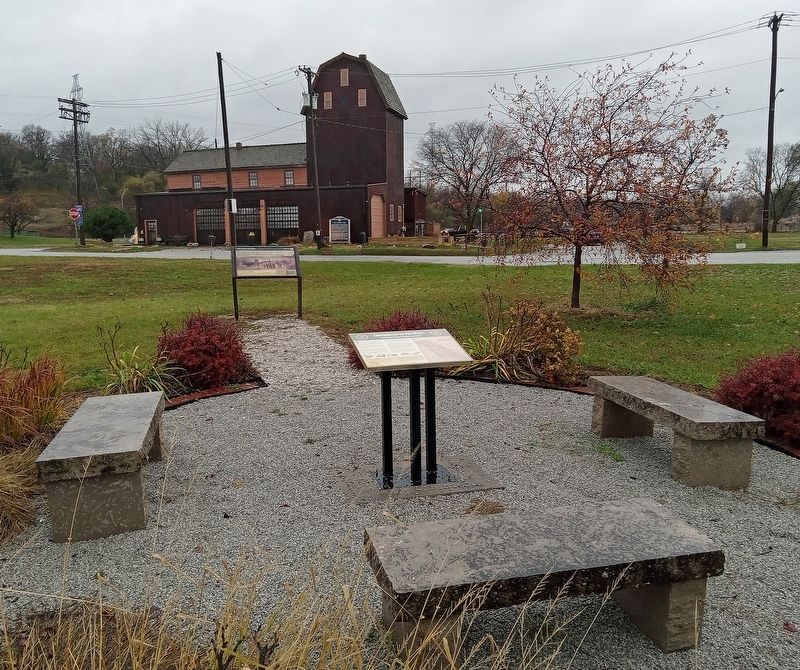
2. Crossroads to the West Marker with the Florence Mill in the distance
You are standing where altogether there were about 142 Mormon wagon trains, about 22 Mormon related freight trains and 10 handcart trains that left the Florence area between 1847 and 1863. These stated groups carried roughly 33,500 persons to Utah. It is known, however, that more people came than listed above and also traveled from here, "The Crossroads to the West."
"I was appointed to take charge of the ferry across the Missouri River, a boisterous river, navigable most of the year for small boats. I put the necessary articles a pioneer needed to cross the plains in John Wheeler's wagon 5 April 1847; 375 lbs. corn $3.75; 155 lbs. flour $4.65; 150 lbs. sifted corn meal $2.00; 1/2 bu potatoes $0.50; dry beans 37 lbs; seed corn 25 lbs, 17 lbs meat $1.25; 12 1/2 lbs salt, fish net, broadax, chopping ax, 1 1/2 in auger, hoe and foot adj, garden seeds, trunk and clothes, wash kettle, bucket, bake kettle, hatchet and knife, 6 bags, auger gun, brace pistols, 4 lbs. powder, 8 lbs lead, iron wedge, horse saddle, bridle, blanket, halter rope, martingales. Total $130.00"
from the journal of John Somers Higbee
John Henry Latey, emigration agent at Florence, Nebraska, joined with the Hodgett Wagon Company when it came through Florence. While at Florence he wrote a letter to Elder John Taylor, reporting on the companies as they came through Florence. Upon the entry of the first two companies (Edmund Ellsworth and Daniel D. McArthur) he wrote: [They were] in fine health and spirits, (singing, as they came along, Elder McAllister's noted handcart song—'Some must push and some must pull,' &c.) One would not think they had come from Iowa City, a long and rough journey of … 300 miles, except by their dust-stained garments and sunburned faces. My heart is gladdened as I write this, for methinks I see their merry countenances and buoyant step, the strains of the hand cart song seems ringing in my ears like sweet music heard at eventide or in a dream."
Latey, J.H., "Correspondence from the Camp at Florence," The Mormon, 30 Aug. 1856, 2.
Topics and series. This historical marker is listed in these topic lists: Religion & Religious Structures • Roads & Vehicles • Settlements & Settlers • Waterways & Vessels. In addition, it is included in the Mormon Pioneer Trail series list. A significant historical year for this entry is 1847.
Location. 41° 20.628′ N, 95° 57.727′ W. Marker is in Omaha, Nebraska, in Douglas County. It is in Florence. It is at the intersection of Dick Collins Road and Bridge Street, on the right when traveling west on Dick Collins Road. Touch for map. Marker is in this post office area: Omaha NE 68112, United States of America. Touch for directions.

Regionally, this marker is in Eastern Nebraska. It is also in the American Midwest, in the Lewis & Clark Corridor, in the Corn Belt, and on the prairies. Globally, it is in North America, the Western Hemisphere, the Western World, and the Anglosphere. Historically, it finds itself in what was once the Louisiana Purchase.
Other nearby markers. At least 8 other markers are within walking distance of this marker: The Road to Zion (a few steps from this marker); The Florence Mill (within shouting distance of this marker); A Meeting House for the Saints (about 500 feet away, measured in a direct line); The Mormon Pioneer Trail / A Meeting House For The Saints (about 500 feet away); Mormon Pioneer Memorial Bridge (approx. 0.2 miles away); From Indian Lands to the Golden Gate (approx. 0.4 miles away); A Little Town That Dreamed of Greatness (approx. 0.4 miles away); The Bank of Florence (approx. half a mile away). Touch for a list and map of all markers in Omaha.
Another marker is no longer nearby. The Florence Mill (was within shouting distance of this marker but has been confirmed missing).
Credits. This page was last revised on November 26, 2024. It was originally submitted on November 22, 2024, by McGhiever of Minneapolis, Minnesota. This page has been viewed 341 times since then and 31 times this year. Photos: 1, 2. submitted on November 22, 2024, by McGhiever of Minneapolis, Minnesota.
