
Near Montrose in Montrose County, Colorado — The American Mountains (Southwest)
Fort Crawford
The Cantonment on the Uncompahgre
Photographed by Jacquelyn Ormsbee, November 27, 2024
1. Fort Crawford Marker
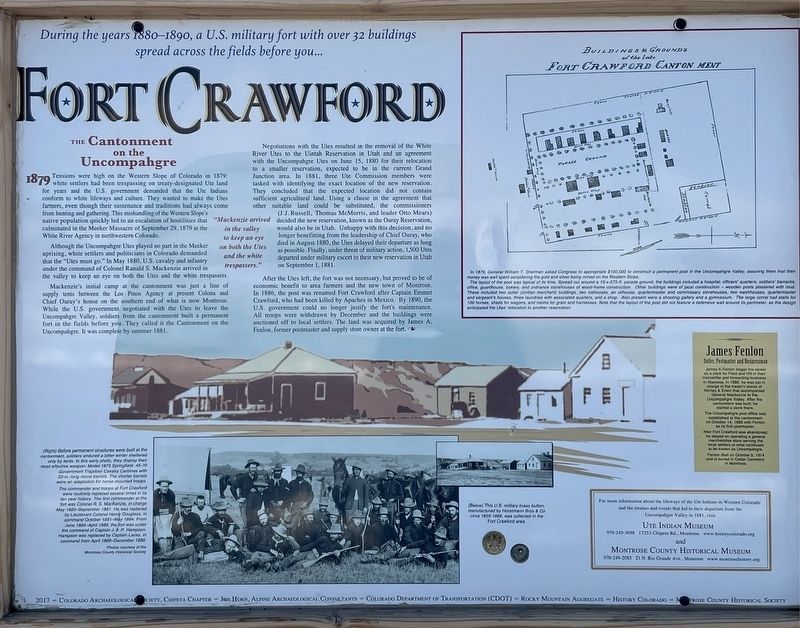
During the years 1880-1890, a U.S. military fort with over 32 buildings spread across the fields before you...
Tensions were high on the Western Slope of Colorado in 1879: white settlers had been trespassing on treaty-designated Ute land for years and the U.S. government demanded that the Ute Indians conform to white lifeways and culture. They wanted to make the Utes farmers, even though their sustenance and traditions had always come from hunting and gathering. This mishandling of the Western Slope's native population quickly led to an escalation of hostilities that culminated in the Meeker Massacre of September 29, 1879 at the White River Agency in northwestern Colorado.
Although the Uncompahgre Utes played no part in the Meeker uprising, white settlers and politicians in Colorado demanded that the "Utes must go." In May 1880, U.S. cavalry and infantry under the command of Colonel Ranald S. Mackenzie arrived in the valley to keep an eye on both the Utes and the white trespassers.
Mackenzie's initial camp at the cantonment was just a line of supply tents between the Los Pinos Agency at present Colona
this page online
Negotiations with the Utes resulted in the removal of the White River Utes to the Uintah Reservation in Utah and an agreement with the Uncompahgre Utes on June 15, 1880 for their relocation to a smaller reservation, expected to be in the current Grand Junction area. In 1881, three Ute Commission members were tasked with identifying the exact location of the new reservation. They concluded that the expected location did not contain sufficient agricultural land. Using a clause in the agreement that other suitable land could be substituted, the commissioners (J.J. Russell, Thomas McMorris, and leader Otto Mears) decided the new reservation, known as the Ouray Reservation, would also be in Utah. Unhappy with this decision, and no longer benefitting from the leadership of Chief Ouray, who died in August 1880, the Utes delayed

Photographed by Jacquelyn Ormsbee, November 27, 2024
2. Fort Crawford Marker
After the Utes left, the fort was not necessary, but proved to be of economic benefit to area farmers and the new town of Montrose. In 1886, the post was renamed Fort Crawford after Captain Emmet Crawford, who had been killed by Apaches in Mexico. By 1890, the U.S. government could no longer justify the fort's maintenance. All troops were withdrawn by December and the buildings were auctioned off to local settlers. The land was acquired by James A. Fenlon, former postmaster and supply store owner at the fort.
Fort Crawford Cantonment
In 1879, General William T. Sherman asked Congress to appropriate $100,000 to construct a permanent post in the Uncompahgre Valley, assuring them that their money was well spent considering the gold and silver being mined on the Western Slope.
The layout of the post was typical of its time. Spread out around a 15-x-575-ft. parade ground, the buildings included a hospital, officers' quarters, soldiers' barracks,

courtesy Montrose County Historical Museum
3. Fort Crawford Marker
James Fenton Sutler, Postmaster and Businessman
James A. Fenlon began his career as a clerk for Field and Hill in their mercantile and forwarding business in Alamosa. In 1880, he was put in charge of the trader's stores of Kinney & Erwin that accompanied General Mackenzie to the Uncompahgre Valley. After the cantonment was built, he started a store there. The Uncompahgre post office was established at the cantonment on October 14, 1880 with Fenton as its first postmaster. After Fort Crawford was abandoned, he stayed on operating a general merchandise store serving the local settlers at what continued to be known as Uncompahgre. Fenton died on October 5, 1914 and is buried in Cedar Cemetery in Montrose.
Erected 2017 by Colorado Archaeological Society; Alpine Archaeological Consultants; Colorado Department of Transportation; Rocky Mountain Aggregate; History Colorado; Montrose County Historical Society.
Topics. This historical marker is listed in these topic lists: Forts and Castles • Indigenous Peoples and Communities • Settlements & Settlers • Wars, US Indian. A significant historical month for this entry is May 1880.
Location. 38° 22.614′ N, 107° 49.106′ W. Marker is near Montrose, Colorado, in Montrose County. It is on US 550 Frontage Road just south of Uncompahgre Road, on the right when traveling south. Touch for map. Marker is in this post office area: Montrose CO 81403, United States of America. Touch for directions.

Regionally, this marker is in the Western Slope. It is also in the American Mountain West, in Colorado Plateau, and at the Four Corners. Globally, it is in North America, the Rocky Mountains, the Western Hemisphere, the Western World, and the Anglosphere. Historically, it finds itself in what was once Mexico’s Alta California.
Other nearby markers. At least 8 other markers are within 5 miles of this marker, measured as the crow flies: A different marker also named Fort Crawford (a few steps from this marker); The Hangin' Tree (approx. 4.6 miles away); The Utes / Uncompahgre River Country / Ouray (1833-1880) / Chipeta (1843-1924) (approx. 4.8 miles away); The Dominguez-Escalante Expedition / Dominguez-Escalante Country (approx. 4.8 miles away); In Behalf of the Light (approx. 4.8 miles away); So Bold, So Beautiful a Land (approx. 4.9 miles away); Pageant in the Wilderness (approx. 4.9 miles away); Building An Empire: The Spanish Frontier (approx. 4.9 miles away). Touch for a list and map of all markers in Montrose.
More about this marker. Another historical marker at this location was removed and replaced by this one. See Nearby Marker - Fort Crawford.
Also see . . .
1. History Colorado — Ute Indian Museum. For more information about Ute Indians in Western Colorado. (Submitted on November 28, 2024.)
2. Montrose County Historical Museum. For more information about Ute Indians in Western Colorado. (Submitted on November 28, 2024.)
Credits. This page was last revised on June 29, 2025. It was originally submitted on November 28, 2024, by Craig Baker of Sylmar, California. This page has been viewed 391 times since then and 75 times this year. Photos: 1, 2, 3. submitted on November 28, 2024, by Craig Baker of Sylmar, California.
