Fort Payne in DeKalb County, Alabama — The American South (East South Central)
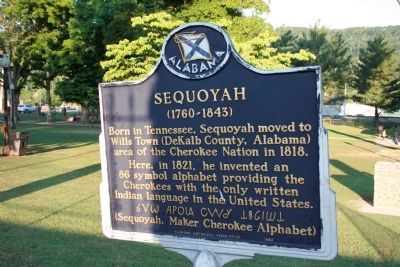
Sequoyah
(1760-1843)
Photographed by Tim Carr, June 15, 2008
1. Sequoyah Marker
Born in Tennessee, Sequoyah moved to Wills Town (DeKalb County, Alabama) area of the Cherokee Nation in 1818.
Here, in 1821, he invented an 86 symbol alphabet providing the Cherokees with the only written Indian language in the United States.
(Sequoyah, Maker Cherokee Alphabet)
Erected 1983 by Alabama Historical Association.
Topics and series. This historical marker is listed in these topic lists: Education • Indigenous Peoples and Communities. In addition, it is included in the Alabama Historical Association series list. A significant historical year for this entry is 1818.
Location. Marker has been reported missing. It was located near 34° 26.615′ N, 85° 43.199′ W. Marker was in Fort Payne, Alabama, in DeKalb County. It was on Gault Avenue North (U.S. 11) east of 4th Street, on the right when traveling east. Marker is located in Union Park near the water fountain. Touch for map. Marker was in this post office area: Fort Payne AL 35968, United States of America. Touch for directions.

Regionally, this marker was in North Alabama. It was also in the American South, specifically in the Deep South, in
this page online
Other nearby markers. At least 8 other markers are within walking distance of this location: Whittler's Corner (within shouting distance of this marker); Alabama (within shouting distance of this marker); Confederate Monument (within shouting distance of this marker); Fort Payne Opera House (about 400 feet away); Sequoyah | Socks | Song | Scenery (about 500 feet away); Fort Payne Residential Historic District (about 800 feet away); Main Street Historic District (approx. 0.3 miles away); Cherokee Indian Removal (approx. 0.3 miles away). Touch for a list and map of all markers in Fort Payne.
Other markers no longer nearby. Wills Town Mission (was here, next to this marker but has been confirmed missing); Fort Payne’s Fort (was here, next to this marker but has
Photographed by Tom Bosse, November 25, 2016
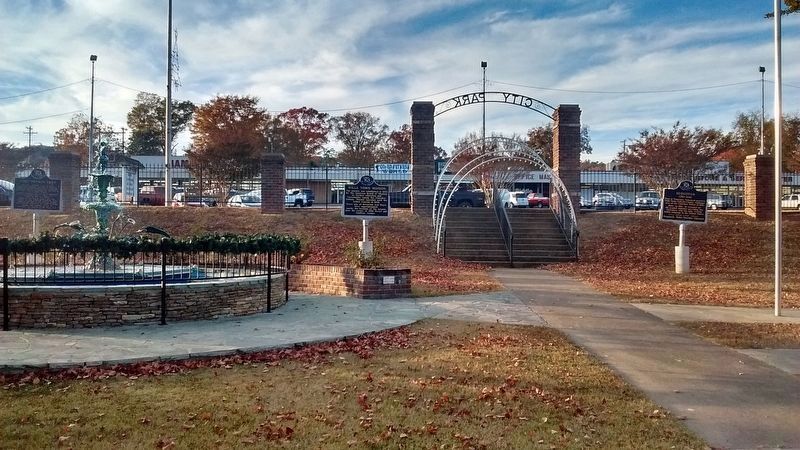
2. Sequoyah Marker
The Sequoyah Marker is located on the right.
Also see . . . Cherokee syllabary (ᏣᎳᎩ / Tsalagi). Omniglot. (Submitted on April 13, 2015, by Allen C. Browne of Silver Spring, Maryland.)
Photographed by Allen C. Browne, February 16, 2015
3. Sequoyah
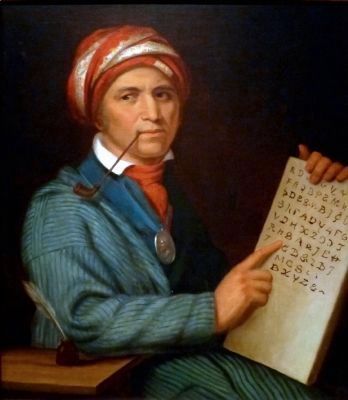
This portrait of Sequoyah by Henry Inman, after Charles Bird King hangs in the National Portrait Gallery in Washington DC. The original Charles Bird King portrait burned in a fire at the Smithsonian Castle in 1865.
“Born Cherokee town of Tuskegee, eastern Tennessee Sequoyah, the son of a Cherokee chief's daughter and a fur trader from Virginia, was a warrior and hunter and, some say, a silversmith. For twelve years he worked to devise a method of writing for the Cherokee language. His syllabary of eighty-five symbols representing vowel and consonant sounds was approved by the Cherokee chiefs in 1821. The simple utilitarian system made possible a rapid spread of literacy throughout the Cherokee nation. Medicine men set down ceremonies for healing, divination, war, and traditional ball games; missionaries translated hymns and the New Testament into the native language; and in 1828 the Cherokee Phoenix, a weekly bilingual newspaper, began publication at New Echota, Georgia.” — National Portrait Gallery
“Born Cherokee town of Tuskegee, eastern Tennessee Sequoyah, the son of a Cherokee chief's daughter and a fur trader from Virginia, was a warrior and hunter and, some say, a silversmith. For twelve years he worked to devise a method of writing for the Cherokee language. His syllabary of eighty-five symbols representing vowel and consonant sounds was approved by the Cherokee chiefs in 1821. The simple utilitarian system made possible a rapid spread of literacy throughout the Cherokee nation. Medicine men set down ceremonies for healing, divination, war, and traditional ball games; missionaries translated hymns and the New Testament into the native language; and in 1828 the Cherokee Phoenix, a weekly bilingual newspaper, began publication at New Echota, Georgia.” — National Portrait Gallery
Credits. This page was last revised on December 11, 2024. It was originally submitted on February 27, 2010, by Timothy Carr of Birmingham, Alabama. This page has been viewed 2,887 times since then and 70 times this year. Last updated on November 29, 2024, by Edward Troxel of Creal Springs, Illinois. Photos: 1. submitted on February 27, 2010, by Timothy Carr of Birmingham, Alabama. 2. submitted on November 27, 2016, by Tom Bosse of Jefferson City, Tennessee. 3. submitted on April 13, 2015, by Allen C. Browne of Silver Spring, Maryland. • Devry Becker Jones was the editor who published this page.
