Hanover Township near Loudonville in Ashland County, Ohio — The American Midwest (Great Lakes)
The American Chestnut
Mohican State Park
Photographed by Joel Seewald, November 11, 2024
1. The American Chestnut Marker
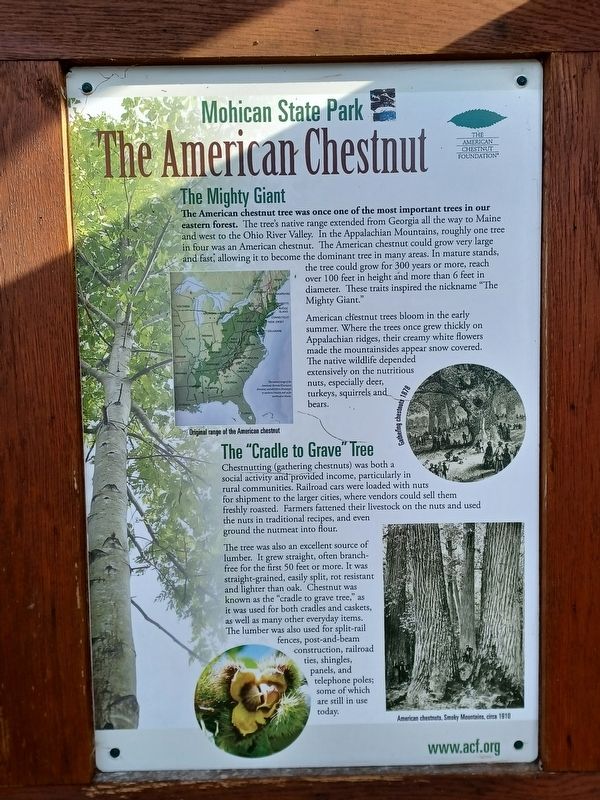
American chestnut trees bloom in the early summer. Where the trees once grew thickly on Appalachian ridges, their creamy white flowers made the mountainside appear snow covered. The native wildlife depended extensively on the nutritious nuts, especially deer, turkeys, squirrels and bears.
The "Cradle to Grave" Tree
Chestnutting (gathering chestnuts) was both a social activity and provided income, particularly in rural communities. Railroad cars were loaded with nuts for shipment to the larger cities, where vendors could sell them freshly
this page online
The tree was also an excellent source of lumber. It grew straight, often branch-free for the first 50 feet or more. It was straight-grained, easily split, rot resistant and lighter than oak. Chestnut was known as the "cradle to grave tree," as it was used for both cradles and caskets, as well as many other everyday items. The lumber was also used for split-rail fences, post-and-beam construction, railroad ties, shingles, panels, and telephone poles; some of which are still in use today.
Captions, top to bottom:
• Original range of the American chestnut
• Gathering chestnuts 1878
• American chestnuts, Smoky Mountains, circa 1910
Photographed by Joel Seewald, November 11, 2024
2. The American Chestnut Marker: Chestnut Blight
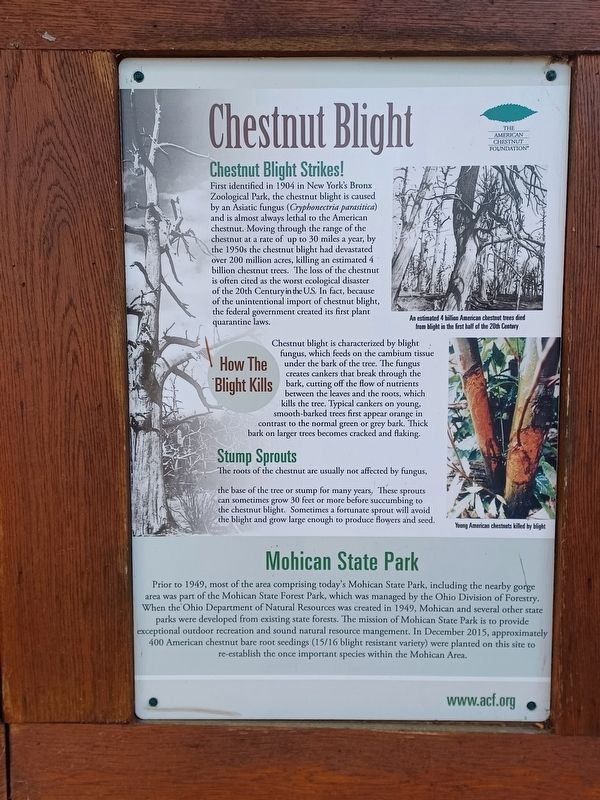
How The Blight Kills
Chestnut blight is characterized by blight fungus, which feeds on the cambium tissue under the bark of the tree. The fungus creates cankers that break through the bark, cutting off the flow of nutrients between the leaves and the roots, which kills the tree. Typical cankers on young, smooth-barked trees first appear orange in contrast to the normal green or grey bark. Thick bark on larger trees becomes cracked and flaking.
Stump Sprouts
The roots of the chestnut tree are usually not affected by fungus, [missing line] the base of the tree or stump for many years. These sprouts can sometimes grow 30 feet or more before succumbing to the chestnut blight. Sometimes a fortunate sprout will avoid the blight and grow large enough to produce flowers and seed.
Photographed by Joel Seewald, November 11, 2024
3. The American Chestnut Marker: Restoring the Chestnut
Captions, top to bottom:
• An estimated 4 billion American chestnut trees died from the blight in the first half of the 20th Century
• Young American chestnuts killed by blight
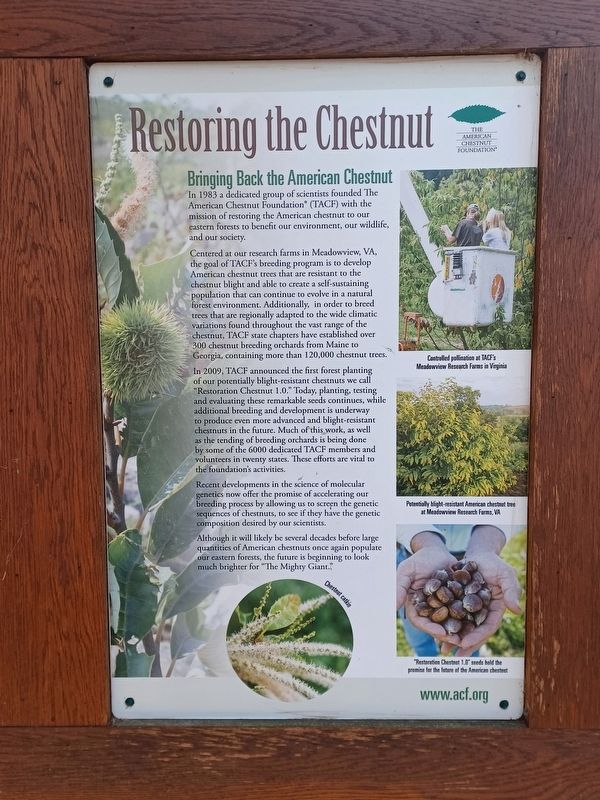
In 1983 a dedicated group of scientists founded The American Chestnut Foundation® (TACF) with the mission of restoring the American chestnut to our eastern forests to benefit our environment, our wildlife, and our society.
Centered at our research farms in Meadowview, VA, the goal
Photographed by Joel Seewald, November 11, 2024
4. The American Chestnut Marker
In 2009, TACF announced the first forest planting of our potentially blight-resistant chestnuts we call "Restoration Chestnut 1.0." Today, planting, testing and evaluating these remarkable seeds continues, while additional breeding and development is underway to produce even more advanced and blight-resistant chestnuts in the future. Much of this work, as well as the tending of breeding orchards is being done by some of the 6000 dedicated TACF members and volunteers in twenty states. These efforts are vital to the foundations' activities.
Recent developments in the science of molecular genetics now offer the promise of accelerating our breeding process by allowing us to screen the genetic sequences of chestnuts, to see if they have the genetic composition desired by our scientists.
Although it will likely be several decades before large quantities of American chestnuts once again populate our eastern forests, the future is beginning to look much brighter for "The Mighty Giant."
Captions, top to bottom:
• Controlled pollination at TACF's Meadowview Research Farms in Virginia
• Potentially blight-resistant American chestnut tree at Meadowview Research Farms, VA
• "Restoration Chestnut 1.0" seeds hold the promise for the future of the American chestnut
• Chestnut catkin
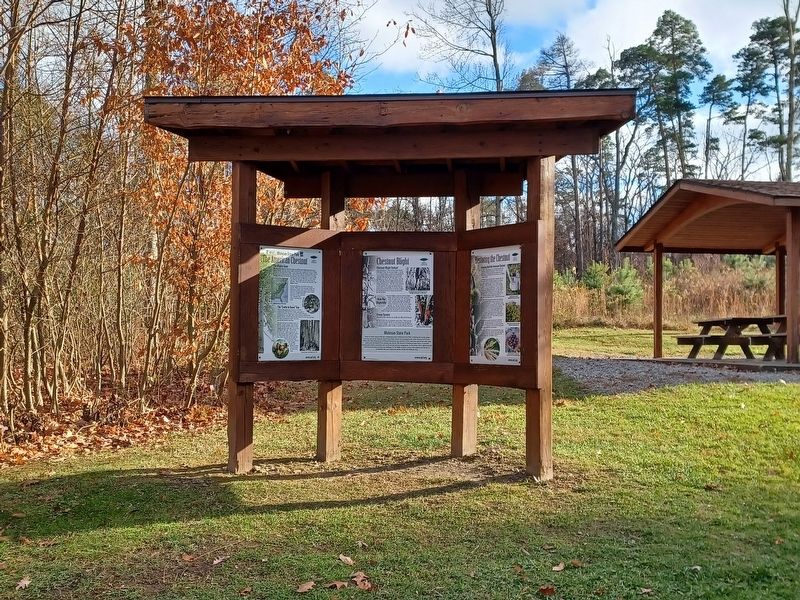
Erected by The American Chestnut Foundation.
Topics. This historical marker is listed in these topic lists: Environment • Horticulture & Forestry. A significant historical month for this entry is December 2015.
Location. 40° 36.643′ N, 82° 17.174′ W. Marker is near Loudonville, Ohio, in Ashland County. It is in Hanover Township. It is on Gorge Overlook, on the right when traveling east. Marker is adjacent to the gorge overlook parking lot, about one mile northwest of Ohio Route 97, in Mohican State Park. Touch for map. Marker is in this post office area: Perrysville OH 44864, United States of America. Touch for directions.

Regionally, this marker is in Amish Country. It is also in the American Midwest. Globally, it is in North America, the Western Hemisphere, the Western World, and the Anglosphere. Historically, it finds itself in what was once the Haudenosaunee (Iroquois) Confederacy, the territory of the Mississippian Culture, and the Northwest Territory.
Other nearby markers. At least 8 other markers are within 2 miles of this marker, measured as the crow flies: Clear Fork Gorge (within shouting distance of this marker); High Water Mark (approx. one mile away); Ohio Department of Natural Resources 75th Anniversary (approx. one mile away); Mohican Fire Tower (approx. 1.1 miles away); a different marker also named Mohican Fire Tower (approx. 1.1 miles away); Cline Cabin (approx. 1.4 miles away); The Corn Crib (approx. 1.4 miles away); The Plow (approx. 1.4 miles away). Touch for a list and map of all markers in Loudonville.
Additional commentary.
1. Nearly identical marker
There is a nearly identical marker in Scioto Trail State Forest. The only difference is the text at the bottom of the middle panel.
— Submitted November 30, 2024, by Joel Seewald of Madison Heights, Michigan.
Credits. This page was last revised on May 31, 2025. It was originally submitted on November 30, 2024, by Joel Seewald of Madison Heights, Michigan. This page has been viewed 302 times since then and 36 times this year. Photos: 1, 2, 3, 4. submitted on November 30, 2024, by Joel Seewald of Madison Heights, Michigan.
