
Utica in Oneida County, New York — The American Northeast (Mid-Atlantic)
Devereux St. and the Abolitionist Press
The Oneida County Freedom Trail Walking Tour - Stop 3
Photographed by Duane and Tracy Marsteller, October 5, 2024
1. Devereux St. and the Abolitionist Press Marker
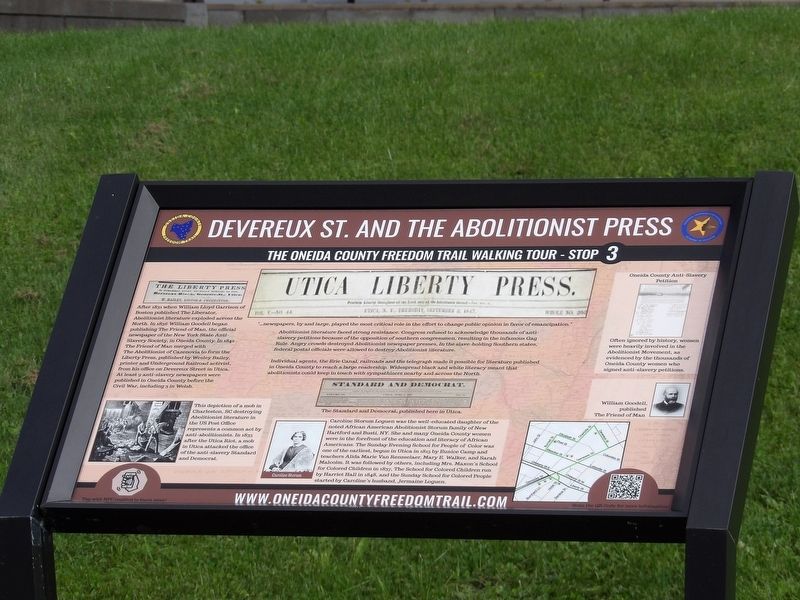
Abolitionist literature faced strong resistance. Congress refused to acknowledge thousands of anti-slavery petitions because of the opposition of southern congressmen, resulting in the infamous Gag Rule. Angry crowds destroyed Abolitionist newspaper presses. In the slave-holding Southern states, federal postal officials were allowed to destroy Abolitionist literature.
Individual agents, the Erie Canal, railroads and the telegraph made it possible for literature published in Oneida County to reach a large readership. Widespread black and white literacy meant that abolitionists could keep in touch with sympathizers nearby and across the North.
[Top left] After 1831, when William Lloyd Garrison of Boston published The Liberator, Abolitionist literature exploded across the North. In 1836 William Goodell began publishing The Friend of Man, the official newspaper of the New York State Anti-Slavery Society, in Oneida County. In 1842 The Friend of Man merged with The Abolitionist of Cazenovia
this page online
[Bottom left] This depiction of a mob in Charleston, SC destroying Abolitionist literature in the US Post Office represents a common act by anti-abolitionists. In 1835 after the Utica Riot, a mob in Utica attacked the office of the anti-slavery Standard and Democrat.
[Top center] The Standard and Democrat, published here in Utica.
[Bottom center] Caroline Storum Loguen was the well-educated daughter of the noted African American Abolitionist Storum family of New Hartford and Busti, NY. She and many Oneida County women were in the forefront in the education and literacy of African Americans. The Sunday Evening School for People of Color was one of the earliest, begun in Utica in 1815 by Eunice Camp and teachers Alida Marie Van Rensselaer, Mary E. Walker, and Sarah Malcolm. It was followed by others, including Mrs. Maxon's School for Colored Children in 1837, The School for Colored
Photographed by Duane and Tracy Marsteller, October 5, 2024
2. Devereux St. and the Abolitionist Press Marker
[Top right] Oneida County Anti-Slavery Petition. Often ignored by history, women were heavily involved in the Abolitionist Movement, as evidenced by the thousands of Oneida County women who signed anti-slavery petitions.
[Center right] William Goodell, published The Friend of Man.
Erected by Oneida County Freedom Trail Commission. (Marker Number 3.)
Topics. This historical marker is listed in these topic lists: Abolition & Underground RR • Communications • Education • Women. A significant historical year for this entry is 1831.
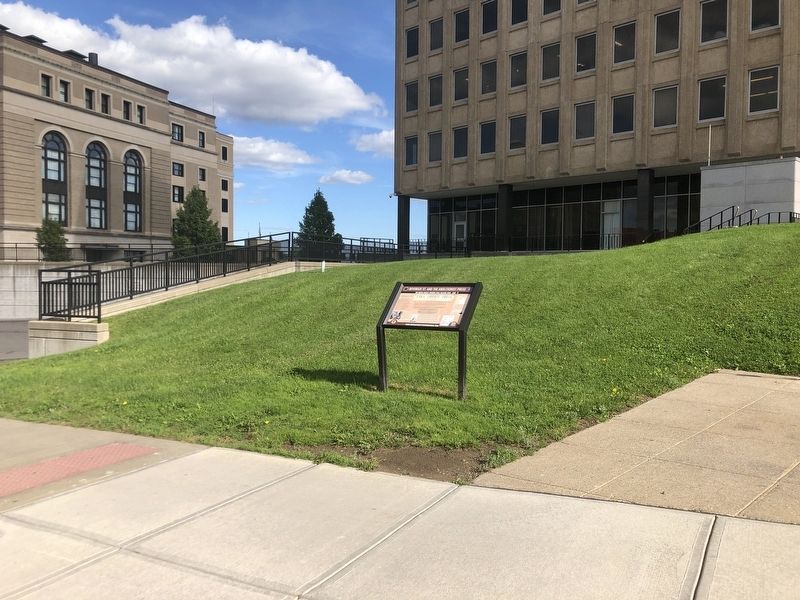
Location. 43° 5.977′ N, 75° 13.833′ W. Marker is in Utica, New York, in Oneida County. It is at the intersection of Charlotte Street and Devereux Street, on the right when traveling north on Charlotte Street. Touch for map. Marker is in this post office area: Utica NY 13501, United States of America. Touch for directions.

Regionally, this marker is in Upstate New York and in the Mohawk Valley. It is also in the American Northeast and in the Mid-Atlantic. Globally, it is in North America, the Great North Woods, the Western Hemisphere, the Western World, and the Anglosphere. Historically, it finds itself in what was once the Haudenosaunee (Iroquois) Confederacy, New Netherland, and one of the original Thirteen Colonies.
Other nearby markers. At least 8 other markers are within walking distance of this marker: Post St. and the Underground Railroad (about 700 feet away, measured in a direct line); Site of The Utica Riot of 1835 (approx. 0.2 miles away); Why Utica? (approx. 0.2 miles away); This is Mohawk Country (approx. ¼ mile away); Mechanics Hall - Utica's Civic Center (approx. ¼ mile away); The Utica Rescue (approx. 0.3 miles away); General Herkimer Marched Past This Spot (approx. 0.4 miles away); The Site of Old Fort Schuyler (approx. 0.4 miles away). Touch for a list and map of all markers in Utica.
Credits. This page was last revised on December 3, 2024. It was originally submitted on December 3, 2024, by Duane and Tracy Marsteller of Murfreesboro, Tennessee. This page has been viewed 314 times since then and 27 times this year. Photos: 1, 2. submitted on December 3, 2024, by Duane and Tracy Marsteller of Murfreesboro, Tennessee.
