Danville, Virginia — The American South (Mid-Atlantic)
M.C. Martin (1897-1981)

Photographed by C. Ryan Dodson, November 16, 2024
1. M. C. Martin Marker
As a pillar of the community, M.C. Martin's work in the banking industry and Civil Rights Movement had a the profound impact reaching beyond his home in Danville, VA.
Maceo Conrad "M.C." Martin was a distinguished banker as well as a community leader. During his 19-year bank presidency, he strived to provide members of the community, African American, white, and otherwise, with the tools that he successfully employed to achieve success throughout his career as a banker - self-help and financial empowerment.
In 1919, the Savings Bank of Danville was started by a group of African American men in Danville, VA. It was one of the only African American owned banks in Virginia. Maceo Conrad "M.C." Martin and his father, Romey O. Martin, were two of the original founders. M.C. Martin served as the bank's official president for 19 years and was widely regarded as the managing banker from 1919-1970. In his first year as president, he suggested changing the bank's name to First State Bank (FSB). He was 22 years old when he started. FSB grew its assets from $95,000 in 1919 to $1.4 million by 1950, more than $3 million by 1963,
this page online
A civil rights victory spawns a state park. In 1948, a banker named Maceo Conrad Martin made a drive to Staunton River State Park knowing that he'd be denied entry based on the color of his skin. He used this incident to file a lawsuit against the Commonwealth, arguing that Virginia was violating the law by not providing a "separate but equal" facility for Black parkgoers. He won the case, and the state eventually chose Prince Edward Lake (today one of the two lakes at Twin Lakes State Park) as the place to build an official park.
By 1950, Prince Edward

Photographed by C. Ryan Dodson, November 9, 2024
2. M. C. Martin Marker
(captions)
1919: Group portrait of First State Bank founders. M.C. Martin is seated in the middle row, far right. His father, Romney O. Martin is standing behind him in the top row, far right.
Left to right: Sylvesta Jennings (former First State Bank president), Paula K. Martin (M.C. Martin's daughter), Jill Smith Handy (granddaughter), Albert Handy (grandson-in-law)
Prince Edward Lake was the main attraction at the new state park.
The dance hall at Prince Edward State Park was a popular destination for black Virginians. It was open on the weekends for dances and parties. (Photo by Virginia State Parks)
Left to right: M.C. Martin, Lillian Slade, and L. Wilson York (former First State Bank president) circa 1950s
Funding for park improvements provided by the Eco Ambassador Council (a coalition of regional businesses dedicated to protecting and promoting our natural resources) the Dan River Basin Association, Danville Parks and Recreation, and family and friends of M.C. Martin.
Erected 2024

Photographed by C. Ryan Dodson, November 9, 2024
3. M. C. Martin Marker
Topics. This historical marker is listed in these topic lists: African Americans • Civil Rights • Industry & Commerce • Parks & Recreational Areas. A significant historical year for this entry is 1919.
Location. 36° 35.52′ N, 79° 24.045′ W. Marker is in Danville, Virginia. It is on Memorial Drive (Virginia Route 413) east of Sycamore Street, on the right when traveling east. Located in M.C. Martin Park. Touch for map. Marker is in this post office area: Danville VA 24541, United States of America. Touch for directions.

Regionally, this marker is in Southside Virginia and specifically in Central Virginia. It is also in the American South and specifically in the Upper South. Globally, it is in North America, the Western Hemisphere, the Western World, and the Anglosphere. Historically, it finds itself in what was once the territory of the Mississippian Culture, one of the original Thirteen Colonies, one of the Confederate States of America, and the Antebellum South.
Other nearby markers. At least 8 other markers are within walking distance of this marker: Union Street Bridge

Photographed by C. Ryan Dodson, November 16, 2024
4. M. C. Martin Marker
as seen from the hiking trail in M. C. Martin Park

Photographed by C. Ryan Dodson, November 16, 2024
5. M. C. Martin Park
In addition to the Marker, M.C. Martin Park features the Creekside Trail

Photographed by C. Ryan Dodson, November 17, 2024
6. Portrait of M. C. Martin
This portrait of M. C. Martin and the founders of First State Bank is displayed in the Danville Mall
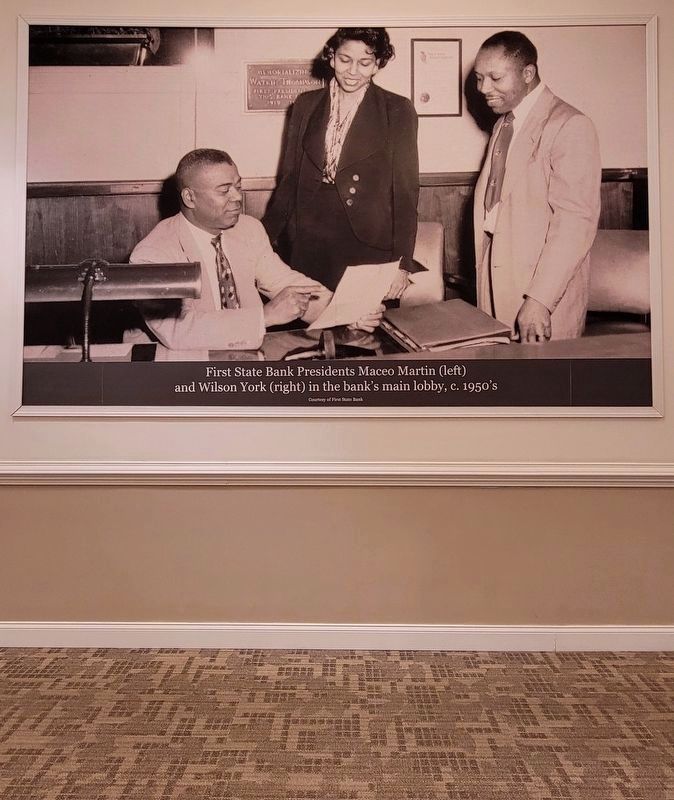
Photographed by C. Ryan Dodson, December 10, 2024
7. Portrait of M.C. Martin
This portrait of M. C. Martin is displayed in the Danville Mall.

Photographed by C. Ryan Dodson, March 11, 2025
8. M.C. Martin Memorial Bench
Added to M.C. Martin Park in 2025.
Credits. This page was last revised on May 15, 2025. It was originally submitted on December 6, 2024, by C. Ryan Dodson of Danville, Virginia. This page has been viewed 369 times since then and 45 times this year. Photos: 1, 2, 3, 4, 5, 6. submitted on December 6, 2024, by C. Ryan Dodson of Danville, Virginia. 7. submitted on January 22, 2025, by C. Ryan Dodson of Danville, Virginia. 8. submitted on May 10, 2025, by C. Ryan Dodson of Danville, Virginia. • Bernard Fisher was the editor who published this page.
