Agua Dulce in Los Angeles County, California — The American West (Pacific Coastal)
How Do We Know What We Know?
Tataviam Ancestors
| — | Vasquez Rocks | — |

Photographed by Craig Baker, December 16, 2024
1. How Do We Know What We Know? Marker
Prior to European contact in the early 1700s, Tataviam ancestors lived here for over 1,300 years, with archaeological evidence indicating human life here at least 4,500 years ago. We have knowledge of many parts of their lives here, even though we have no written records dating from these long-ago times. So how do we know what we know?
Food Processing
What clues do you see that might tell you what this spot was used for? Notice the darkened, burned soil near the Juniper behind this sign, and the holes ground into the bedrock to your left. These clues indicate that this was a food processing site, or kitchen.
Steatite and Trade
The village's link into both regional and far-reaching trade networks was their nearby source of highly desirable steatite, or soapstone. Steatite is easily carved and polished into ceremonial or decorative items like pendants, effigies, and tobacco pipes. It also conducts heat well, making excellent arrow-shaft straighteners.
Sources Include:
Ancestral Knowledge: Information passed down and preserved through generations.
Archaeological
this page online
DNA Research: Connects living descendants to the lineages of their ancestors.
Genealogy: Mission records provide birth places and family trees of Native peoples.
Ethnographies: The study of cultural groups through interviews and observations.
photo captions:
· A recreation of a traditional local kitchen, featuring basketry, grinding tools, animal pelts, and local foods including pine nuts, acorns, and seeds. Image courtesy Leon Worden.
· "Hopper mortars" are a hybrid artifact, combining stone and basketry. The lower stone bowl features a groove, which was lined with sticky asphaltum, where a woven basket was affixed.
· Two of Elder Garcia‘s carvings: a steatite dolphin and abalone fishhook.
· The traditional practice of steaite carving is still held by tribal members today, seen here in the beautiful work by FTBMI Elder Ted Garcia. Image courtesy FTBMI.
· Other Local Artifact Types. *Indicates trade items found in this area made from non-local materials.
· Examples of Local Native Plants Commonly Used for Food

Photographed by Craig Baker, December 16, 2024
2. Marker Detail - Local Artifacts
Please remember, all features in this park are protected. Do not disturb, damage, or remove any plants, rocks, or artifacts. Doing so permanently damages the cultural record and preserved environments at this special place. We must all do our part to protect and preserve these precious resources. Interested in learning more? Many of the artifacts shown here are viewable in our Interpretive Center.
Erected 2024 by County of Los Angeles Department of Parks and Recreation.
Topics. This historical marker is listed in these topic lists: Anthropology & Archaeology • Indigenous Peoples and Communities.
Location. 34° 29.24′ N, 118° 19.14′ W. Marker is in Agua Dulce, California, in Los Angeles County. It can be reached from Escondido Canyon Road half a mile east of Agua Dulce Canyon Road, on the right when traveling east. Located in Vasquez Rocks Natural Area, on the Nature Heritage Trail. Touch for map. Marker is at or near this postal address: 10700 Escondido Canyon Rd, Santa Clarita CA 91390, United States of America. Touch for directions.

Regionally, this

Photographed by Craig Baker, December 16, 2024
3. How Do We Know What We Know? Marker
Other nearby markers. At least 11 other markers are within walking distance of this marker: Pacific Crest Trail (about 600 feet away, measured in a direct line); "Devil’s Punchbowl Wildlife" Mural (about 700 feet away); Toney Residence (about 800 feet away); The Village of Mapipinga (approx. 0.2 miles away); European Contact & the Spanish Era (approx. 0.2 miles away); The Mexican & Early American Eras (approx. 0.2 miles away); Land and Industry (approx. 0.3 miles away); The Castle of Vasquez Rocks (approx. half a mile away); The Krieg-Toney Family (approx. half a mile away); Vasquez Rocks Becomes a Park (approx. half a mile away); The Asher Family (approx. 0.6 miles away). Touch for a list and map of all markers in Agua Dulce.
More about this marker. Other interpretive signs
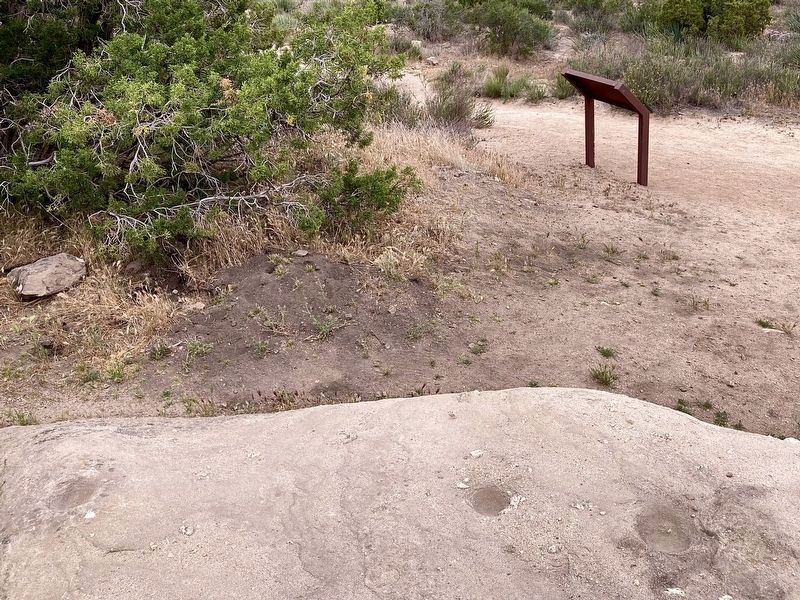
Photographed by Craig Baker, May 17, 2025
4. Mortars and Darkened Soil

Photographed by Craig Baker, December 16, 2024
5. Vasquez Rocks
Credits. This page was last revised on May 28, 2025. It was originally submitted on December 16, 2024, by Craig Baker of Sylmar, California. This page has been viewed 254 times since then and 53 times this year. Photos: 1, 2, 3. submitted on December 16, 2024, by Craig Baker of Sylmar, California. 4. submitted on May 28, 2025, by Craig Baker of Sylmar, California. 5. submitted on December 16, 2024, by Craig Baker of Sylmar, California.
