Weimar in Colorado County, Texas — The American South (West South Central)
Etta Moten Barnett

Photographed by James Hulse, December 17, 2024
1. Etta Moten Barnett Marker
After starring in several broadway shows and radio programs, Etta made her way to Hollywood, where she had a breakthrough role in Gold Diggers of 1933. A show at the Fox Theater in Washington, D.C. brought her to the attention of First Lady Eleanor Roosevelt, who invited her to sing for the President the following night. On January 30, 1934, Etta Moten became the first African American woman to give a solo performance at the White House. She performed a set of songs requested by Franklin and Eleanor Roosevelt as part of the celebration of his birthday, later that year, she married noted journalist Claude Barnett (1889-1967), who owned the Associated Negro Press.
For decades Etta remained active in civil rights organizations such as the National Council of Negro Women and participated in the 1963 National March on Washington for Jobs and Freedom. As an award-winning entertainer, she was inducted into the Black Filmmakers Hall of Fame and named by the Texas Women's Chamber of Commerce as one of Texas 100 most influential women. She retired to Chicago and devoted the rest of her life to fostering interracial and interreligious understanding. Etta died at the age of 102. She is remembered today for breaking color barriers in the entertainment industry and for furthering civil liberties.
Erected 2019
this page online
Topics. This historical marker is listed in these topic lists: African Americans • Arts, Letters, Music • Civil Rights • Women. A significant historical date for this entry is January 30, 1934.
Location. 29° 42.122′ N, 96° 46.83′ W. Marker is in Weimar, Texas, in Colorado County. It is at the intersection of West Jackson Street and South Center Street, on the right when traveling west on West Jackson Street. The marker is located at the city library near the gazebo. Touch for map. Marker is at or near this postal address: 1 Jackson Square, Weimar TX 78962, United States of America. Touch for directions.

Regionally, this marker is in the American South and on the Gulf Coast. Globally, it is in North America, a Gulf of Mexico state, the Western Hemisphere, the Western World, and the Anglosphere. Historically, it finds itself in what was once New Spain, the Republic of Texas, one of the Confederate States of America, and the Antebellum South.
Other nearby markers. At least 8 other markers are within 4 miles of this marker, measured as the crow flies: Weimar Railroad Depot

Photographed by James Hulse, December 17, 2024
2. Etta Moten Barnett Marker
Also see . . . Etta Moten Barnett. Wikipedia
Etta Moten Barnett (November 5, 1901 – January 2, 2004) was an American actress and contralto vocalist, who was identified with her signature role of "Bess" in Porgy and Bess. She created new roles for African-American women on stage and screen. After her performing career, Barnett was active in Chicago as a major philanthropist and civic activist, raising funds for and supporting cultural, social and church institutions. She also hosted a radio program in Chicago and represented the United States in several official delegations to nations in Africa.(Submitted on December 18, 2024, by James Hulse of Medina, Texas.)

Photographed by James Hulse, December 17, 2024
3. The view of the Etta Moten Barnett Marker along the gazebo
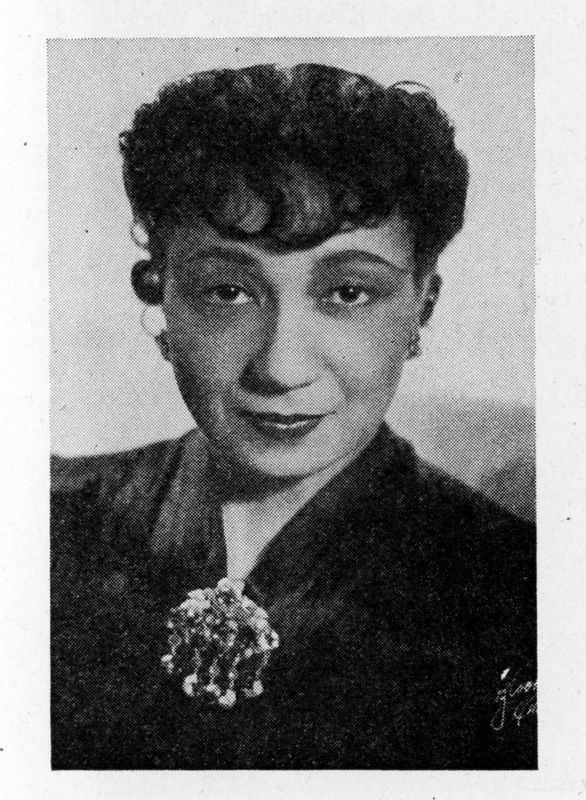
Public Domain - Maud Cuney-Hare AP, 1936
4. Etta Moten Barnett
Credits. This page was last revised on December 18, 2024. It was originally submitted on December 18, 2024, by James Hulse of Medina, Texas. This page has been viewed 250 times since then and 29 times this year. Photos: 1, 2, 3, 4. submitted on December 18, 2024, by James Hulse of Medina, Texas.
