
Edwardsville in Madison County, Illinois — The American Midwest (Great Lakes)
Ninian Edwards
1775-1833
| — | Namesake of the City of Edwardsville | — |
Photographed by Jason Voigt, December 19, 2024
1. Ninian Edwards Marker
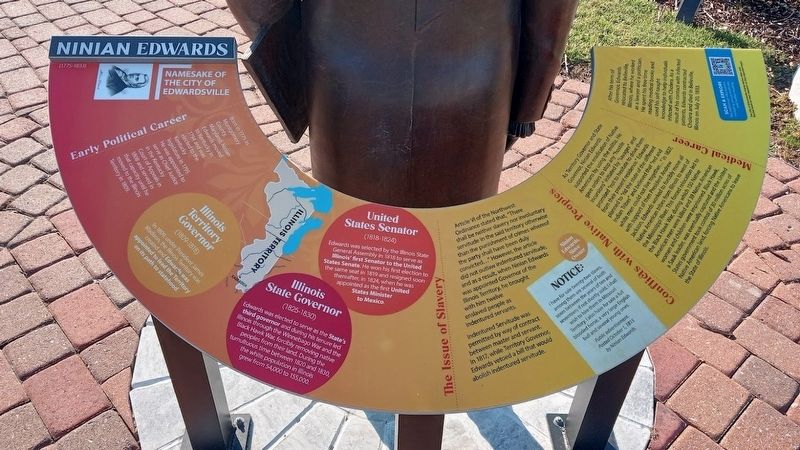
Early Political Career
Born in 1775 in Montgomery County, Maryland, Ninian Edwards moved to Kentucky in 1794 and was elected to the Kentucky legislature in 1795. He was appointed to serve as Chief Justice in the Kentucky Court of Appeals in 1808 and served in that capacity until he moved to the Illinois Territory in 1809.
Illinois Territory Governor (1809-1818)
In 1809, under President James Madison, the Illinois Territory was created and Edwards was appointed to lead the Territory on its path to statehood.
United States Senator (1818-1824)
Edwards was selected by the Illinois State General Assembly in 1818 to serve as Illinois' first Senator to the United States Senate. He won his first election to the same seat in 1819 and resigned soon thereafter, in 1824, when he was appointed as the first United States Minister to Mexico.
Illinois State Governor (1825-1830)
Edwards was elected to serve as the State's third governor and during his tenure led Illinois through the Winnebago War and the Black Hawk War, forcibly removing native peoples from their land. During the tumultuous time between 1820 and 1830,
this page online
The Issue of Slavery
Article VI of the Northwest Ordinance stated that, "There shall be neither slavery nor involuntary servitude in the said territory otherwise than the punishment of crimes whereof the party shall have been duly convicted…" However, the article did not outlaw indentured servitude, and as a result when Ninian Edwards was appointed Governor of the Illinois Territory, he brought with him twelve enslaved people as indentured servants.
Indentured Servitude was permitted by way of contract between master and servant. In 1817, while Territory Governor, Edwards vetoed a bill that would abolish indentured servitude.
Conflicts with Native Peoples
As Territory Governor and State Governor, Ninian Edwards supported the eradication of Native Americans by using the militia. He gave orders to stop any "hostile incursions" initiated by "savages" and promised "not to hesitate to drive them from their present residence." Edwards planned to "rid the state of the different Indian Tribes" and believed that "red and white men could not live together…" In 1827, with

Photographed by Jason Voigt, December 19, 2024
2. Ninian Edwards Marker
Medical Career
After his term of Governor, Edwards relocated to Belleville, Illinois, where he worked as a lawyer and a politician. He spent his free-time reading medical books and used his self-taught knowledge to help individuals infected with Cholera. As a result of his contact with infected patients, Edwards contracted Cholera and died in Belleville, Illinois on July 20, 1933.
Erected by City of Edwardsville.
Topics. This historical marker is listed in these topic lists: Indigenous Peoples and Communities • Science & Medicine • Settlements & Settlers. A significant historical date for this entry is July 20, 1933.
Location. 38° 48.666′ N, 89° 57.529′ W.

Photographed by Jason Voigt, December 19, 2024
3. Ninian Edwards Marker
Marker is behind the Ninian Edwards statue.

Regionally, this marker is in Greater St. Louis. It is also in the American Midwest, in the Lewis & Clark Corridor, in the Corn Belt, and in the Great River Road Region. Globally, it is in North America, the Western Hemisphere, the Western World, and the Anglosphere. Historically, it finds itself in what was once the territory of the Mississippian Culture and also the Northwest Territory.
Other nearby markers. At least 8 other markers are within walking distance of this marker: A different marker also named Ninian Edwards (here, next to this marker); Edwardsville (within shouting distance of this marker); Site of Abraham Lincoln's Speech (about 700 feet away, measured in a direct line); Edwardsville National Bank Clock (approx. 0.2 miles away); Lusk Cemetery (approx. 0.2 miles away); First Cemetery in the City of Edwardsville (approx. ¼ mile away); The Madison County Poor Farm (approx. ¼ mile away); Cleaon Etzkorn Bandstand (approx. ¼ mile away). Touch for a list and map of all markers in Edwardsville.
Additional commentary.
1. Addressing the controversy
A statue of Ninian Edwards was placed in 2008, at City Plaza. In 2020, some Edwardsville residents wanted Edwards' statue to come down because of his pro-slavery views among other controversies. The statue still stands in the same location but in 2021 the pedestal (that the statue stood on) was removed. A brand-new historical marker was later put up behind the statue, probably to educate one on Edwards' views and what was considered acceptable during a different time in the United States.
— Submitted December 20, 2024, by Jason Voigt of Glen Carbon, Illinois.
Credits. This page was last revised on December 20, 2024. It was originally submitted on December 20, 2024, by Jason Voigt of Glen Carbon, Illinois. This page has been viewed 207 times since then and 69 times this year. Photos: 1, 2, 3. submitted on December 20, 2024, by Jason Voigt of Glen Carbon, Illinois.
