Near San Saba in San Saba County, Texas — The American South (West South Central)
On This Site a Treaty of Peace
Photographed by James Hulse, December 22, 2024
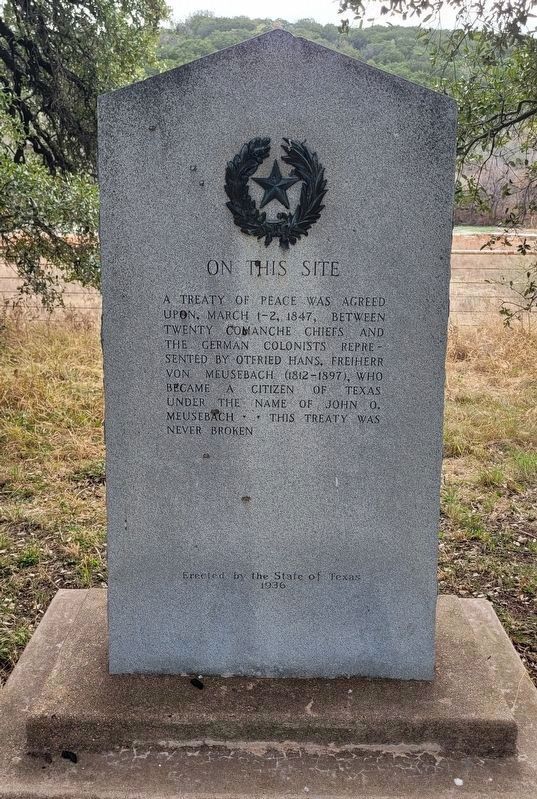
1. On This Site a Treaty of Peace Marker
A treaty of peace was agreed upon, March 1-2, 1847, between twenty Comanche chiefs and the German colonists represented by Otfried Hans, Freiherr von Meusebach (1812-1897), who became a citizen of Texas under the name of John O. Meusebach - This treaty was never broken.
Erected 1936 by State of Texas. (Marker Number 991.)
Topics and series. This historical marker is listed in these topic lists: Immigration • Indigenous Peoples and Communities. In addition, it is included in the Texas 1936 Centennial Markers and Monuments series list. A significant historical year for this entry is 1847.
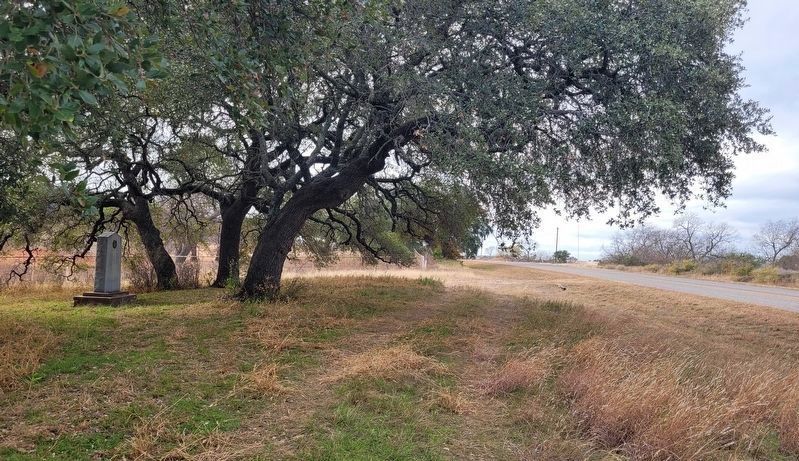
Location. 31° 9.253′ N, 98° 55.107′ W. Marker is near San Saba, Texas, in San Saba County. It is on Farm to Market Road 2732 10 miles south of U.S. 190, on the left when traveling south. The marker is located along the east side of the highway. Touch for map. Marker is at or near this postal address: 9371 Farm To Market 2732, San Saba TX 76877, United States of America. Touch for directions.

Regionally, this marker is in Big Country. Globally, it is in North America, a Gulf of Mexico state, the Western Hemisphere, the Western World, and the Anglosphere. Historically, it finds itself in what was once New Spain, the Republic of Texas, and one of the Confederate States of America.
Other nearby markers. At least 8 other markers are within 12 miles of this marker, measured as the crow flies: A.J. Rose Mill (within shouting distance of this marker); Richland Springs Cemetery (approx. 7.9 miles away); John Duncan's Fort (approx. 8.1 miles away); First State Bank Building (approx. 8.4 miles away); First State Bank in Richland Springs (approx. 8.4 miles away); Harkeyville (approx. 8.7 miles away); Wedding Oak (approx. 11.1 miles away); Beveridge Bridge, San Saba County (approx. 11.2 miles away). Touch for a list and map
this page online
Also see . . . Meusebach-Comanche Treaty. Texas State Historical Association (TSHA)
The Fisher-Miller land grant comprised lands between the Llano and Colorado rivers and constituted the hunting grounds of the Comanche Indians. This land was to be used for the settlements of the immigrants who arrived in Texas under the auspices of the Society for the Protection of German Immigrants. Prince Carl of Solms-Braunfels, the first commissioner of the society, had pledged from the beginning that he would do his utmost to get on good terms with the Indians. It was, however, not until John O. Meusebach had taken charge of the affairs of the German immigrants that regular expeditions into Indian-controlled lands took place. Government officials, however, were unable to assure military assistance and surveyors refused to enter the region of the grant for fear of being attacked by the Indians. Dr. Friedrich A. Schubert's expedition into the area antagonized the Indians, and his inaccurate reports estimated the number of Indians inhabiting the area between the Llano and San Saba rivers as between 40,000 and(Submitted on December 23, 2024, by James Hulse of Medina, Texas.)60,000. The Fisher-Miller land grant awarded by the state of Texas stipulated that the land had to be settled (at least in part) and surveyed by the fall of 1847. It became therefore necessary to enter the Indian territory. A mounted troop including well-armed Germans, Mexicans, and several American surveyors set out from Fredericksburg on January 22, 1847. They were joined in camp by Meusebach two days later. A detailed report on the expedition was written by noted geologist Ferdinand von Roemer and is still available. James Pinckney Henderson, the governor of Texas, had sent a messenger to warn Meusebach of the consequences of entering Indian territory; however, contacts with the Indians had already been made and the deliberations continued. The final session took place on March 1 and 2, 1847, at the lower San Saba, about twenty-five miles from the Colorado River.Photographed by James Hulse, December 22, 20242. On This Site a Treaty of Peace Marker
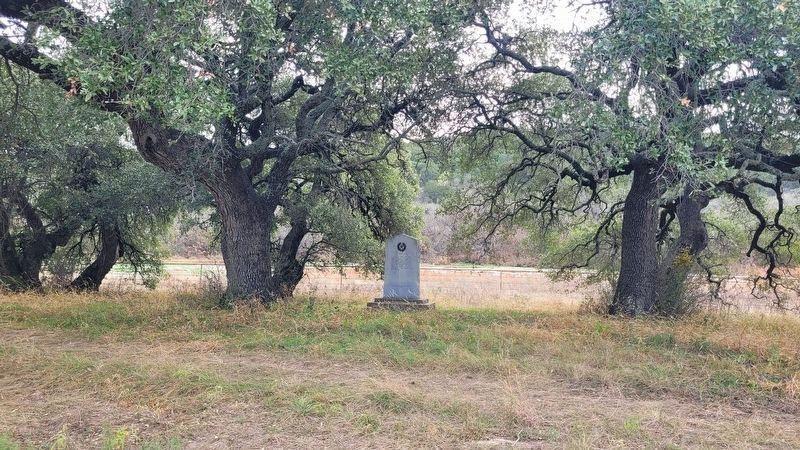
Photographed by James Hulse, December 22, 2024
3. The view of the marker along the highway
Credits. This page was last revised on July 11, 2026. It was originally submitted on December 22, 2024, by James Hulse of Medina, Texas. This page has been viewed 662 times since then and 191 times this year. Last updated on July 10, 2026, by Joe Lotz of Flower Mound, Texas. Photos: 1, 2, 3. submitted on December 23, 2024, by James Hulse of Medina, Texas.
