Near Charlottesville in Albemarle County, Virginia — The American South (Mid-Atlantic)
The Stables
Photographed by William Pope, October 13, 2024
1. The Stables Marker
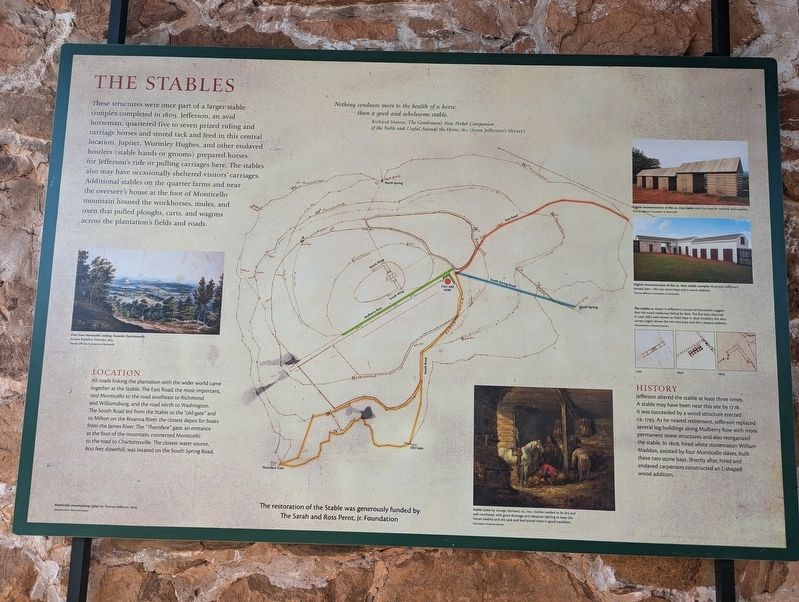
Nothing conduces more to the health of a horse then a good and whole stable. Richard Mason, The Gentleman's New Pocket Companion...of the Noble and Useful Animal the Horse, 1811 (from Jefferson's library)
These structures were once part of a larger stable complex completed in 1809. Jefferson, an avid horseman, quartered five to seven prized riding and carriage horses and stored tack and feed in this central location, Jupiter, Wormley Hughes, and other enslaved hostlers (stable hands or grooms) prepared horses for Jefferson's ride or pulling carriages here. The stables also may have occasionally sheltered visitors' carriages. Additional stables on the quarter farms and near the overseer's house at the foot of Monticello mountain housed the workhorses, mules, and oxen that pulled ploughs, carts, and wagons across the plantation's fields and roads.
Location
All roads linking the plantation with the wider world came together at the Stable. The East Road, the most important, tied Monticello to the road southeast to Richmond and Williamsburg, and the road north to Washington. The South Road led from the Stable so the
this page online
History
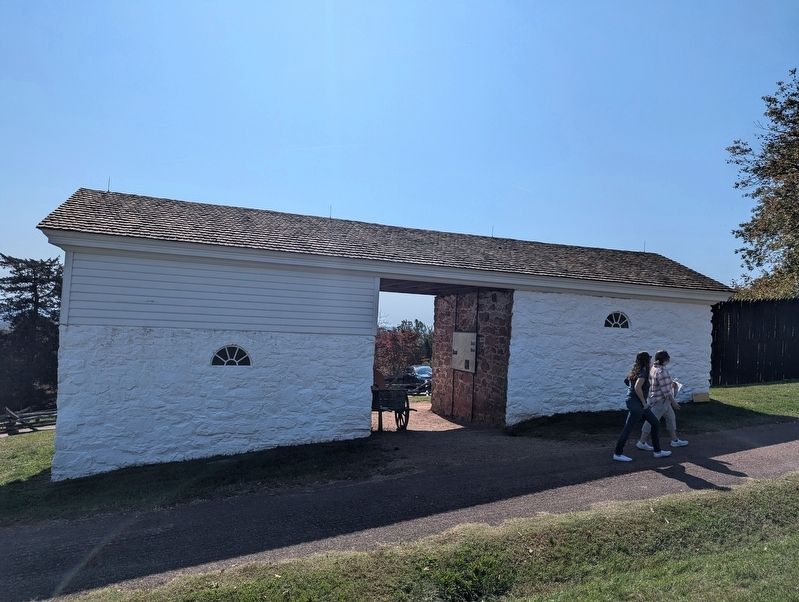
Jefferson altered the stable at least three times. A stable may have been near this site by 1778. It was succeeded by a wood structure erected ca. 1793 As he neared retirement, Jefferson replaced several log buildings along Mulberry Row with more permanent stone structures and also reorganized the stable. In 1808, hired white stonemason William Maddox, assisted by four Monticello slaves, built these two stone bays. Shortly after, hired and enslaved carpenters constructed an L-shaped wood addition.
(captions)
View from Monticello looking towards Charlottesville by Jane Braddick Peticolas, 1825.
Thomas Jefferson Foundation at Monticello
Stable Scene by George Morland, ca. 1790. Stables needed to be dry and well-ventilated, with good drainage and adequate lighting to keep the horses healthy and the tack and feed stored there in good condition.
Gloucester Museums Service
Digital reconstruction of the ca. 1793 stable with five bays for animals and supplies.
Thomas Jefferson Foundation at Monticello
Digital reconstruction of the ca. 1809 stable complex illustrates Jefferson's revised plan - two stone bays and a wood addition
Thomas Jefferson Foundation at Monticello
The stables as drawn in Jefferson's surveys of Monticello suggests that the wood stable was failing by 1806. The five bays depicted in 1796 (left) were shown as three bays in 1806 (middle); the 1809 survey (right) shows the two new bays and the L-shaped addition.
Massachusetts Historical Society
Monticello mountaintop (plat) by Thomas Jefferson, 1809.
Massachusetts Historical Society
The
Photographed by William Pope, October 13, 2024
2. The Stables Marker
Topics. This historical marker is listed in these topic lists: Animals • Colonial Era. A significant historical year for this entry is 1778.
Location. 38° 0.61′ N, 78° 27.033′ W. Marker is near Charlottesville, Virginia, in Albemarle County. It can be reached from Monticello Loop 0.6 miles north of Thomas Jefferson Parkway (Virginia Route 53), on the left when traveling north. This marker is located on the Monticello Historic Site and is reachable by foot only. Touch for map. Marker is at or near this postal address: 975 Monticello Loop, Charlottesville VA 22902, United States of America. Touch for directions.

Regionally, this marker is in the Piedmont and in Central Virginia. It is also in the American South and specifically in the Upper South. Globally, it is in North America, the Western Hemisphere, the Western World, and the Anglosphere. Historically, it finds itself in what was once the territory of the Mississippian Culture, one of the original Thirteen Colonies, one of the Confederate States of America, and the Antebellum
Photographed by William Pope, October 13, 2024
3. The Stables Marker
Other nearby markers. At least 8 other markers are within walking distance of this marker: Horses & Mules (a few steps from this marker); Slave Housing (within shouting distance of this marker); Mulberry Row (about 300 feet away, measured in a direct line); Textiles (about 400 feet away); Vegetable Garden (about 400 feet away); a different marker also named Mulberry Row (about 500 feet away); Sally Hemings (about 500 feet away); Sally Hemings's Life (about 500 feet away). Touch for a list and map of all markers in Charlottesville.
Also see . . . Visit Monticello. Thomas Jefferson Foundation (Submitted on January 1, 2025.)
Credits. This page was last revised on January 1, 2025. It was originally submitted on December 25, 2024, by William Pope of Marietta, Pennsylvania. This page has been viewed 252 times since then and 36 times this year. Photos: 1, 2, 3. submitted on December 25, 2024, by William Pope of Marietta, Pennsylvania. • Bernard Fisher was the editor who published this page.
