Altstadt in Koblenz, Rhineland-Palatinate, Germany — Central Europe
Gewässer-Lehrpfad Rhein-Mosel
⎯⎯⎯
Rhine Mosel Water Trail
- Fremde Tierarten (Neozoen) -
Photographed by Steve Stoessel, December 16, 2024
1. Gewässer-Lehrpfad Rhein-Mosel / Rhine Mosel Water Trail Marker

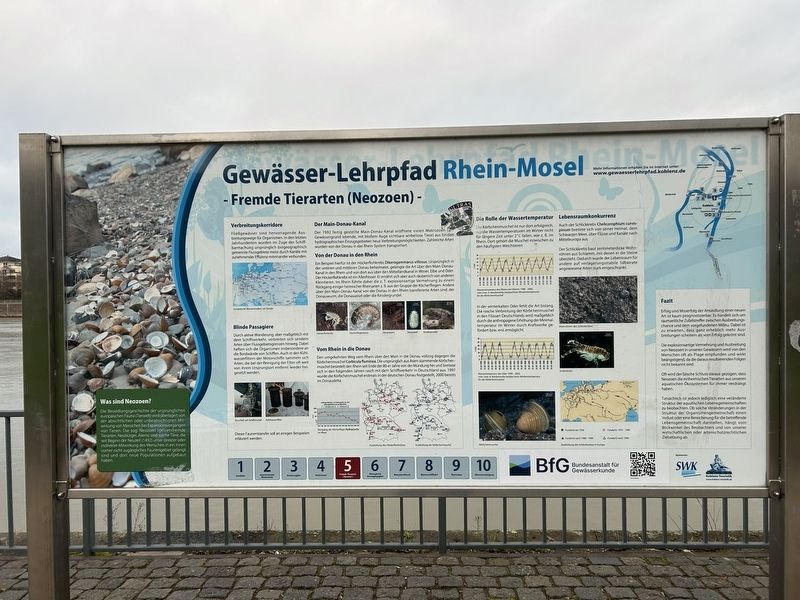
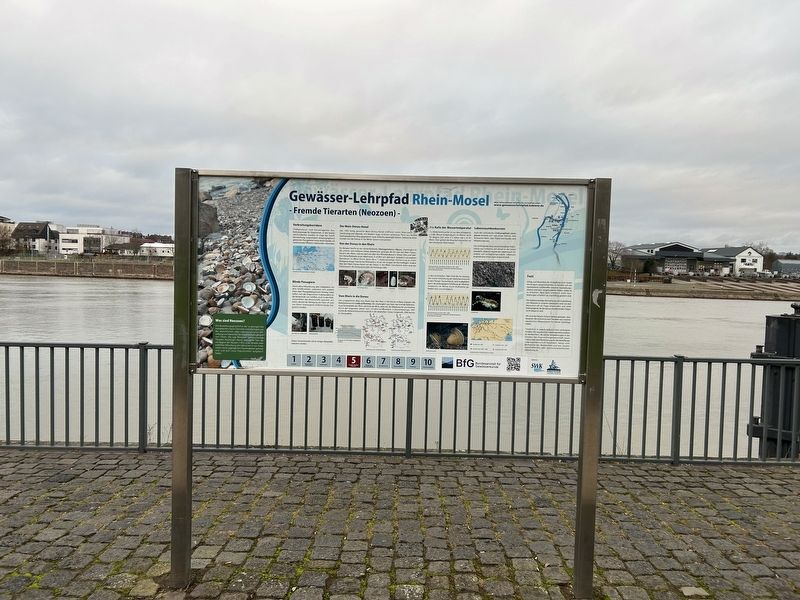
Fließgewässer sind hervorragende Ausbreitungswege für Organismen. In den letzten Jahrhunderten wurden im Zuge der Schiffbarmachung ursprünglich biogeographisch getrennte Flussgebiete meist durch Kanale mit zunehmender Effizienz miteinander verbunden.
Blinde Passagiere
Durch aktive Wanderung, aber maßgeblich mit dem Schiffsverkehr, verbreiten sich seitdem Arten über Flussgebietsgrenzen hinweg. Dabei heften sich die Organismen insbesondere a die Bordwände von Schiffen. Auch in den Kühlwasserfiltern der Motorschiffe sammeln sich Arten, die bei der Reinigung der Filter oft weit von ihrem Ursprungsort entfernt wieder freigesetzt werden.
Der Main-Donau-Kanal
Der 1992 fertig gestellte Main-Donau-Kanal eröffnete vielen Makrozoen (am Gewässergrund lebende, mit bloßem Auge sichtbare wirbellose Tiere) aus beiden hydrographischen Einzugsgebieten neue Verbreitungsmöglichkeiten. Zahlreiche Arten wurden von der Donau in das Rhein-System transportiert.
Von der Donau in den Rhein
Ein Beispiel hierfür ist der Höckerflohkrebs Dikerogammarus villosus. Ursprünglich in der unteren und mittleren Donau
this page online
Vom Rhein in die Donau
Den umgekehrten Weg vom Rhein über den Main in die Donau vollzog dagegen die Körbchenmuschel Corbicula fluminea, Die ursprünglich aus Asien stammende Körbchenmuschel besiedelt den Rhein seit Ende der 80-er Jahre von der Mündung her und breitete sich in den folgenden Jahren rasch mit dem Schiffsverkehr in Deutschland aus. 1997 wurde die Körbchenmuschel erstmals in der deutschen Donau festgestellt, 2000 bereits im Donaudelta.
Die Rolle der Wassertemperatur
Die Körbchenmuschel ist nur dort erfolgreich wo die Wassertemperaturen im Winter nicht für längere Zeit unter 2°C fallen, wie z.
Photographed by Steve Stoessel, December 16, 2024
2. Gewässer-Lehrpfad Rhein-Mosel / Rhine Mosel Water Trail Marker
Lebensraumkonkurrenz
Auch der Schlickkrebs Chelicorophium curvispinum breitete sich von seiner Heimat, dem Schwarzen Meer, über Flüsse und Kanäle nach Mitteleuropa aus.
Der Schlickkrebs baut zentimeterdicke Wohnröhren aus Schlamm, mit denen er die Steine überzieht. Dadurch wurde der Lebensraum für andere auf verlagerungsstabile Substrate angewiesene Arten stark eingeschränkt.
Fazit
Erfolg und Misserfolg der Ansiedlung einer neuen Art ist kaum prognostizierbar. Es handelt sich um raumzeitliche Zufallstreffer zwischen Ausbreitungschance und dem vorgefundenen Milieu. Dabei ist zu erwarten, dass ganz erheblich mehr Ausbreitungen scheitern als vom Erfolg gekrönt sind.
Die explosionsartige Vermehrung und Ausbreitung von Neozoen in unseren Gewässern wird von den Menschen oft als Plage empfunden und wirkt
Photographed by Steve Stoessel, December 16, 2024
3. Gewässer-Lehrpfad Rhein-Mosel / Rhine Mosel Water Trail Marker
Oft wird der falsche Schluss daraus gezogen, dass Neozoen die einheimischen Tierarten aus unseren aquatischen Ökosystemen für immer verdrängt haben.
Tatsächlich ist jedoch lediglich eine veränderte Struktur der aquatischen Lebensgemeinschaften zu beobachten. Ob solche Veränderungen in der Struktur der Organismengemeinschaft einen Verlust oder eine Bereicherung für die betreffende Lebensgemeinschaft darstellen, hängt vom Blickwinkel des Beobachters und von unserer wirtschaftlichen oder artenschutzrechtlichen Zielsetzung ab.
Was sind Neozoen?
Die Besiedlungsgeschichte der ursprünglichen europäischen Fauna (Tierwelt) wird überlagert von der absichtlichen oder unbeabsichtigten Mitwirkung von Menschen bei Expansionsvorgängen von Tieren. Die sog. Neozoen (gebietsfremde Tierarten, Neubürger, Aliens) sind solche liere, die seit Beginn der Neuzeit (1492) unter direkter oder indirekter Mitwirkung des Menschen in ein ihnen vorher nicht zugängliches Faunengebiet gelangt sind und dort neue Populationen aufgebaut haben.
Flowing waters are excellent distribution routes for organisms. In the last few centuries, river basins that were originally biogeographically separate have been connected to one another, mostly by canals with increasing efficiency, as they were made navigable.
Stowaways
Since then, species have been spreading across river basin boundaries through active migration, but mainly through shipping traffic. The organisms attach themselves particularly to the sides of ships. Species also collect in the cooling water filters of motor ships, and are often released far from their place of origin when the filters are cleaned.
The Main-Danube Canal
The Main-Danube Canal, completed in 1992, opened up new distribution opportunities for many macrozoans (invertebrates that live on the bottom of the water and are visible to the naked eye) from both hydrographic catchment areas. Numerous species were transported from the Danube to the Rhine system.
From the Danube to the Rhine
One example of this is the humpback shrimp Dikerogammarus villosus. Originally native to the lower and middle Danube, the species reached the Rhine via the Main-Danube Canal and from there via the Mittelland Canal into the Weser, Elbe and Oder. The humpback shrimp is an omnivore. However, it also feeds on other small animals as a predator. In the Rhine, the sometimes explosive reproduction led to a decline in some native Rhine species, e.g. from the group of cooker flies. Other species transferred from the Danube to the Rhine via the Main-Danube Canal are: the Danube worm, the Danube woodlouse or the Kessler goby.
From the Rhine to the Danube
The basket mussel Corbicula fluminea, on the other hand, took the opposite route from the Rhine via the Main to the Danube. The basket mussel, which originally comes from Asia, has been colonizing the Rhine from the mouth since the late 1980s and spread rapidly in Germany with shipping traffic in the following years. The basket mussel was first found in the German Danube in 1997, and in 2000 in the Danube delta.
The role of water temperature
The basket mussel is only successful where the water temperature in winter does not fall below 2°C for a long period of time, such as in the Rhine. There the mussel is now one of the most common mollusks. The species is currently absent from the winter-cold Oder. The rapid spread of the basket mussel in the rivers of Germany is obviously required or made possible by the anthropogenic increase in the minimum temperature in winter caused by power plants.
Habitat competition
The mud crayfish Chelicorophium curvispinum also spread from its home in the Black Sea to Central Europe via rivers and canals.
The mud crayfish builds centimeter-thick living tubes out of mud, which it covers the stones with. This has severely restricted the habitat for other species that depend on stable substrates.
Conclusion
The success or failure of the establishment of a new species is difficult to predict. It is a matter of chance in space and time between the chance of spreading and the environment found. It is to be expected that considerably more spreads will fail than be crowned with success.
The explosive proliferation and spread of neozoa in our waters is often perceived by people as a nuisance and is frightening because the resulting consequences are unknown.
The wrong conclusion is often drawn that neozoa have displaced native animal species from our aquatic ecosystems forever.
In fact, however, only a changed structure of the aquatic communities can be observed. Whether such changes in the structure of the community of organisms represent a loss or an enrichment for the community in question depends on the point of view of the observer and on our economic or species protection objectives.
What are neozoans?
The settlement history of the original European fauna (animal world) is overshadowed by the intentional or unintentional involvement of humans in the expansion processes of animals. The so-called neozoans (non-native animal species, new residents, aliens) are those that, since the beginning of the modern era (1492), have reached a faunal area that was previously inaccessible to them with the direct or indirect involvement of humans and have built up new populations there.
Topics. This historical marker is listed in these topic lists: Environment • Waterways & Vessels. A significant historical year for this entry is 1992.
Location. 50° 21.778′ N, 7° 36.006′ E. Marker is in Koblenz, Rheinland-Pfalz (Rhineland-Palatinate). It is in Altstadt. It is on Kastorstraße. Touch for map. Marker is at or near this postal address: Kastorstraße 28, Koblenz RP 56, Germany. Touch for directions.

Regionally, this marker is in the German Rhineland, in the Upper Middle Rhine Valley, and specifically in the Moselle Valley. Globally, it is in Europe, the European Union, Atlantic Europe, Central Europe, the Schengen Area, Western Europe, and the Western World. Historically, it finds itself in what was once the Roman Empire, the Holy Roman Empire, and the former West Germany.
Other nearby markers. At least 8 other markers are within walking distance of this marker: Festungsbaukunst des 19.Jahrhunderts in Koblenz (here, next to this marker); Peter Altmeier (about 90 meters away, measured in a direct line); Schöffenhaus / Aldermen’s House (about 210 meters away); Kastorbrunnen Memorial (about 240 meters away); Altes Kauf- und Danzhaus / Old Trading and Dance Hall (approx. 0.2 kilometers away); “Pfarrhaus Liebfrauen” / Church of Our Lady Rectory (approx. 0.2 kilometers away); Kastorbrunnen (approx. 0.2 kilometers away); Kastorhof (approx. 0.3 kilometers away). Touch for a list and map of all markers in Koblenz.
Also see . . .
1. Corbicula_fluminea (Basket Clam) (Wikipedia). (Submitted on January 22, 2025, by Steve Stoessel of Niskayuna, New York.)
2. Marker Link. (Submitted on January 22, 2025, by Steve Stoessel of Niskayuna, New York.)
Credits. This page was last revised on February 10, 2025. It was originally submitted on January 16, 2025, by Steve Stoessel of Niskayuna, New York. This page has been viewed 97 times since then and 21 times this year. Photos: 1, 2, 3. submitted on January 16, 2025, by Steve Stoessel of Niskayuna, New York.
