Hot Springs in Garland County, Arkansas — The American South (West South Central)
Dr. Edith Irby Jones
Medical Pioneer
| — | Hot Springs Arkansas Walk of Fame | — |
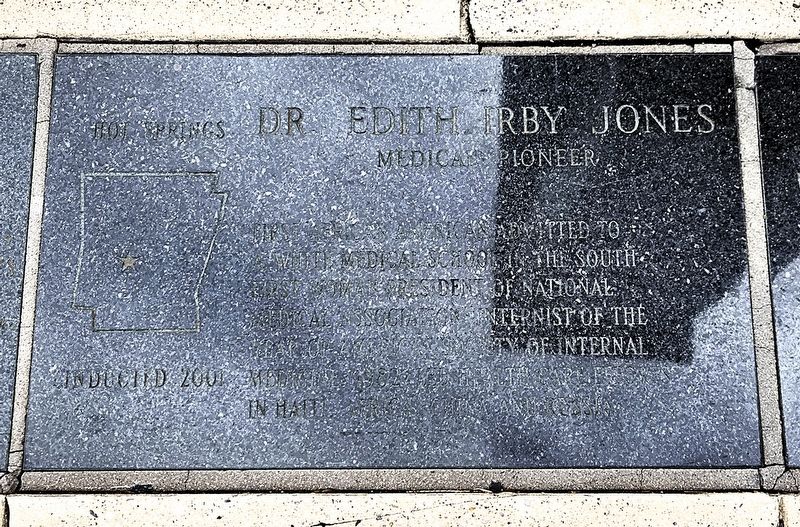
Photographed by Cosmos Mariner, September 14, 2024
1. Dr. Edith Irby Jones Marker
First African American admitted to a white medical school in the South • First woman President of National Medical Association • Internist of The Year of American Society of Internal Medicine, 1982 • Led health care efforts in Haiti, Africa, China and Russia
Hot Springs, Arkansas • Inducted 2001
Erected by Hot Springs Arkansas Walk of Fame.
Topics. This historical marker is listed in these topic lists: African Americans • Education • Science & Medicine • Women. A significant historical year for this entry is 1982.
Location. 34° 30.644′ N, 93° 3.231′ W. Marker is in Hot Springs, Arkansas, in Garland County. It is on Central Avenue (State Highway 7) just north of Spring Street, on the right when traveling north. The marker is embedded in the sidewalk on the north side of the Hot Springs City Visitor Center. Touch for map. Marker is at or near this postal address: 629 Central Avenue, Hot Springs National Park AR 71901, United States of America. Touch for directions.

Regionally, this marker is in the Ouachita Mountains. It is also in the American South and specifically in the Upper South. Globally, it
this page online
Other nearby markers. At least 8 other markers are within walking distance of this marker: Charles Portis (here, next to this marker); Cliff Harris (here, next to this marker); General Douglas MacArthur (here, next to this marker); Jo Ann Castle (here, next to this marker); Arthur Hunnicutt (here, next to this marker); Tommy Freeman (here, next to this marker); The Browns (here, next to this marker); The Cella Family (here, next to this marker). Touch for a list and map of all markers in Hot Springs.
Related markers. Click here for a list of markers that are related to this marker. Dr. Edith Irby Jones
Also see . . . Edith Irby Jones (Wikipedia).
Excerpt: Edith Irby Jones (December 23, 1927 – July 15, 2019) was the first African American to be accepted as a non-segregated student at the University of Arkansas for Medical Sciences and the(Submitted on January 18, 2025, by Cosmos Mariner of Cape Canaveral, Florida.)first black student to attend racially mixed classes in the American South. She was the first African American to graduate from a southern medical school, first black intern in the state of Arkansas, and later first black intern at Baylor College of Medicine.Photographed by Cosmos Mariner, September 13, 20242. Dr. Edith Irby Jones MarkerLooking east from Central Avenue; it is the rightmost of four markers in this photo. The Hot Springs City Visitor Center parking lot is in the background.
Her childhood was difficult: at the age of eight, she lost her father; an older sister died at 12 years of age from typhoid fever; and Irby herself suffered from rheumatic fever as a child. These events inspired her desire to help those who were underserved and impoverished and catalyzed her toward a career in medicine. Her mother relocated the family to Hot Springs, where Irby graduated in 1944 from Langston Secondary School.
After winning a scholarship to Knoxville College in Knoxville, Tennessee, she studied chemistry, biology and physics. She graduated with her BS from Knoxville College in 1948 and completed a graduate course at Northwestern University in Evanston, Illinois to prepare for Medical School. That same year, she was admitted to the University of Arkansas Medical School, as part of a racially mixed class, and made headlines across the United States. She was the first African American woman to be accepted in any school in the Southern United States. Although admitted to the school, Jones had to deal with racial discrimination, such as being forced to use separate facilities from whites for housing and dining.
She was the first woman president of the National Medical Association and a founding member of the Association of Black Cardiologists. She was honored by many awards, including induction into both the University of Arkansas College of Medicine Hall of Fame and the inaugural group of women inducted into the Arkansas Women's Hall of Fame.

Credits. This page was last revised on January 18, 2025. It was originally submitted on January 18, 2025, by Cosmos Mariner of Cape Canaveral, Florida. This page has been viewed 130 times since then and 12 times this year. Photos: 1, 2. submitted on January 18, 2025, by Cosmos Mariner of Cape Canaveral, Florida.
