
Altstadt in Koblenz, Rhineland-Palatinate, Germany — Central Europe
Geologie - Landschftsentwicklung
⎯⎯⎯
Geology - Landscape Development
Photographed by Steve Stoessel, December 16, 2024
1. GEOLOGIE / LANDSCHAFTSENTWICKLUNG GEOLOGY / LANDSCAPE DEVELOPMENT Marker

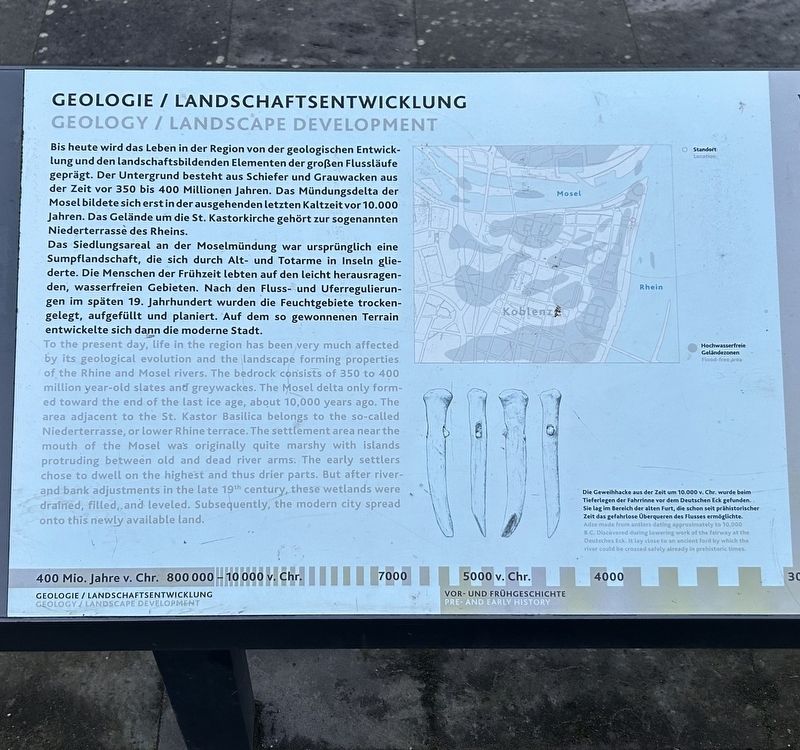
Bis heute wird das Leben in der Region von der geologischen Entwicklung und den landschaftsbildenden Elementen der großen Flussläufe geprägt. Der Untergrund besteht aus Schiefer und Grauwacken aus der Zeit vor 350 bis 400 Millionen Jahren. Das Mündungsdelta der Mosel bildete sich erst in der ausgehenden letzten Kaltzeit vor 10.000 Jahren. Das Gelände um die St. Kastorkirche gehört zur sogenannten Niederterrasse des Rheins. Das Siedlungsareal an der Moselmündung war ursprünglich eine Sumpflandschaft, die sich durch Alt- und Totarme in Inseln gliederte. Die Menschen der Frühzeit lebten auf den leicht herausragenden, wasserfreien Gebieten. Nach den Fluss- und Uferregulierungen im späten 19. Jahrhundert wurden die Feuchtgebiete trockengelegt, aufgefüllt und planiert. Auf dem so gewonnenen Terrain entwickelte sich dann die moderne Stadt.
this page online
[Drawing Captions]
Topics. This historical marker is listed in these topic lists: Anthropology & Archaeology • Science & Medicine.
Location. 50° 21.729′ N, 7° 36.292′ E. Marker is in Koblenz, Rheinland-Pfalz (Rhineland-Palatinate)
Photographed by Steve Stoessel, December 16, 2024
2. Geologie - Landschftsentwicklung / Geology - Landscape Development Marker

Regionally, it is in Europe, the European Union, Atlantic Europe, Central Europe, the Schengen Area, Western Europe, and the Western World. Historically, it finds itself in what was once the Roman Empire and specifically also the Holy Roman Empire.
Other nearby markers. At least 8 other markers are within walking distance of this marker: Römische Zeit/ Roman Period (here, next to this marker); Vor- und Frühgeschichte / Pre and Early History (here, next to this marker); Historical Findings at St. Kastor (here, next to this marker); Der Römische Tempel Unter Der Basilika St. Kastor (here, next to this marker); Mittelalter - Neuzeit: Basilika St. Kastor (here, next to this marker); Moderne: Deutsches Eck Mit Kaiser-Wilhelm-Denkmal (here, next to this marker); Spätgotische Kapelle / Late Gothic Chapel (within shouting distance of this marker); Mit Demonstrationen und Kerzen zur Friedlichen Revolution (about 210 meters away, measured in a direct line). Touch for a list and map of all markers in Koblenz.
Credits. This page was last revised on February 9, 2025. It was originally submitted on January 21, 2025, by Steve Stoessel of Niskayuna, New York. This page has been viewed 125 times since then and 10 times this year. Photos: 1, 2. submitted on January 21, 2025, by Steve Stoessel of Niskayuna, New York.
